

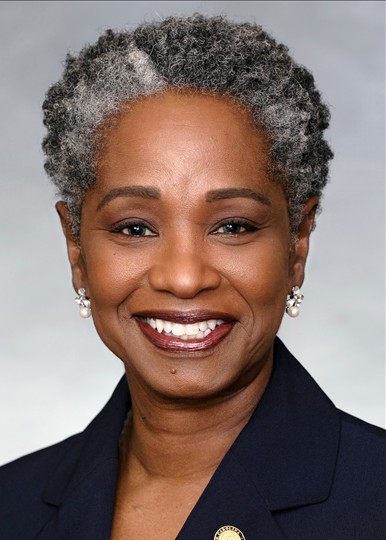
Photo of Val Applewhite
D North Carolina Senate · District 19 On the 2026 ballot

Sen. Val Applewhite

Compare
Total votes
362
all sessions
Attendance
88%
44 missed
Near the chamber average
With party
95%
of cast votes
Lower than 78% of chamber peers
Bipartisan score
2%
crosses aisle rarely
Higher than 76% of chamber peers
Sponsored
273
bills & resolutions
Higher than 79% of chamber peers
Committees
8
assignments
273 bills and resolutions

Sponsored bills

Total
273
Primary
23
Co-sponsor
250
This page
273
matching current filters
Co-sponsor SB 1012
In committee · North Carolina Senate · Co-sponsor
Ban Online For-Profit Charters.

Maddy summaryThis North Carolina bill prohibits charter schools from being managed by for-profit organizations, restricting them to nonprofit management instead. It also mandates that students in remote charter academies take state-mandated tests in person with a social worker present and limits the renewal terms for these remote schools to one year. Additionally, the legislation requires annual financial audits for remote charters and bars renewal for any remote academy deemed low-performing. To support affected families, the bill allocates funding for coaches to assist with school transitions and to establish the new in-person testing program.

In committee May 4, 2026 1 co-sponsor
Co-sponsor SB 950
died · North Carolina Senate · Co-sponsor
School Meals for Every Child.

Maddy summaryThis bill mandates that all public schools in North Carolina, including charter and laboratory schools, provide free breakfast and lunch to every student starting in the 2026-2027 school year. To support this requirement, the state will allocate $116 million from the General Fund to the Department of Public Instruction, with additional flexibility to use existing state aid if necessary. The legislation outlines specific criteria for distributing these funds, such as school size, the number of eligible students, and the quality of food provided, while ensuring that state money supplements rather than replaces other funding sources.

died May 4, 2026 1 co-sponsor
Co-sponsor SB 1019
In committee · North Carolina Senate · Co-sponsor
Grid Utilization.

Maddy summaryThis bill requires electric public utilities in North Carolina to submit detailed reports on how well they use their existing power grids. These reports must analyze current performance, explore ways to improve efficiency without building new lines, and outline plans for implementing these improvements. The state's Utilities Commission will review the reports and set specific targets for utilities to meet, while also establishing metrics to measure grid usage. Additionally, the bill mandates that the Commission decide within 240 days how these usage metrics will influence future decisions on approving utility investment costs.

In committee May 4, 2026 1 co-sponsor
Co-sponsor SB 1043
In committee · North Carolina Senate · Co-sponsor
2026 Water Safety Act.

Maddy summaryThis bill establishes a new fund to address water contamination from specific chemicals known as PFAS and 1,4-dioxane. It allocates $56 million for grants to local water and wastewater systems to help them monitor, treat, and clean up these contaminants, with priority given to areas already facing significant health or environmental risks. An additional $14 million is set aside for scientific research at the University of North Carolina to develop better detection and removal methods for these substances. The legislation also provides $25 million specifically to protect firefighters and their families by funding studies, temporary water supplies, and filtration systems for fire stations affected by these chemicals.

In committee May 4, 2026 1 co-sponsor
Co-sponsor SB 1004
In committee · North Carolina Senate · Co-sponsor
Family Support for Those Who Serve Act.

Maddy summaryThis bill expands tuition waivers at North Carolina community colleges to children of public safety workers who are injured or disabled in the line of duty. It specifically allows children aged 17 to 24 to attend classes for free if their parent is a law enforcement officer, firefighter, volunteer firefighter, or experienced correctional officer with at least 10 years of service. The legislation removes previous time limits on these waivers for community college students, ensuring they can attend for the full duration needed to complete their program. Eligible students must still meet standard admission requirements, and the changes will take effect starting with the 2026-2027 academic year.

In committee May 4, 2026 1 co-sponsor
Co-sponsor SB 898
died · North Carolina Senate · Co-sponsor
Citizens' Tax Relief Circuit Breaker Mods.

Maddy summaryThis bill directs $250,000 to the North Carolina Association of County Commissioners to fund grants for counties that advertise property tax relief programs. It also modifies the state's homestead circuit breaker program by raising the income eligibility limit to $45,000 for single applicants starting in 2027, with a higher threshold for married couples. Additionally, the law requires counties to report their total tax deferrals to the Secretary of Revenue by September 1 to receive reimbursement for those amounts. These changes take effect for tax years beginning on or after July 1, 2027, and July 1, 2026, respectively.

died Apr 30, 2026 1 co-sponsor
Co-sponsor SB 901
died · North Carolina Senate · Co-sponsor
CFSS Gun Prsnt. for Grade 7 and 9 Students.

Maddy summaryThis bill requires the North Carolina Center for Safer Schools to create an interactive presentation detailing the legal, medical, and emotional consequences of youth gun possession and related issues. It mandates that all public schools provide this presentation to every seventh and ninth-grade student, with parents receiving notice and the option to opt their children out at least two weeks in advance. The legislation also allocates $900,000 in recurring state funds starting in 2026 to help schools develop the necessary training and materials for delivering the program.

died Apr 30, 2026 1 co-sponsor
Primary SB 907
died · North Carolina Senate · Lead sponsor
The Ciji Graham Act.

Maddy summarySB 907, known as the Ciji Graham Act, establishes a new High-Risk Pregnancy Care Navigation Program in North Carolina to assist patients with high-risk pregnancies by providing licensed nurse consultants who help coordinate care and address barriers like transportation and insurance. The bill also creates a statewide pregnancy consultation hotline for healthcare providers and community organizations to offer immediate clinical guidance and referrals, alongside a centralized digital hub containing clinical guidelines and a directory of specialists and facilities. Funded through the state General Fund, these measures aim to improve maternal health outcomes and reduce disparities by ensuring timely access to appropriate medical resources and services.

died Apr 30, 2026 0 co-sponsors
Co-sponsor SB 895
In committee · North Carolina Senate · Co-sponsor
Nonprofit Hospitals Tax Exemption.

Maddy summaryThis bill modifies tax exemptions for nonprofit hospitals in North Carolina by linking property tax relief directly to the cost of charity care provided to low-income patients. Under the new rules, a hospital's property tax exemption is calculated based on the actual cost of services given to uninsured or underinsured individuals with family incomes at or below 300% of the federal poverty level. Additionally, the legislation expands sales tax refunds for nonprofit hospitals, allowing them to recover taxes on over-the-counter drugs and capping the total refund at the lesser of a fixed dollar amount or the hospital's verified charity care costs. These changes are designed to ensure that tax benefits are tied to specific charitable activities rather than general operations. The provisions will take effect for tax years beginning on or after July 1, 2027.

In committee Apr 30, 2026 1 co-sponsor
Co-sponsor SB 897
died · North Carolina Senate · Co-sponsor
NC CROWN Act.

Maddy summaryThis bill, known as the North Carolina CROWN Act, expands state employment discrimination laws to explicitly protect individuals from discrimination based on hair texture and protective hairstyles such as braids, twists, and locks. By legally defining these hair styles as traits associated with race, the legislation ensures that employers cannot deny hiring, firing, or otherwise discriminate against people because of their natural hair. The act also strengthens anti-retaliation protections for employees who report discrimination under these new provisions. To support implementation, the bill appropriates $100,000 for the Department of Labor to educate both employers and employees about the law's requirements and rights.

died Apr 30, 2026 1 co-sponsor
Showing 11 to 20 of 273 bills