

Maddy summarySB 265, the "Protecting Our Community Act," regulates hemp-derived consumable products (like edibles or vapes with ≤0.3% delta-9 THC) and bans them on school grounds. It requires businesses to verify buyers' ages (no sales to under 21), mandates independent lab testing for THC levels, and defines terms like "distributor" and "final form product." The law directly affects hemp product manufacturers, sellers (including online retailers), and schools, which must prohibit these items on campus. Key provisions include mandatory child-resistant packaging at point-of-sale and restrictions on selling to minors, aiming to limit youth access while creating new regulatory requirements for the industry.
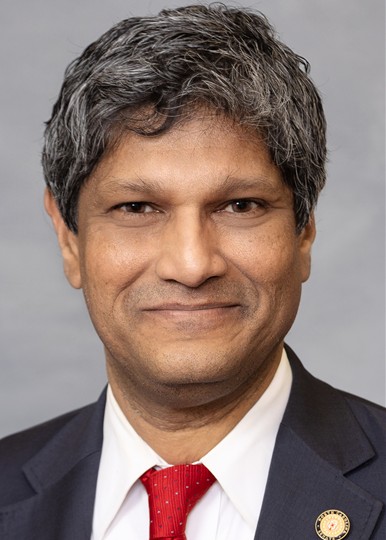
Sen. Jay Chaudhuri
Sponsored bills
Maddy summarySB 264 requires all North Carolina public schools - including traditional, charter, regional, and laboratory schools - to display the U.S. and North Carolina flags in every classroom and near each school's main entrance, while scheduling daily recitation of the Pledge of Allegiance. The bill also mandates age-appropriate instruction about the flags' historical significance and the pledge's meaning. Schools may not compel students or staff to stand, salute, or recite the pledge. Funding of $1 million (one-time) and $100,000 annually is provided to purchase flags, with displays only required if flags are available through donations or purchase.
Maddy summarySB 259, the School Psychologist Omnibus, aims to improve the number and quality of school psychologists in North Carolina public schools. It provides $8.1 million for 2025-2026 to increase school psychologists' salaries by $650 monthly plus 12% for those with NCSP credentials, and allocates $5 million for a grant program offering signing bonuses (up to $5,000) to recruit psychologists, requiring a one-year commitment. Another $5 million funds an internship program with stipends for psychology students and supervisor bonuses, while $5 million supports a virtual training program at Appalachian State University. These provisions directly affect school psychologists, school districts, and psychology training programs across North Carolina.
Maddy summarySB 240 establishes the NCSTARS Grant Program to fund community colleges partnering with public schools and local businesses to create work-based learning programs for students aged 16+ in apprenticeships or preapprenticeships. It provides matching grants of up to $500,000 per year per community college, requiring a 3:1 state-to-local funding match for program costs like student stipends, travel, and staff. The program prioritizes applications modeling the Surry-Yadkin Works FLEET program and mandates annual reports on participation and outcomes. Total funding of $4.75 million is allocated for the 2025-2026 fiscal year, supporting the program through 2028-2029.
Maddy summarySB 156 allows Wake County Schools to align its academic calendar with the schedule of local community colleges, specifically addressing scheduling conflicts between high schools and nearby colleges. This change directly affects Wake County students, staff, and schools by permitting them to match community college terms (e.g., semester start/end dates) without violating state calendar rules. The bill amends North Carolina law to explicitly permit this alignment for Wake County, overriding the standard August 26 school start and June 11 end dates. It applies only to Wake County Schools and takes effect for the 2025-2026 school year.
Maddy summarySB 111, titled "15th Senatorial District Local Act-1," is a procedural bill that solely references the 15th Senatorial District in North Carolina. It contains no substantive policy changes or mechanisms, as Section 1 states it "relates only to the 15th Senatorial District" and Section 2 declares it "effective when it becomes law." This bill does not affect any policies, programs, or individuals beyond its administrative reference to the district's name. It is a minimal procedural act with no practical impact on legislation or constituents.
Maddy summarySB 107 reestablishes nonpartisan elections for North Carolina's appellate, superior, and district court judges, directly affecting candidates running for these judicial positions. The bill mandates that candidates run without party labels on ballots, requires a primary to narrow candidates to two when more file, and sets specific filing deadlines (December 1-17) for notices of candidacy. It also requires candidates to be registered voters in their county and prohibits filing for multiple judicial offices simultaneously. The law aims to restore public confidence in an independent judiciary, as stated in the bill's preamble honoring Judge Joe John's advocacy for nonpartisan judicial elections.
Maddy summaryThis bill appropriates $1.5 million annually from 2025-2027 to fund Dolly Parton's Imagination Library in North Carolina. It directs funds to the North Carolina Partnership for Children, Inc. to mail age-appropriate books monthly to registered children through the early literacy program. The bill provides recurring state funding for an existing program that delivers books directly to children's homes.
Maddy summarySB 95 allows small North Carolina sawmills (producing under 1 million board feet annually) to sell ungraded lumber for use in one- and two-family homes and certain residential structures, directly affecting small sawmill operators and homebuilders. The bill requires sawmill operators to complete state-approved training, mark lumber with specific details (species, mill ID, PS20 compliance), and provide buyers with a compliance certificate. It modifies building codes to permit this ungraded lumber use while mandating code officials review structures for safety but absolving them of liability for failures related to the lumber type. The policy change aims to support small sawmills by expanding their market access under defined safety and transparency conditions.
Maddy summaryThis bill amends existing wastewater regulations to allow for the discharge of treated domestic wastewater into low-flow or zero-flow surface waters, such as intermittent streams and wetlands, under specific conditions. It directly affects municipalities, businesses, and developers by establishing a new permitting process that permits discharges of up to 2 million gallons per day if the treated water has high dissolved oxygen and low biological oxygen demand. The legislation requires the Department of Environmental Quality and the Environmental Management Commission to develop and submit draft rules to the U.S. Environmental Protection Agency for approval by August 1, 2024. Once approved, these rules will create site-specific criteria based on flow data from the U.S. Geological Survey to ensure wastewater discharge does not harm water quality.