

Maddy summarySB 482, the "Don't Tread on Me: An Individual Freedoms Act," creates new legal protections for North Carolinians by limiting state agency actions across multiple areas. It directly affects all residents by prohibiting warrantless government surveillance, requiring agencies to stop demanding private medical, religious, or political information for services, banning ideological restrictions on reproductive care, and protecting parental rights in education and healthcare decisions. Key provisions mandate that schools provide fact-based education without political manipulation, prevent discrimination in employment or housing based on private beliefs, and ensure government benefits are not denied due to personal health choices or political views. The bill establishes these rights as enforceable standards for all state agencies, requiring actions to be "narrowly tailored" to a compelling state interest.
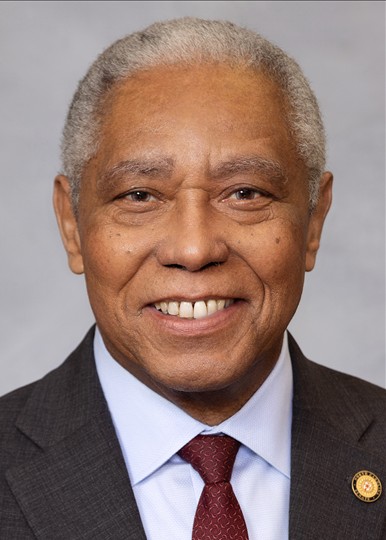
Sen. Dan Blue
Sponsored bills
Maddy summarySB 596 appropriates $169 million from the State Capital and Infrastructure Fund to North Carolina Central University for critical campus repairs. The funds are allocated as $100 million for HVAC, fire safety, and building code upgrades; $9 million for roof and structural repairs; and $60 million for replacing aging electrical, water, and steam infrastructure. These repairs directly address immediate safety risks and system failures affecting the university's campus operations and facilities. The bill becomes effective July 1, 2025, with funding designated for the 2025-2026 fiscal year.
Maddy summarySB 542 allocates $20.3 million in one-time funding and $1 million annually to support Western North Carolina recovery and economic development. It provides $10 million specifically for long-term housing recovery for residents impacted by Hurricane Helene, $5 million to Community Development Corporations (CDCs), $300,000 for women’s business centers, and $5 million for broader economic development programs. The bill also includes $1 million in recurring funds to assist with ongoing housing recovery, match federal disaster funds, and support community services statewide. This legislation directly affects Western NC residents recovering from Hurricane Helene, CDCs, and women’s business centers in Western NC, the Triad, and Piedmont regions.
Maddy summarySB 537 defines the scope of practice for Advanced Practice Registered Nurses (APRNs) in North Carolina, specifically for nurse practitioners (NPs), certified nurse midwives (CNMs), certified registered nurse anesthetists (CRNAs), and clinical nurse specialists (CNSs). The bill provides statutory definitions for each role, detailing permitted activities like diagnosing conditions, prescribing medications, ordering diagnostic tests, and managing patient care within their specialized focus areas. By codifying these definitions in state law, the bill removes longstanding ambiguity about APRN practice that has persisted for decades, as noted by North Carolina courts and the executive branch. This change directly affects over 20,000 APRNs in the state by legally clarifying their scope of practice.
Maddy summarySB 534 allocates $237.5 million in one-time state funding from the Capital and Infrastructure Fund for capital projects at two North Carolina universities. Specifically, it provides $125 million to North Carolina A&T State University for an Agricultural Research Classroom and $112.5 million to Winston-Salem State University for a Health, Physical Education, and Recreation Complex. The funding is designated for the 2025-2026 fiscal year and becomes effective July 1, 2025. This bill directly affects the operations and infrastructure development of these two public universities.
Maddy summarySB 744, the Voucher School Accountability Act, requires nonpublic schools receiving North Carolina Opportunity Scholarship funds to meet new reporting and accountability standards. It mandates annual transparency on tuition fees (capped at 5% annual increases), staff background checks, standardized testing (including ACT for 11th graders), and financial audits for schools receiving over $250,000 in scholarship funds. Schools must also publish student progress data, maintain physical facilities for in-person instruction, and comply with state academic standards. These requirements directly affect participating nonpublic schools and the families using scholarship funds. The bill focuses on enforcing accountability through concrete reporting mechanisms, not changing scholarship eligibility.
Maddy summarySB 354 reenacts North Carolina’s Research and Development (R&D) tax credit with updated eligibility rules, primarily affecting small businesses conducting qualified research in the state. To qualify, businesses must meet specific wage standards (e.g., paying at least 90% of county average wages in certain areas), provide health insurance covering 50% of premiums for full-time employees, maintain environmental and safety compliance, and have no overdue tax debts. The credit applies to expenses for research performed in North Carolina, including costs paid to state universities for research. This bill modifies existing rules to tighten eligibility while maintaining the credit for qualifying small businesses through 2040.
Maddy summarySB 353, the Second Chance Coding Act, requires North Carolina's Division of Juvenile Justice to create a program teaching coding and computer skills to juveniles in youth development centers. The program must include specialized courses, industry certification opportunities, and workforce connections like mentorship and job placement to help these youth transition into careers after release. Implemented by January 1, 2026, with $250,000 in funding for 2025-2026, the bill aims to reduce recidivism by improving job prospects. It directly affects youth committed to juvenile facilities, focusing on concrete skill-building rather than speculative outcomes.
Maddy summarySB 297 establishes a Nursing Fellows Program at Winston-Salem State University (WSSU) to provide forgivable loans to nursing students. The program offers up to $5,000 per semester (or $2,500 per summer) for tuition, books, and fees toward a Bachelor of Science in Nursing (BSN) or Master of Science in Nursing Education (MSN) degree, contingent on recipients committing to work as nurses or nursing instructors in North Carolina. Eligibility requires WSSU nursing degree completion within 10 years, North Carolina RN licensure, and a demonstrated commitment to serve in-state, with loan forgiveness tied to employment in qualifying nursing roles after graduation.
Maddy summarySB 156 allows Wake County Schools to align its academic calendar with the schedule of local community colleges, specifically addressing scheduling conflicts between high schools and nearby colleges. This change directly affects Wake County students, staff, and schools by permitting them to match community college terms (e.g., semester start/end dates) without violating state calendar rules. The bill amends North Carolina law to explicitly permit this alignment for Wake County, overriding the standard August 26 school start and June 11 end dates. It applies only to Wake County Schools and takes effect for the 2025-2026 school year.