

Maddy summaryHB 467 reenacts North Carolina's low-income housing tax credit program, allowing developers to claim tax credits for constructing or rehabilitating affordable housing. It specifies credit percentages (30%, 20%, or 10%) based on the income level of households (50% or less of area median income for 30% credit, 40% for 10% in high-income areas) and the location's income designation (low, moderate, or high-income county/city). Developers can receive credits either as a direct tax refund or a loan from the Housing Finance Agency, with affordability requirements applying for the full credit compliance period. This directly affects developers building qualifying low-income housing projects across North Carolina.
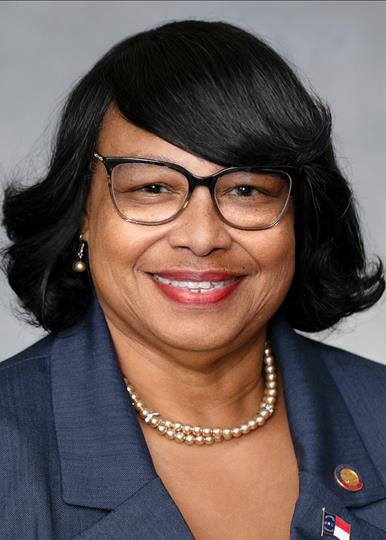
Rep. Gloristine Brown
Sponsored bills
Maddy summaryHB 474, titled "Right to Use Contraception," declares that North Carolina recognizes the right to use contraception to prevent pregnancy as a fundamental liberty. It directly affects all residents who use contraception by stating the state has "no legitimate governmental interest in limiting the freedom to use contraception." The bill amends state law to add a new Article 44, explicitly prohibiting state restrictions on contraceptive access for pregnancy prevention. This is a declarative policy change, not a funding or program measure, and would become effective upon enactment.
Maddy summaryHB 473 protects patients' and healthcare providers' rights to access and provide assisted reproductive technology (ART), including in vitro fertilization (IVF), by prohibiting state interference. It defines ART broadly and explicitly states that fertilized eggs or embryos outside the uterus are not considered "human beings" under North Carolina law. The bill also appropriates $500,000 annually (starting July 2025) from the state General Fund to increase Medicaid maternal support services (the Baby Love Program), matching $913,000 in federal funds for the 2025-2027 biennium. This legislation directly affects patients seeking ART, healthcare providers offering these services, and Medicaid beneficiaries receiving maternal support.
Maddy summaryHB 466 creates a special license plate for North Carolina vehicle owners commemorating the 1776 Halifax Resolves, the first official colonial resolution supporting independence. The plate features a blue background with a feather pen logo and "Birthplace of American Independence" text, with a $30 annual fee added to registration. Proceeds are split: $10 goes to the Special Registration Plate Account and $20 to the Collegiate and Cultural Attraction Plate Account, with the latter's funds for this plate specifically directed to Halifax County for 250th-anniversary events. This is a commemorative plate option, not a policy change affecting laws or regulations.
Maddy summaryHB 430 would raise North Carolina's legal sales age for all tobacco and nicotine products (including e-cigarettes and vaping devices) to 21. It requires retailers to obtain a tobacco sales permit and verify customers' ages using acceptable ID. The bill directly affects tobacco retailers (who must get permits) and youth under 21 (who would be barred from purchasing these products). Key provisions include defining "vapor products" and establishing penalties for violations, such as fines up to $1,000 for repeat offenses.
Maddy summaryHJR 461 is a symbolic resolution passed by North Carolina's legislature urging the U.S. Congress to enact federal legislation admitting Washington, D.C., as the 51st state. It does not create new laws or change DC's status but formally expresses support for statehood based on arguments like DC's population size, residents' tax contributions, and historical denial of voting rights in Congress. The resolution specifically asks Congress to pass the Washington, D.C., Admission Act (H.R. 51/S. 51), which would grant DC two U.S. Senators and at least one House member. It has no legal effect on DC's status but aims to pressure federal lawmakers to act on the issue. This is a procedural resolution, not a bill with binding policy changes.
Maddy summaryHB 452 makes it a crime to obstruct access to or threaten people at healthcare facilities in North Carolina. It prohibits blocking entrances, delaying care, or threatening patients, staff, or those helping others access services. The bill also restricts protests within 8 feet of people near facility entrances (unless consented to) and increases penalties: first offenses are misdemeanors, repeat offenses within three years become more serious misdemeanors, and third offenses escalate to felonies. This law directly affects individuals engaging in protests or obstruction near healthcare facilities, healthcare providers, and patients seeking care. It takes effect December 1, 2025.
Maddy summaryHB 457 increases state funding for small county school systems in North Carolina by revising their base allotment schedule. It directly affects counties with student enrollments between 0-3,300 students per school administrative unit, raising their annual funding amounts - such as increasing the base allotment from $1,820,000 to $2,548,000 for counties with 0-1,300 students. The bill appropriates $20,961,180 in recurring funds from the General Fund for the 2025-2026 fiscal year to implement these changes. The new funding schedule takes effect on July 1, 2025, providing higher per-student support for eligible small counties.
Maddy summaryHB 445 reinstates education-based salary supplements for teachers, instructional support staff (including school social workers), and requires school districts to publicly post minimum salary schedules for occupational and physical therapists. The bill allocates $8 million in recurring funds for the 2025-2026 fiscal year to fund these supplements, using a 2013 salary policy framework to determine eligibility based on academic degrees. School districts must publish therapist salary schedules online by October 15 each year, differentiating pay by experience in five-year intervals. The law takes effect July 1, 2025, directly affecting educators and therapists in North Carolina public schools.
Maddy summaryHB 453 increases Medicaid reimbursement rates for two specific services in North Carolina. It raises the rate for personal care services (e.g., help with daily tasks) to $7.50 per 15-minute increment for beneficiaries in programs like State Plan Personal Care Services and Community Alternatives programs. It also increases private duty nursing rates to $16.25 per 15 minutes for both children under 21 and adults, using state funds to match federal support. The changes, effective July 1, 2025, will directly affect Medicaid beneficiaries receiving these services through approved programs.