

Maddy summaryThis bill modifies North Carolina's divorce laws to allow victims of domestic violence to file for divorce without waiting the usual one-year separation period. To qualify for this expedited process, the applicant must provide proof of abuse through a domestic violence protection order, a criminal conviction against their spouse, or a judge's ruling based on evidence such as police records or medical documentation. Additionally, the legislation allocates $50,000 in state funds to a specific nonprofit organization to support victims of domestic violence. The changes apply to divorce cases filed after the law takes effect and do not impact cases already pending in court.
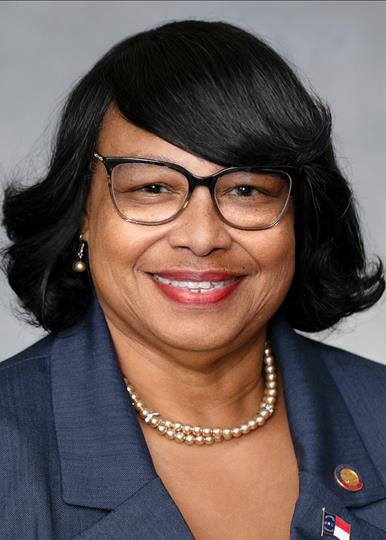
Rep. Gloristine Brown
Sponsored bills
Maddy summaryThis bill expands access to North Carolina's Innovations waiver for families with children who have significant medical needs by adding 6,635 new slots and funding them with $240 million starting in 2026. It also modifies the Opportunity Scholarship Program to prioritize students from lower-income households by capping eligibility at 200% of the federal free lunch income threshold and adjusting grant amounts based on family income levels. To support these changes, the legislation reduces the overall scholarship fund by $240 million while simultaneously directing substantial recurring funding to the program's reserve for the next 15 years.
Maddy summaryThis bill, known as the Fair Share for Public Schools Act, would introduce a new 7% income tax on individuals in North Carolina earning more than $1 million annually. The revenue generated from this tax, after deducting administrative costs, would be directed to the State Public School Fund to support local schools on a per-pupil basis. The law applies to taxable years beginning on or after January 1, 2026, and is designed to provide additional funding for public education without altering existing tax rates for lower-income earners.
Maddy summaryHB 1048 allocates $72,000 from the state's General Fund to support the annual Winston-Salem HIV/AIDS Awareness Walk in the 2026-2027 fiscal year. The funding is designated as a directed grant to Joyful Soul Treasures, Inc., a nonprofit organization responsible for organizing the event. This legislation aims to help the walk raise awareness, reduce stigma, and increase education about HIV/AIDS within the community. The bill becomes effective on July 1, 2026.
Maddy summaryHB 1051 allocates $250,000 in state funds to the MedAid Foundation to improve healthcare for seniors and vulnerable populations in North Carolina. The grant is intended to address barriers such as a lack of affordable medical supplies, limited preventive care, and insufficient support from existing facilities. This funding will be available for the 2026-2027 fiscal year, with the bill taking effect on July 1, 2026.
Maddy summaryHB 1063 establishes new regulations for large-scale data centers in North Carolina to protect utility customers and local resources. The law defines a large data center as a facility requiring 40 megawatts of electricity or consuming over a billion liters of water annually. Operators must obtain a certificate of operation and submit detailed disclosures regarding their energy and water usage before construction begins. Facilities are required to generate at least 25% of their power on-site using clean energy and pay full costs for any infrastructure upgrades needed to serve them. Additionally, the bill limits state and local incentives for these facilities to prevent shifting utility costs to residential and small business customers.
Maddy summaryHB 1056 aims to increase housing supply in North Carolina by allowing residential construction in commercial zones and banning minimum parking requirements for new developments. The bill also creates a state program to reimburse local governments for costs associated with speeding up housing permit reviews and provides additional funding to the state housing finance agency. These measures are designed to reduce regulatory barriers that currently limit the number of homes being built and help address rising housing costs.
Maddy summaryHB 1053 directs the North Carolina General Assembly to allocate additional state funds to the Department of Public Instruction for classroom supplies and equipment. Starting in the 2026-2027 school year, the bill provides $28.6 million, with further increases of $15.1 million and $22.6 million planned for the 2027-2028 and 2028-2029 fiscal years respectively. These recurring funds are intended to increase the specific allotment given to schools for instructional materials and equipment. The legislation becomes effective on July 1, 2026.
Maddy summaryThis bill requires the North Carolina Department of Commerce to create a biennial report assessing economic opportunity, affordability, and family economic security across the state. The report must use existing public data to track specific metrics such as poverty rates, job wages, household spending on essentials like housing and childcare, and access to education and workforce training. It will be submitted to legislative committees and the public by January 31 of each odd-numbered year, with funding of $200,000 allocated starting in the 2026-2027 fiscal year to support its implementation.
Maddy summaryHB 1045, known as the Fair Wages in Health Care Act, establishes minimum hourly wages for five specific direct care occupations in North Carolina: home care aides, direct support professionals, certified nursing assistants, psychiatric aides, and licensed practical nurses. The bill sets wage floors ranging from $18 to $24 per hour depending on the role, with protections against employers using different job titles to avoid paying the required rates. To help healthcare providers meet these new costs, the Department of Health and Human Services must adjust reimbursement rates for publicly funded programs and update contracts with managed care organizations. The law takes effect on October 1, 2027, and applies to all employers in the state, regardless of whether they are public or private entities.