

Maddy summaryHB 61 increases penalties for assaulting certain emergency personnel with a firearm in North Carolina. It reclassifies assaults against law enforcement officers, probation/parole officers, National Guard members, detention facility staff, emergency medical technicians, medical responders, firefighters, and law enforcement telecommunicators as a Class B1 felony (instead of Class D) when committed during their duties. The bill specifically targets firearm assaults, making them punishable by more severe prison sentences. This law takes effect December 1, 2025, for offenses occurring on or after that date.
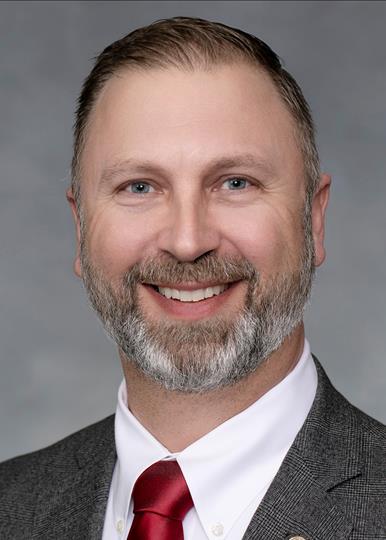
Rep. Matthew Winslow
Sponsored bills
Maddy summaryHB 60 increases Medicaid dental reimbursement rates from 35% to 46% of average dentist charges (2023 rates) to align with neighboring states. The bill allocates $52 million annually from North Carolina's General Fund, matched by $95 million in federal funds, to cover this rate increase starting July 1, 2025. It directly affects dentists who accept Medicaid patients and Medicaid beneficiaries seeking dental care, aiming to boost provider participation and prevent costly emergency treatments. The change addresses years of stagnant rates that reduced dental provider enrollment in Medicaid.
Maddy summaryHB 64 proposes a constitutional amendment that would require the North Carolina General Assembly to approve the governor's clemency grants (including reprieves, commutations, and pardons after conviction). Currently, the governor can grant clemency without legislative input; this bill would mandate a majority vote in both legislative chambers for such grants to take effect. If the governor grants clemency after the legislature has adjourned for over 30 days, the bill requires the governor to reconvene the session for legislative consideration. The amendment must be approved by voters in the November 2026 general election to become part of the state constitution.
Maddy summaryHB 39 excludes motor vehicles owned by veterans with a 100% disability rating certified by the U.S. Department of Veterans Affairs from North Carolina property tax. It amends state tax law to add these vehicles as a designated exempt class under G.S. 105-275. The exclusion applies to vehicles registered on or after January 1, 2026. This policy directly affects eligible disabled veterans who own motor vehicles, reducing their property tax burden. The bill does not change eligibility criteria or tax rates for other vehicle classes.
Maddy summaryHB 36 requires North Carolina's Department of Veterans and Military Affairs to improve maintenance at all four state veterans cemeteries, directly affecting veterans' families and cemetery operations. The bill mandates addressing specific issues like headstone installation delays, equipment damage to graves, drainage problems, debris, and poor grounds appearance, while allowing military groups to volunteer for upkeep. It also directs the department to review and adjust funeral service policies, including chapel-only options, service duration, attendee limits, and grave visitation rules during services. The department must submit a report on these changes to legislative committees by October 1, 2025.
Maddy summaryHB 12 would require North Carolina and all its local governments to observe Eastern Standard Time year-round, eliminating the biannual clock changes for daylight saving time. This bill directly affects state agencies, local municipalities, and residents by keeping the state on standard time permanently, as permitted under federal law (the Uniform Time Act of 1966). The key provision amends state law to mandate year-round standard time, aligning with a federal provision that allows states to forgo daylight saving time. The bill would take effect on March 8, 2026, if enacted. This is a procedural change to time observance, not a new policy affecting services or regulations.
Maddy summaryThis is a commemorative resolution (not a policy bill) honoring former North Carolina House Representative Joseph "Joe" Robert John, Sr., who served District 40 from 2017-2025 and died January 20, 2025. The resolution expresses the House's appreciation for his public service, extends sympathy to his family, and formally recognizes his contributions to North Carolina's judiciary, criminal justice, and community. It has no policy impact or new legal provisions - its purpose is solely to memorialize his career and legacy. The resolution was adopted unanimously by the House on January 29, 2025.
Maddy summaryThis bill, known as the SHALOM Act, adds a new section to North Carolina law that officially adopts the International Holocaust Remembrance Alliance's definition of antisemitism. The law requires state agencies and organizations to use this definition as a guide for training, education, and identifying hate crimes or discrimination against Jewish people. It also establishes a framework for tracking and reporting incidents of antisemitism within the state. The legislation includes a specific provision stating that adopting this definition does not violate free speech rights protected by the U.S. and state constitutions.
Maddy summaryThis bill proposes a constitutional amendment to North Carolina that would restrict voting rights exclusively to United States citizens who are at least 18 years old. The legislation does not change current law immediately but instead sets up a statewide vote on November 5, 2024, where voters will decide whether to adopt this new rule. If approved by the majority of voters, the amendment will permanently update the state constitution to remove the ability of non-citizens to vote in any election. If voters reject the measure, the existing voting qualifications will remain unchanged.
Maddy summaryHB 984 creates a new legal process in North Carolina that allows property owners to request law enforcement agencies to quickly remove people who are occupying their private residential homes without permission. To use this process, an owner must file a sworn complaint stating that the occupants are not tenants, have no legal right to the property, and have been told to leave, while also confirming there is no ongoing lawsuit between the parties. If a police department or sheriff's office verifies the complaint, they are required to remove the unauthorized individuals within 48 hours and may arrest them for trespassing or other offenses. The bill also establishes that property owners must pay for police time if they request officers to stay on site to help change locks or secure the property, and it provides a way for removed individuals to sue for damages if the removal was done incorrectly.