

Maddy summaryHouse Bill 288 requires the official Prisoner of War/Missing in Action (POW/MIA) flag to be displayed at all state-owned buildings and public schools in North Carolina. This applies whenever the United States flag is flown, provided an existing flagpole can accommodate the POW/MIA flag. The state will purchase these flags for state-owned buildings, while local boards of education may accept donations or use available funds for their schools.
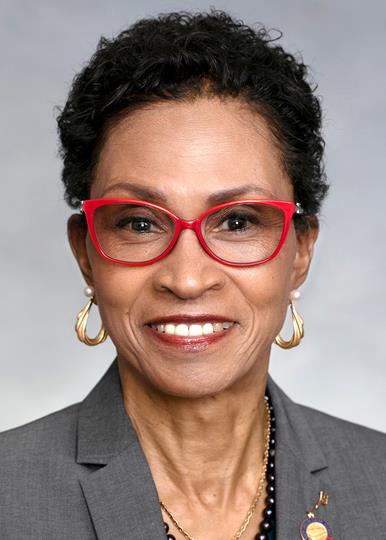
Rep. Renée Price
Sponsored bills
Maddy summaryHouse Bill 110 establishes the National Guard Student Loan Repayment Program in North Carolina. This program provides student loan repayment awards to active members of the North Carolina National Guard, incentivizing them to begin or complete a term of service of at least three years. Awards cannot exceed the recipient's total student loan debt or $50,000 for a three-year service term, with potential for additional funds for longer service. Recipients must sign an agreement to repay a portion of the award if they voluntarily terminate their service early. The bill appropriates over $25.5 million to a new fund for the program for the 2025-2026 fiscal year.
Maddy summaryHouse Bill 703 allows State veterans cemeteries to sell monuments and memorials directly to honor individuals interred within them. This bill permits the sale of items such as memorial trees, granite or marble markers, and benches, though not headstones. State veterans cemeteries can establish stylistic guidelines for these items and must not charge more than the market rate. The funds generated from these sales will be retained by the selling cemetery and dedicated solely to its maintenance, improvement, and care. This act becomes effective on October 1, 2025.
Maddy summaryHouse Bill 743 (HB 743) allows direct support professionals to permanently reside in specific licensed group homes where they provide services to clients. The bill directs the Department of Health and Human Services (DHSR) to adopt rules necessary to implement this change for facilities licensed under 10A NCAC 27G .5601(c)(3). DHSR is also required to report its progress on these changes to the Joint Legislative Oversight Committee on Health and Human Services by September 30, 2025. This legislation aims to establish a framework for live-in support within these residential settings.
Maddy summaryHB 631 establishes a joint legislative study commission to examine the feasibility of creating a State Infrastructure Bank in North Carolina. This commission will investigate how such a bank could sustainably finance various infrastructure projects, including transportation, environmental, energy, and housing, to support economic growth and community development. Composed of legislators, state officials, and appointed experts, the commission will hold public meetings across the state and provide recommendations to the General Assembly by late 2026.
Maddy summaryHouse Bill 363 allows regional public transportation authorities to operate buspool services further than ten miles beyond their usual service area. This bill amends G.S. 160A-610(20), removing the previous mileage restriction specifically for buspool services. The change enables these authorities to extend buspool routes into more distant communities, potentially affecting a broader range of commuters.
Maddy summaryHB 69, the Military and Veterans Educational Promise Act, provides two key benefits for military-affiliated individuals and veterans at North Carolina's University of North Carolina (UNC) schools. First, it requires UNC institutions to allow eligible military members (including reservists) and their spouses to defer admission for up to five years (for active duty) or two years (for reserve service) upon enrollment notice. Second, it establishes in-state tuition rates for honorably discharged veterans who served at least 90 days in the military, graduated from a North Carolina high school after 2004, had a North Carolina duty station, or received a Purple Heart. The bill applies to all UNC institutions beginning in the 2025-2026 academic year.
Maddy summaryHouse Bill 213, titled "Post NC Veterans' Benefits," requires employers in North Carolina to display a notice about veterans' benefits. This bill mandates that employers with five or more persons working in a room post this information in a conspicuous place. The Commissioner of Labor will provide a digital or printed form of this notice. The poster must include details on services such as benefits and claims, employment and training, housing assistance, and how to request military records, with the Department of Labor consulting the Department of Military and Veterans Affairs to create it.
Maddy summaryHB 113 creates a joint legislative committee to study potential changes to North Carolina's Medicaid program if federal funding decreases. The 12-member committee (six senators appointed by the Senate President Pro Tempore, six representatives appointed by the House Speaker) will examine cost-saving options like reducing optional services, adjusting provider payments, or improving managed care efficiency. It must submit a final report with recommendations to the General Assembly by April 30, 2026, but the bill itself does not make any direct policy changes to Medicaid. This is a procedural measure establishing a study body, not a policy enactment.
Maddy summaryHB 699 would have prohibited North Carolina sheriffs from firing deputy sheriffs or other employees in their office for failing to make campaign contributions to the sheriff or the sheriff's campaign committee. This directly affects sheriff's office employees who could previously face employment consequences based on political donations. The bill's key provision would have made it illegal for sheriffs to use campaign contributions as a factor in hiring, firing, or disciplinary decisions. It represents a policy change to prevent coercion of employees through campaign donation requirements.