

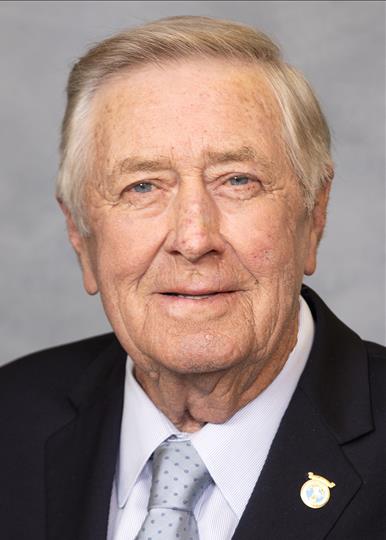
Photo of William Brisson
R North Carolina House · District 22

Rep. William Brisson

Compare
Total votes
6,754
all sessions
Attendance
96%
294 missed
Near the chamber average
With party
95%
of cast votes
Near the chamber average
Bipartisan score
3%
crosses aisle rarely
Near the chamber average
Sponsored
608
bills & resolutions
Near the chamber average
Committees
11
assignments
608 bills and resolutions

Sponsored bills

Total
608
Primary
60
Co-sponsor
548
This page
608
matching current filters
Co-sponsor HB 218
Passed · North Carolina House · Co-sponsor
Emergency Information on DMV Applications.

Maddy summaryHB 218 requires the North Carolina Division of Motor Vehicles (DMV) to include a request for emergency contact information on applications for drivers' licenses, learners' permits, and identification cards. This applies to both new applications and renewal applications. Providing this emergency contact information will be optional for the applicant. The act is set to become effective on October 1, 2026.

Passed Apr 16, 2025 1 co-sponsor
Co-sponsor HB 889
In committee · North Carolina House · Co-sponsor
Lumber River State Park Directives.

Maddy summaryHB 889 requires North Carolina's Department of Natural and Cultural Resources to negotiate an agreement with Fair Bluff town by March 2026 to manage Lumber River State Park's River Walk, adjacent park, and parking areas as a single unit. It directs the department to use Fair Bluff's existing Lumber River Visitors Center as the park's headquarters, clarifying that no new admission fees are required except for special events or private rentals. The agreement must define management responsibilities for shared spaces, outline how user fees (for events only) will be handled, and address asset transfers between the town and state. This bill does not create new fees or regulations but reorganizes park management structure and location.

In committee Apr 14, 2025 1 co-sponsor
Co-sponsor HB 892
In committee · North Carolina House · Co-sponsor
Commercial Drivers License Training/Disaster Affected Areas.

Maddy summaryHB 892 establishes a North Carolina grant program to help residents in Western counties impacted by Hurricane Helene obtain Commercial Driver's License (CDL) training and secure related jobs. The program provides $4,000 per trainee to approved CDL training providers (offering four-week accelerated programs within 75 miles of Asheville) and $1,500 for temporary housing stipends for trainees needing financial assistance. Priority is given to Western NC residents affected by Hurricane Helene, with $2.5 million in state funds allocated for the 2025-2026 fiscal year. The initiative connects training directly to disaster recovery employment through partnerships with local employers and housing providers.

In committee Apr 14, 2025 1 co-sponsor
Co-sponsor HB 397
Passed · North Carolina House · Co-sponsor
Use of Epinephrine Nasal Spray.

Maddy summaryHB 397 allows schools in North Carolina to use epinephrine nasal spray as an emergency treatment option alongside traditional auto-injectors for students experiencing anaphylaxis. The bill amends school health policies to include nasal spray devices in the definition of "epinephrine auto-injector delivery systems," requiring all schools to maintain at least two emergency epinephrine supplies (now including nasal spray) in secure but accessible locations. Schools must train staff to recognize anaphylaxis symptoms, store devices properly, and follow emergency action plans developed with school nurses. This applies to public schools, charter schools, and regional schools starting in the 2025-2026 school year. The policy directly affects school staff, students with severe allergies, and school health protocols.

Passed Apr 10, 2025 1 co-sponsor
Co-sponsor HB 826
In committee · North Carolina House · Co-sponsor
No Retaliation Against Mandatory Reporters.

Maddy summaryHB 826, titled "No Retaliation Against Mandatory Reporters," protects employees required by North Carolina law to report suspected abuse, neglect, fraud, or other threats to vulnerable populations (such as child welfare workers, healthcare providers, and sex offender compliance reporters). The bill prohibits employers from taking retaliatory actions like firing, demoting, or reducing pay against these employees for making good-faith reports. Key provisions require employers to inform workers of their rights, provide annual training on reporting duties, and establish a rebuttable presumption of retaliation if adverse actions occur within 60 days of a report. Enforcement is handled by the North Carolina Commissioner of Labor, who can order reinstatement, back pay, or fines up to $5,000 per violation.

In committee Apr 9, 2025 1 co-sponsor
Co-sponsor HB 335
In committee · North Carolina House · Co-sponsor
Expand Emergency Judge Eligibility.

Maddy summaryHB 335 expands eligibility for emergency judges in North Carolina by allowing retired judges who previously served in both Superior Court and District Court to qualify for emergency judge roles on either court. Currently, retired judges could only serve as emergency judges on the specific court they retired from, but this bill removes that restriction for judges with dual court experience. The change directly affects retired judges who held positions in both court systems before retiring, making them eligible to be assigned to emergency duties in either court. This adjustment streamlines the pool of available judges for temporary court needs without altering compensation or other existing rules.

In committee Apr 8, 2025 1 co-sponsor
Co-sponsor HB 766
In committee · North Carolina House · Co-sponsor
Expand Access to Teen Mental Health First Aid.

Maddy summaryHB 766 appropriates $1.87 million to fund expanded Teen Mental Health First Aid (tMHFA) training for North Carolina high school students in grades 9-12 (ages 14-18). The bill directly affects students by providing evidence-based training to help them recognize, understand, and respond to peers' mental health and substance use challenges. Key provisions include funding for the Department of Health and Human Services to scale up tMHFA programs statewide, building on a pilot that trained 1,519 teens and showed a 50% increase in teens' willingness to seek adult support. The training focuses on connecting peers to trusted adults during crises, addressing high rates of unmet mental health needs among teens (64% don’t seek help, per the bill’s rationale).

In committee Apr 7, 2025 1 co-sponsor
Co-sponsor HB 680
In committee · North Carolina House · Co-sponsor
The Protect Children from Cannabis Act.

Maddy summaryThis bill would regulate hemp-derived consumable products (like edibles, vapes, and beverages) by requiring retailers to obtain permits, limiting THC content to 0.3%, and mandating age verification for all sales. It directly affects vape shops, gas stations, convenience stores, and online sellers currently selling these products to minors. The law creates new enforcement rules for the Commission, requiring proof of age (e.g., driver's license) and banning sales to anyone under 21.

In committee Apr 3, 2025 1 co-sponsor
Co-sponsor HB 710
In committee · North Carolina House · Co-sponsor
Mental Health Crisis Unit Pilot for Local School Administrative Units.

Maddy summaryHB 710 establishes a three-year pilot program to fund mental health crisis units in North Carolina public schools. It allocates $2 million total (up to $250,000 annually per district) to select up to eight school districts starting in 2025-2026, prioritizing those with high student mental health needs or trauma history. Each participating district must staff units with at least a school nurse, social worker, and licensed counselor to provide crisis intervention during school hours and rotate across schools. The program requires annual reports on participating districts and student mental health impacts, ending June 30, 2028.

In committee Apr 3, 2025 1 co-sponsor
Co-sponsor HB 588
In committee · North Carolina House · Co-sponsor
School Psychologist Omnibus.

Maddy summaryHB 588 aims to improve the number and quality of school psychologists in North Carolina through multiple funding initiatives. It provides a $650 monthly salary boost and a 12% supplement for certified school psychologists (totaling $8.1 million), establishes a $5 million grant program to fund signing bonuses (up to $5,000) for recruiting new psychologists with a one-year commitment requirement, and creates a $5 million internship program offering stipends at starting salaries. Additionally, it allocates $5 million for a virtual training program at Appalachian State University and $1.6 million to expand school psychology programs at five UNC institutions to double graduate output. The bill also includes an interstate licensure compact to facilitate practice across state lines, with all programs requiring annual reporting to the legislature.

In committee Apr 1, 2025 1 co-sponsor
Showing 31 to 40 of 608 bills
Previous 1 3 4 5 61 Next