

Maddy summaryHB 294 changes Jackson County's school board elections from nonpartisan to partisan, requiring candidates to run under political party labels instead of as nonpartisan candidates. This affects all future Jackson County school board elections, directly impacting voters and candidates in the county's five single-member districts. The bill modifies election rules to align with standard partisan voting procedures for county offices, replacing the current nonpartisan plurality method. It becomes effective for the 2025 school board elections.
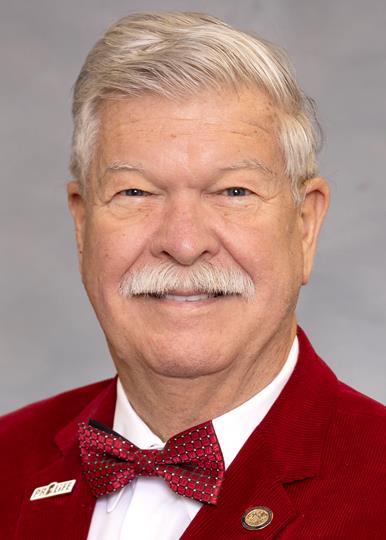
Rep. Mike Clampitt
Sponsored bills
Maddy summaryHB 16 requires the North Carolina General Assembly to display the national motto "In God We Trust" directly above and behind the dais for the Speaker of the House and President of the Senate, aligning with the U.S. House of Representatives' display. The bill mandates the Legislative Services Officer to implement this, first using private gifts or donations for costs, and if none are provided within 90 days, using state funds. It becomes effective July 1, 2025. This is a procedural bill affecting legislative chamber decor, not a substantive policy change.
Maddy summaryHB 514 defines the scope of practice for Advanced Practice Registered Nurses (APRNs) in North Carolina, including nurse practitioners (NPs), certified nurse midwives (CNMs), certified registered nurse anesthetists (CRNAs), and clinical nurse specialists (CNSs). The bill explicitly outlines the specific responsibilities for each role - such as CNMs managing reproductive health care, NPs diagnosing and treating illnesses, and CRNAs administering anesthesia - removing ambiguity in current law. It directly affects over 20,000 APRNs in North Carolina who currently face restrictions due to undefined practice parameters. The legislation aims to align North Carolina with 36 other states that have clarified APRN authority without compromising patient safety, as supported by research cited in the bill. This statutory definition is intended to improve healthcare access and reduce costs by enabling APRNs to practice to the full extent of their training.
Maddy summaryHB 47, the Disaster Recovery Act of 2025 - Part I, allocates $524 million from the Helene Fund to support recovery efforts in North Carolina counties impacted by Hurricane Helene. The bill directs funds to specific programs including home reconstruction ($120 million), agricultural crop loss assistance ($200 million), road and bridge repairs ($100 million), small business infrastructure grants ($55 million), debris removal ($20 million), fire department equipment ($10 million), and tourism promotion ($4 million). These resources directly assist residents, farmers, local governments, and businesses in designated hurricane-affected counties by addressing immediate rebuilding needs and supporting economic recovery. The bill requires programs to align with federal disaster recovery guidelines to maximize potential federal reimbursement, with reporting requirements for certain initiatives.
Maddy summaryHB 186, the "Stars and Stripes Commitment Act," requires all North Carolina public schools (including charter, regional, and laboratory schools) to schedule the daily recitation of the Pledge of Allegiance within one hour of the start of the instructional day. It also mandates that schools display U.S. and North Carolina flags in classrooms when available and provide age-appropriate instruction about the flag and pledge’s meaning. The bill applies to all school governing bodies and state education board meetings, requiring the pledge to open each meeting. Crucially, it explicitly states the policy does not compel anyone to stand, salute, or recite the pledge. The law takes effect for the 2025-2026 school year.
Maddy summaryHB 463 establishes a supplemental insurance plan for North Carolina first responders diagnosed with specific mental health conditions (like anxiety, depression, or PTSD) directly resulting from their job. It provides three key benefits: up to $5,000 annually for out-of-pocket mental health costs, 75% of salary or $5,000 monthly (max 12 weeks/year) for leave due to treatment, and disability benefits (75% salary or $5,000/month, max 36 months) if unable to work. Eligibility requires a job-related diagnosis, current employment as a defined first responder (including police, firefighters, EMTs, and dispatchers), and exclusion from workers' compensation benefits. The plan aims to support recovery and return to duty while limiting benefits to cover gaps not met by other sources.
Maddy summaryHB 21 creates a voluntary designation on North Carolina driver's licenses for individuals with autism spectrum disorder (ASD), as defined by state law. People with a medical diagnosis of ASD can request this designation by providing acceptable documentation, such as a healthcare professional's certification, to the Division of Motor Vehicles. The designation appears only in the license record and is accessible solely to law enforcement during interactions to promote safety - no other use is permitted. Individuals may add or remove the designation at any time without affecting their license eligibility or rights.
Maddy summaryHB 37 standardizes monthly pension benefits for North Carolina firefighters and rescue squad workers under the state pension fund. It sets a uniform $175 monthly pension for members with 20+ years of service who reach age 55, replaces the previous $180 amount, and maintains $175 for disability benefits and line-of-duty death benefits. The bill also allows members affected by city annexations or department closures to continue contributing $15 monthly until they reach 20 years of service for pension eligibility. These changes apply to current and future members of the pension fund who meet the service requirements. The bill does not alter contribution rates or eligibility for most members but adjusts benefit amounts and extends certain provisions.
Maddy summaryHB 400, "Bentley's Law," requires defendants convicted of certain felony death-by-vehicle offenses (specifically violations of G.S. 20-141.4 subsections (a1), (a5), or (a6)) to pay child support as restitution to the minor children of the deceased victim. The court must order payments until each child turns 18 and graduates high school, considering the child’s needs, living standards, and custody arrangements. Payments are made to the clerk of court for distribution to the surviving parent or guardian within 10 days, with enforcement treated as a civil judgment. This law directly affects children of victims in these specific vehicular homicide cases and mandates financial support through the criminal sentencing process.
Maddy summaryHB 5, the NC Constitutional Carry Act, allows any U.S. citizen aged 18 or older to carry a concealed handgun without a permit, effective upon enactment. This directly affects most adult residents who are not prohibited from firearm ownership under existing state or federal law. The bill removes the permit requirement for concealed carry (per new Section 14-415.35(a)), while maintaining all existing prohibitions - such as for felons, domestic violence offenders, or those under indictment. It also preserves the ability to obtain permits for reciprocity or other purposes, and continues allowing officials with permits to carry while on duty. The law does not change restrictions for prohibited individuals, who remain barred from concealed carry.