

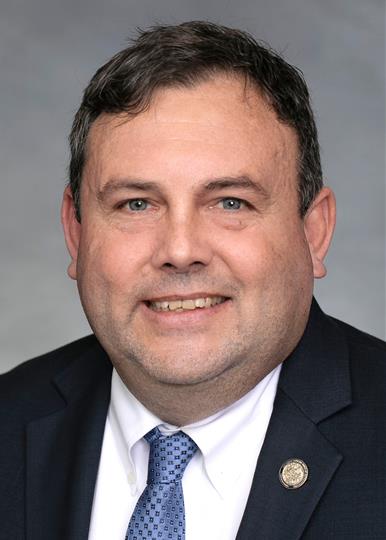
Photo of Eric Ager
D North Carolina House · District 114 On the 2026 ballot

Rep. Eric Ager

Compare
Total votes
1,281
all sessions
Attendance
99%
8 missed
Near the chamber average
With party
95%
of cast votes
Lower than 80% of chamber peers
Bipartisan score
3%
crosses aisle rarely
Higher than 79% of chamber peers
Sponsored
603
bills & resolutions
Higher than 92% of chamber peers
Committees
9
assignments
603 bills and resolutions

Sponsored bills

Total
603
Primary
24
Co-sponsor
579
This page
603
matching current filters
Co-sponsor HB 27
died · North Carolina House · Co-sponsor
School Calendar Flexibility/Alamance/Open Calendar.

Maddy summaryHB 27 allows Alamance-Burlington Schools to start the school year as early as August 19 (instead of the standard August 26) if they demonstrate "good cause" - specifically, if the district averaged 8 emergency closures per year over four of the last ten years due to weather, power outages, or other emergencies. The bill modifies existing law to grant this flexibility while requiring schools to still meet minimum instructional day requirements. It applies exclusively to Alamance-Burlington Schools and takes effect for the 2025-2026 school year. The change does not affect schools already operating under a modified calendar.

died Feb 24, 2025 1 co-sponsor
Co-sponsor HB 30
died · North Carolina House · Co-sponsor
School Calendar Flexibility/Winston-Salem/Forsyth, Stokes, Davidson/August 11 and Assessments.

Maddy summaryHB 30 grants Winston-Salem/Forsyth, Stokes, and Davidson County Schools additional flexibility to set their school calendar opening date as early as August 19 (instead of the standard August 26) if they demonstrate "good cause" through documented emergency closures (8+ days in 4 of the last 10 years). It also allows these districts to administer annual student assessments earlier if their fall semester ends before December 31. The bill modifies existing calendar rules under state law and applies only to these three school systems beginning in the 2025-2026 school year. These changes aim to accommodate emergency-related school closures while ensuring minimum instructional requirements are met.

died Feb 24, 2025 1 co-sponsor
Primary HB 104
died · North Carolina House · Lead sponsor
School Calendar Flexibility/Buncombe/Open Calendar.

Maddy summaryHB 104 allows Buncombe County Schools to adopt an earlier school start date (no earlier than August 19, instead of the standard August 26) if the district meets "good cause" criteria - specifically, if they've had eight or more school closure days annually due to weather or emergencies during four of the last ten years. The bill amends a state law to grant this specific waiver for Buncombe County only, without changing statewide calendar requirements. It applies only to Buncombe County Schools beginning with the 2025-2026 school year and does not alter closing dates or instructional day minimums. This is a targeted local flexibility measure, not a statewide policy change.

died Feb 24, 2025 0 co-sponsors
Co-sponsor HB 31
died · North Carolina House · Co-sponsor
Make Election Day A State Holiday.

Maddy summaryHB 31 would amend North Carolina's State Human Resources Act to make every statewide general election day a paid holiday for state employees. This change would add election days to the current list of paid holidays (which includes Martin Luther King Jr.'s Birthday and Veterans Day), while maintaining the limit of 13 paid holidays per year. The bill directly affects state workers, ensuring they receive paid time off on election days without reducing the total number of paid holidays. It does not change election dates or voting procedures, only the employment benefits for state employees on those days. The legislation is currently pending in committee review.

died Feb 24, 2025 1 co-sponsor
Co-sponsor HB 148
In committee · North Carolina House · Co-sponsor
School Calendar Flexibility/Jackson, Swain, Transylvania/Open Calendar.

Maddy summaryHB 148 allows Jackson, Swain, and Transylvania County Schools to start the school year earlier than the standard date (as early as August 19 instead of August 26) if they can prove they averaged at least eight weather-related school closures annually over the past decade. The bill specifically targets these three counties and requires them to maintain sufficient instructional days despite the earlier start. It does not change statewide calendar rules but creates a limited exception for qualifying districts based on documented emergency closure history. The change would apply beginning with the 2025-2026 school year.

In committee Feb 21, 2025 1 co-sponsor
Co-sponsor HB 132
In committee · North Carolina House · Co-sponsor
School Calendar Flexibility/Cumberland/Open Calendar.

Maddy summaryHB 132 allows Cumberland County Schools to set an earlier school start date (as early as August 19, instead of the standard August 26) if they demonstrate "good cause" based on historical emergency closures. Specifically, it requires the county to show schools were closed eight days per year during any four of the last ten years due to weather, power failures, or other emergencies. The bill modifies existing calendar rules to accommodate this flexibility while ensuring schools still meet minimum instructional day requirements. This change applies only to Cumberland County Schools and takes effect for the 2025-2026 school year.

In committee Feb 18, 2025 1 co-sponsor
Co-sponsor HB 131
In committee · North Carolina House · Co-sponsor
Reenact Solar Energy Tax Credit.

Maddy summaryHB 131 reinstates a 35% tax credit for businesses and homeowners who install solar energy systems in North Carolina. Businesses can claim the credit over five years (with a $2.5 million maximum per installation), while homeowners receive capped credits based on system type (e.g., $1,400 for water heating, $3,500 for space heating). The credit applies to equipment placed in service in the state and expires for new installations after 2017, though projects meeting 2015 construction milestones qualify for extension. This bill renews a previously expired tax incentive program for solar energy adoption.

In committee Feb 18, 2025 1 co-sponsor
Co-sponsor HB 129
In committee · North Carolina House · Co-sponsor
Judge Joe John Nonpartisan Judicial Elections Act.

Maddy summaryHB 129, the "Judge Joe John Nonpartisan Judicial Elections Act," reestablishes nonpartisan elections for all North Carolina judicial offices, including Supreme Court justices, Court of Appeals judges, and superior and district court judges. The bill requires candidates to run without party labels, with primaries held only when more than two candidates file for an office, and winners elected based on highest vote totals (using a random draw only in tie situations). It also restores public financing for judicial campaigns, aiming to reduce partisan influence in judicial races. This bill directly affects judicial candidates, voters, and the election process for all statewide and local judicial positions in North Carolina.

In committee Feb 18, 2025 1 co-sponsor
Co-sponsor HB 128
In committee · North Carolina House · Co-sponsor
Establish Prostate Cancer Control Program.

Maddy summaryHB 128 appropriates $2 million annually for fiscal years 2025-2026 and 2026-2027 to create a statewide prostate cancer screening program administered by North Carolina's Department of Health and Human Services. The program provides free or low-cost screenings and follow-up care to uninsured or underinsured men aged 50-70 (40-70 with family history of prostate cancer) who meet income requirements (below 250% of federal poverty level). Eligibility requires no Medicare Part B or Medicaid coverage and specific age/family history criteria as defined in the bill. The program begins July 1, 2025.

In committee Feb 17, 2025 1 co-sponsor
Primary HB 108
In committee · North Carolina House · Lead sponsor
The Sober Operator Act of 2025.

Maddy summaryHB 108, "The Sober Operator Act of 2025," lowers North Carolina's legal blood alcohol concentration (BAC) limit for driving from 0.08% to 0.05% for all vehicles and vessels. It directly affects all drivers, requiring them to maintain a lower BAC level and facing faster license revocation if they refuse tests or exceed the new limit. Key provisions include mandating video recording of impaired driving court proceedings for transparency, requiring impaired drivers to cover processing costs, and allowing repeat offenders to prove sobriety to regain driving privileges. The bill also streamlines evidence rules by admitting BAC test results to reduce court delays and ensures equal treatment in impaired driving cases.

In committee Feb 13, 2025 0 co-sponsors
Showing 351 to 360 of 603 bills
Previous 1 … 35 36 37 … 61 Next