

Maddy summaryHB 113 creates a joint legislative committee to study potential changes to North Carolina's Medicaid program if federal funding decreases. The 12-member committee (six senators appointed by the Senate President Pro Tempore, six representatives appointed by the House Speaker) will examine cost-saving options like reducing optional services, adjusting provider payments, or improving managed care efficiency. It must submit a final report with recommendations to the General Assembly by April 30, 2026, but the bill itself does not make any direct policy changes to Medicaid. This is a procedural measure establishing a study body, not a policy enactment.
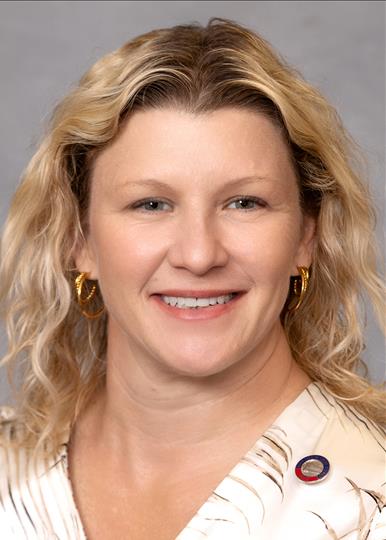
Rep. Laura Budd
Sponsored bills
Maddy summaryHB 952 establishes the North Carolina Child Care Finance Agency to provide loans and bonds for constructing or rehabilitating childcare facilities. The agency will prioritize small providers (under 10 locations), high-quality licensed centers, faith-based organizations, and businesses offering on-site childcare for employees. It directly affects childcare providers, employers with childcare programs, and families seeking affordable, accessible care by financing facility development. This policy change creates a dedicated state mechanism to address North Carolina’s childcare shortage through targeted infrastructure investment.
Maddy summaryHB 954 creates a State Critical Infrastructure and Construction Resiliency Fund to support disaster recovery and preparedness. It requires counties that experienced a Governor-declared Type I, II, or III disaster in the past three years to redirect 5% of their annual highway use tax revenue into the fund. The Governor can use these funds for new infrastructure projects and resiliency efforts in disaster-affected areas, as well as for state/local response activities following a federal disaster declaration under the Stafford Act. This directly affects eligible counties and their residents by providing dedicated resources for rebuilding and preventing future disaster impacts.
Maddy summaryHB 914 allows colleges and religious institutions in qualifying North Carolina cities (population over 50,000 in urban areas) to develop affordable housing on their owned land without needing special zoning approvals or permits. The bill requires 80% of new housing units to be reserved for low-income residents (at or below 80% of median income), with limited exceptions for staff housing. It includes location restrictions, such as avoiding historic districts, heavy industrial areas, and sites where over one-third is currently light industrial. This policy change streamlines development by treating such housing as a "use by right" under existing zoning.
Maddy summaryHB 933 increases Medicaid rates to ensure direct care workers for people with intellectual or developmental disabilities earn at least $18 per hour, affecting home/community providers, group homes, and waiver programs like NC Innovations. It adds 1,000 slots to the NC Innovations waiver program (with $36 million in annual state funding) and requires a 10-year plan to address unmet service needs. The bill also removes income and resource limits for Medicaid eligibility under the Health Coverage for Workers with Disabilities program. These changes take effect July 1, 2025, with $183 million in annual state funding supporting the wage increases and $36 million for new waiver slots.
Maddy summaryThis bill increases law enforcement and judicial resources in Mecklenburg County by funding 12 additional State Trooper positions and five new magistrates, effective July 1, 2025. It also raises minimum fines for drivers who fail to stop for school buses and establishes vehicle registration records as preliminary evidence of who was driving during such violations. Additionally, the bill expands the operating hours of the Metrolina Transportation Management Center and creates new rules for accessing highway camera footage, limiting public disclosure to specific individuals directly involved in incidents captured by the cameras.
Maddy summaryHB 932 establishes a permanent 10% base salary increase for teachers and first responders in North Carolina, effective July 1, 2025. The bill appropriates $700 million annually for first responders (including law enforcement, firefighters, EMTs, dispatchers, and certain nurses) and $900 million annually for teachers (classroom staff, principals, and instructional support) from the General Fund. Funds must be used solely for the pay increase, added to base salary, and included in future salary calculations - no administrative costs are permitted. Employing authorities and school entities must certify costs and verify implementation by deadlines, with unspent funds reverting to the General Fund annually.
Maddy summaryHB 915 reenacts a 25% tax credit for film production companies in North Carolina that spend at least $250,000 on qualifying expenses within the state. The credit applies to costs like equipment rentals, wages (excluding payments over $1 million to top earners), insurance, and employee benefits, but excludes political ads, news broadcasts, live sports events, and obscene content. The credit is capped at $20 million per feature film and requires producers to notify the North Carolina Film Office before claiming it. This reenactment makes the credit effective for qualifying expenses occurring on or after January 1, 2025, after a prior sunset clause expired in 2015.
Maddy summaryHB 940 prohibits employment discrimination based on pregnancy, childbirth, or pregnancy-related conditions in North Carolina. It requires employers to treat pregnant employees the same as others with similar abilities to work, provide reasonable accommodations (like modified schedules or breastfeeding breaks), and grant leave for pregnancy-related disability on par with other medical leave. The bill also mandates that employers allow return to the same or equivalent position after leave and clarifies that discrimination claims must be filed within three years. It directly affects employers with 15+ employees and pregnant or postpartum workers in North Carolina.
Maddy summaryHB 941 expands North Carolina's Teaching Fellows Program to address teacher shortages by providing forgivable loans to students pursuing teaching careers in high-need areas like special education, STEM, elementary education (K-6), and specific secondary subjects. The bill establishes a Trust Fund to cover loan amounts (up to $12,000 annually for up to four years), administrative costs, mentorship, and extracurricular programs like summer initiatives and alumni engagement. It requires selected colleges to meet strict standards, including high graduate effectiveness rates, alignment with "Science of Reading" training for elementary programs, and diverse school practicum opportunities. The program directly affects prospective teachers enrolled at up to 14 approved institutions of higher education who commit to teaching in qualifying licensure areas across North Carolina public schools.