

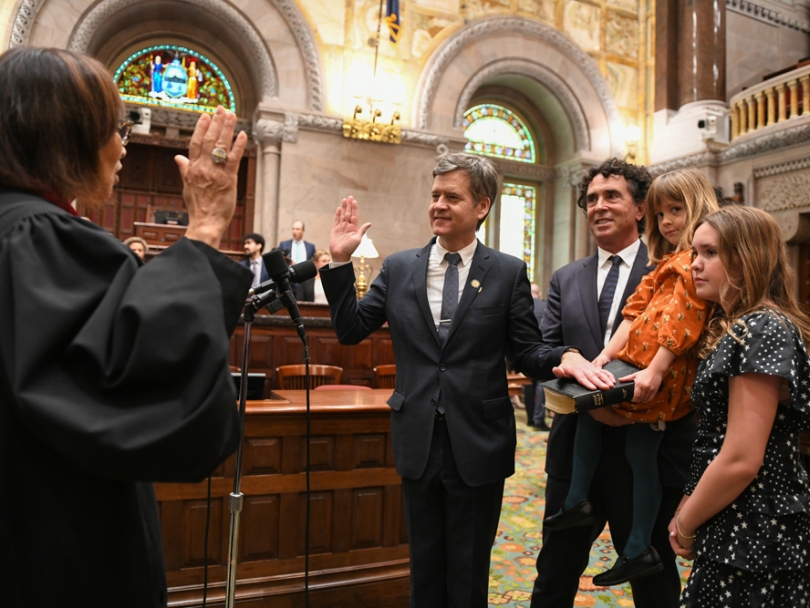
Maddy summaryS 7030 amends New York's insurance law to expand the legal definition of "infertility" to explicitly include individuals in same-sex relationships. This change directly affects same-sex couples seeking insurance coverage for infertility treatments, as the updated definition now recognizes their circumstances under the same medical criteria used for heterosexual couples. The key provision adds "or be in a same-sex relationship" to the existing definition, which previously focused on heterosexual conception attempts. The bill does not create new benefits but adjusts how infertility is defined for insurance purposes, aligning the legal standard with current medical practice. It became law immediately upon enactment.
Sponsored bills
Requires the Metropolitan Transportation Authority, in consultation with the New York city transit authority, the Long Island Rail Road and the Metro-North Commuter Railroad Company, to allow riders travelling within the limits of the city of New York to pay a fare for commuter rail service equal to that of a MetroCard ride and for such riders to make free transfers.
Maddy summaryThis bill allows taxpayers to voluntarily contribute any whole dollar amount to a new "uterine fibroids education fund" when filing state corporate or personal income taxes. The contributions, which do not reduce the taxpayer's required tax payment, will be collected through designated spaces on tax forms. All funds will be managed by the state's tax and finance departments and used exclusively for approved educational programs about uterine fibroids, including grants for healthcare providers and public outreach initiatives. The fund is established under the state finance law, with spending requiring approval from the health department and annual expenditure requirements.
Establishes new targets for offshore wind electricity generation; includes the requirements that there is at least 15 gigawatts of offshore wind electricity generation by 2040, at least 18 gigawatts of offshore wind electricity generation by 2045 and at least 20 gigawatts of offshore wind electricity generation by 2050.
Provides that funds recovered from public authorities for the provision of governmental services and allocated to the independent authorities budget office shall only be used for direct expenses of the authorities budget office and may not be used for fringe benefits and indirect costs.
Enacts the "faith-based affordable housing act" for development on residential land; defines terms; provides that each village, town, and city shall allow the construction and occupation of residential buildings on any covered site up to the specified densities; provides that all residential buildings constructed pursuant to this section in a town, village, or city with fewer than one million inhabitants shall set aside twenty percent of the residential floor area for households earning an average of eighty percent of area median income; outlines the densities for New York city; makes related provisions.
Relates to school climate and codes of conduct on school property and disciplinary action following violation of such codes of conduct; makes conforming amendments.
Maddy summaryThis bill increases residential solar tax credits by raising the credit rate to 26% of qualified solar equipment costs. It sets new annual credit limits: $3,750 for systems installed before 2026, $5,000 for 2026-2025, and $10,000 for systems installed on or after January 1, 2026. The credit applies to homeowners who install qualifying solar systems (including equipment for heating, cooling, hot water, or electricity) at their primary residence, covering equipment purchases, installation, and certain lease agreements. Low-income taxpayers and those in disadvantaged communities may receive refunds for excess credits starting in 2026, rather than carrying them forward. The policy directly affects residential property owners installing solar energy systems in the state.
Directs the department of transportation to conduct a study to evaluate the standard approach of setting or adjusting speed limits, specifically the usage of 85th percentile rule.
Maddy summaryThis bill prohibits businesses from making deceptive environmental marketing claims, affecting companies that advertise products or services with environmental benefits. It bans misleading practices like "paltering" (selectively highlighting truthful details to create false impressions) and deceptive "net zero" claims that lack transparency about emissions coverage or rely heavily on offsets. Businesses must clearly specify all emissions scopes, distinguish between actual reductions and offset purchases, and substantiate claims. The law also allows consumers or authorities to pursue legal action without proving financial harm from these deceptive practices.