

Provides that when the governor declares a weather related state of emergency in a city having a population of one million or more, all public and private elementary and secondary schools shall be closed and remain closed until such emergency is terminated.
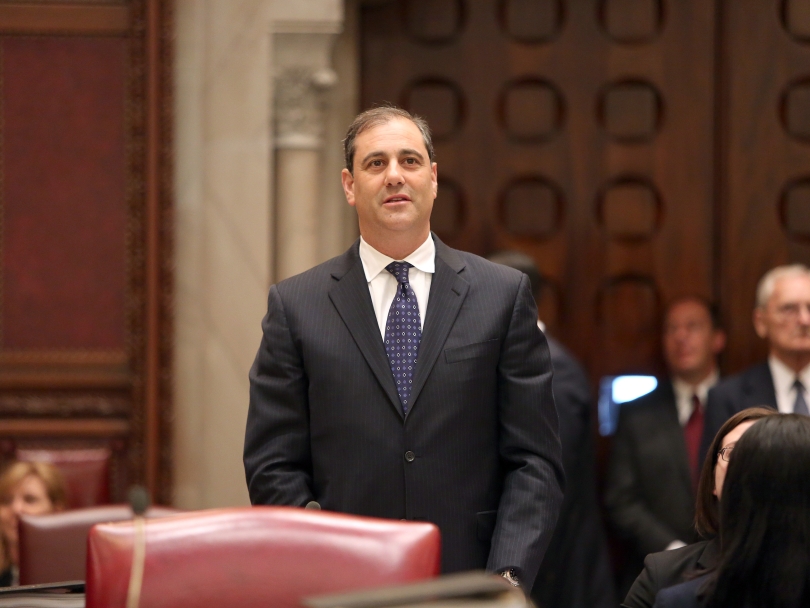
Sen. Andrew Lanza
Sponsored bills
Maddy summaryThis bill raises the severity level of all computer tampering offenses by one degree in New York's penal law. It changes classifications so that, for example, computer tampering previously classified as a fourth-degree misdemeanor (the least severe) becomes a fourth-degree felony, while higher degrees (third, second, first) also move up to more serious felony categories. The bill directly affects individuals convicted of computer tampering crimes, as it increases potential penalties by elevating their offense level. These changes apply to all existing computer tampering statutes (sections 156.20-156.27) and take effect November 1, 2025.
Maddy summaryThis bill (S 6950) requires charter schools to follow the same suspension procedures for students as public schools, ensuring consistency in due process. It amends education law to clarify that charter schools must use their board of trustees (not a public school board) when applying suspension rules under Section 3214. The law specifically states students can only be suspended in line with public school due process requirements, and charter schools cannot deny admission to students suspended from public schools until that suspension period ends. This affects all charter schools and their students by standardizing disciplinary processes.
Provides for a 75-25 percent split in the New York city transit authority's operating surplus between the authority and the Metropolitan transit authority where previously the split was 50-50.
Maddy summaryThis bill changes how child support non-payment cases are handled in court. It makes a defendant's inability to pay child support an argument they can raise (an "affirmative defense"), rather than requiring prosecutors to prove the defendant could pay as part of the crime itself. The law applies to both misdemeanor (second-degree) and felony (first-degree) cases for failing to support a child. However, this defense does not apply if the defendant voluntarily quit a job, reduced their income, or failed to seek work despite being able to do so. The bill shifts the legal burden in these cases but does not change the penalties for non-support.
Requires a mental health medical professional to examine incarcerated individuals in solitary confinement when such incarcerated individual is in such confinement for a period in excess of twenty-four hours.
Maddy summaryThis bill repeals a specific provision (Section 265.37) of New York's Penal Law that previously made it a crime to possess ammunition feeding devices holding more than seven rounds. It directly affects individuals who might have faced charges under this outdated law. The key change is removing this criminal offense entirely, meaning possession of such devices will no longer be prohibited under state law. The bill does not create new restrictions or requirements - it simply eliminates an existing penalty.
Requires pre-employment investigation of school district personnel to determine criminal history or the presence of controlled substances or communicable diseases; requires submission to fingerprinting and other tests.
Establishes the class A-I felony of criminal use of a firearm for possessing a deadly weapon or displaying what appears to be or is a rifle, pistol, revolver, shotgun, machine gun or other firearm during the commission of a class A or violent felony; repeals the offenses of criminal use of a firearm in the first and second degrees.
Maddy summaryBill S 1189 establishes new licensure requirements for entities providing fiscal intermediary services for personal assistance programs. Beginning April 1, 2027, these fiscal intermediaries must obtain a license from the commissioner, a process that includes an application fee and an assessment of their character, competence, and compliance. The bill also broadens the definition of fiscal intermediaries, modifies their annual reporting obligations, and creates a confidential state registry for personal assistants that these intermediaries must maintain. This legislation directly affects fiscal intermediaries, personal assistants, and consumers utilizing these services.