

Relates to the length of time of a state disaster emergency declaration; requires the governor to transmit a weekly report to the legislature during a state disaster emergency; relates to the communication between the governor and parties affected by a suspension of laws during a state disaster emergency.
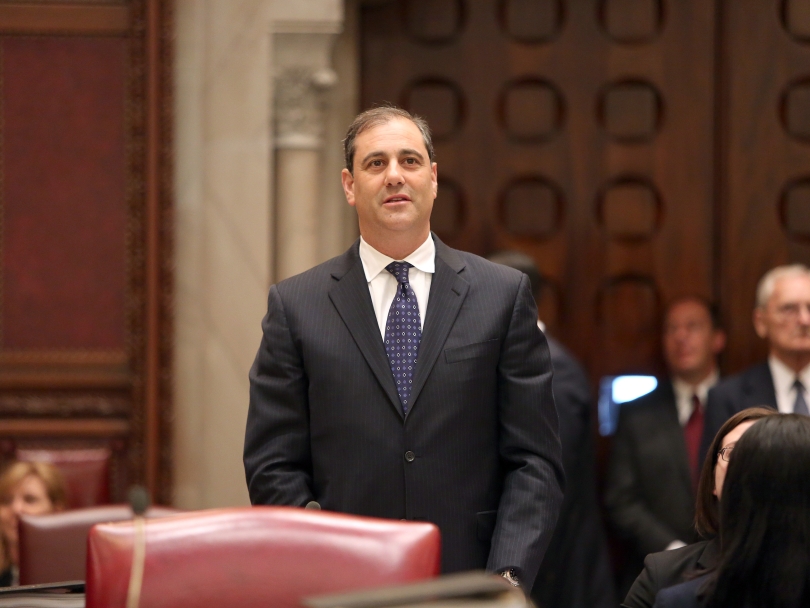
Sen. Andrew Lanza
Sponsored bills
Permits a violation captured by a speed camera to be dismissed upon the application of the person alleged to be liable for such violation if any information that is required to be inserted in the notice of liability is omitted from such notice of liability, misdescribed or illegible.
Maddy summaryS 503 allows courts to admit evidence of a defendant’s prior sexual offenses in current sexual offense cases, provided the evidence is relevant to issues like motive, intent, or a common pattern. The court must first determine that the evidence’s value outweighs its potential to unfairly prejudice the defendant. Prosecutors must disclose such evidence to the defense at least 15 days before trial, including witness details or testimony summaries. This bill applies to all pending cases after its effective date, aligning with federal evidence standards for similar crimes.
Maddy summaryS 5884 establishes a crisis intervention demonstration program in New York City and other cities with populations of one million or more. It requires the state mental health commissioner to create a coordinator position to train law enforcement officers on responding to mental health and substance abuse crises, while partnering with community mental health providers to offer alternatives to jail. The program will be funded through a new state fund (initially up to $1 million from the state general fund) and federal/private grants, with annual reporting on training participation and program effectiveness. This bill directly affects law enforcement agencies in large cities that choose to participate, as well as mental health service providers and individuals experiencing behavioral health crises.
Maddy summaryBill S 3713 exempts colleges and universities from the metropolitan commuter transportation mobility tax. It directly affects institutions of higher education by removing this tax obligation from their operations. The bill amends tax law to explicitly include "any institution providing higher education" in the list of entities already exempt from the tax, such as public schools and libraries. This change takes effect July 1, 2025, following enactment.
Maddy summaryThis bill authorizes uniformed court officers and court clerks designated as peace officers to execute arrest warrants under specific circumstances. It directly affects these court personnel by granting them the legal authority to carry out warrant executions during their official duties, overriding existing restrictions. The key provision amends the criminal procedure law to explicitly permit this action when acting pursuant to their special duties, as outlined in Article 120. This change clarifies and expands their operational capacity without altering broader law enforcement roles.
Maddy summaryS 6966 creates a tax credit for taxpayers who pay for the care of a qualifying disabled child, such as one with autism, developmental disabilities, or a physical disability. The credit equals 20% of up to $2,400 in qualifying care expenses (e.g., home health services, day care, equipment), plus an additional $75 if expenses exceed $240 annually. To qualify, the child must live with the taxpayer and be within the third degree of family relation. The credit reduces tax liability, and any unused portion is paid as a refund without interest.
Prohibits sex offenders from operating automobiles participating in mobile application based transportation networks or being employed by such transportation networks.
Expands eligibility for the disabled homeowners' exemption to certain surviving spouses; provides that if a person is eligible for the exemption and predeceases their spouse, such surviving spouse shall be eligible for the exemption, provided that all other requirements are satisfied.
Maddy summaryS 7024 elevates crimes committed on Metropolitan Transportation Authority (MTA) property to a higher felony category. It makes any crime on MTA-owned or operated property (including stations, vehicles, and facilities) count as one category higher than the original offense - for example, a class B felony becomes an A-1 felony. The bill mandates minimum sentencing ranges: at least six years for indeterminate sentences on class B felonies, and a minimum 20-year term for A-1 felony convictions. This directly affects individuals convicted of crimes in MTA spaces, altering their sentencing under New York’s penal law.