

Maddy summaryS 1528 establishes a tax on carbon-based fuels like coal, natural gas, and petroleum, imposed on fuel distributors and utilities based on carbon dioxide emissions. The tax starts at $35 per ton of carbon dioxide equivalent and increases by $15 annually to a maximum of $185 per ton. Revenue from the tax funds a dedicated "Carbon Dioxide Emissions Fund," with 60% returned as tax credits to low-to-moderate income residents (below 115% of area median income) and 40% allocated to clean energy transition, mass transit, and climate adaptation projects. The bill requires annual reporting by distributors and utilities and mandates public reporting on tax adjustments to address inflation and climate goals.
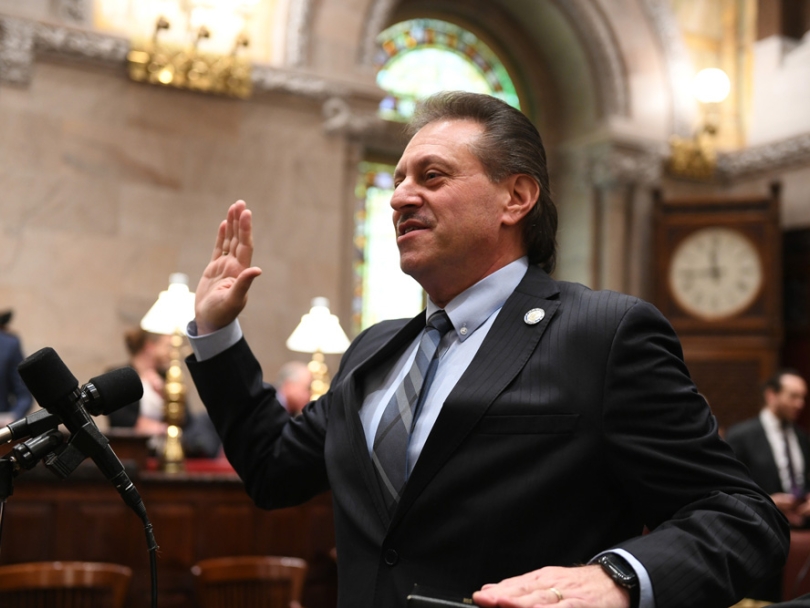
Sen. Joe Addabbo
Sponsored bills
Provides that a person is guilty of criminal mischief in the third degree when such person intentionally damages property of another person to promote or suppress a political ideology, or otherwise as an expression of political ideology.
Directs local law enforcement agencies in municipalities authorizing an auxiliary police force by local law to provide retirement service identification cards to auxiliary police officers who retire with 10 or more years of service or who are injured in the course of duty and unable to continue duty due to such injury.
Provides that in a city with a population of one million or more, where a student is applying to attend a public elementary or middle school and such student has a sibling who already attends such school, such student whose application is pending shall be given preference for admission.
Maddy summaryThis bill changes probation rules by restricting when people on community supervision (like probation) can be sent back to jail. It prohibits reincarceration for minor technical violations (such as curfew breaches, unpaid fees, or failing to notify a supervisor), but allows it for violations related to serious offenses like kidnapping, coercion, or firearm use. For absconding, it sets maximum jail periods (30 days for first violation, up to 90 days for repeat offenses). The law affects individuals on probation for specific crimes, particularly those involving violence or weapons, aiming to limit jail time for minor infractions while maintaining enforcement for high-risk conduct.
Maddy summaryThe Hunger-Free Campus Act (S 2637) creates a grant program for public colleges and universities to address student food insecurity. To qualify, campuses must meet specific requirements, including establishing student-led hunger task forces, providing SNAP enrollment assistance, operating on-campus food pantries, and conducting annual student hunger surveys. Grants fund initiatives like meal donation programs, SNAP outreach, and awareness campaigns to support students' basic food needs. The program requires institutions to report on grant usage and outcomes to the state education commissioner, with priority given to schools with high Pell Grant enrollment.
Prohibits cannabis retail and on-site consumption licensees from operating such premises within one thousand feet of the perimeter of a school grounds; prohibits the advertising and marketing of cannabis content within one thousand feet of the perimeter of a school grounds, playgrounds, child day care providers, public parks, and libraries.
Maddy summaryThis bill requires state agencies managing the opioid stewardship fund to submit quarterly reports detailing fund activity. The reports must include the total funds held, amounts paid out each quarter, and the names and locations of all organizations receiving funds (awards) and providing funds (receipts). These reports are sent to the opioid settlement board, state legislative leaders, and relevant committees, aiming to increase transparency in how opioid settlement funds are distributed and managed. The requirement applies directly to the Office of Addiction Services and the Department of Health.
Maddy summaryThis bill (S 4608) sets fixed deadlines to speed up the approval process for casino licenses in downstate New York. It requires all license applications to be submitted by June 27, 2025, mandates the gaming board to review approved applications and recommend up to three license winners by December 1, 2025, and requires the commission to finalize selections by December 31, 2025. The bill directly affects casino license applicants seeking licenses in Zone One or specific regions of Zone Two (Regions 1, 2, and 5). It establishes clear timelines for the application, review, and selection phases to accelerate the process.
Maddy summaryThis bill (S 3934) defines "fentanyl analogue" as any synthetic opioid structurally similar to fentanyl through specific chemical modifications (e.g., changes to its ring structures or groups). It classifies all such analogues as Schedule I drugs under New York's public health law, treating them like the most strictly controlled narcotics. The law also removes the requirement for individuals to know a substance's chemical structure to be charged with possession or sale of these analogues. Exceptions include FDA-approved medications and substances used under investigational exemptions.