

Expands the training time for local municipalities in relation to the open meetings law; requires at least one hour of such training be provided by the committee on open government or an appropriate entity in relation to compliance with the open meetings law and if not provided, a justification shall be given.
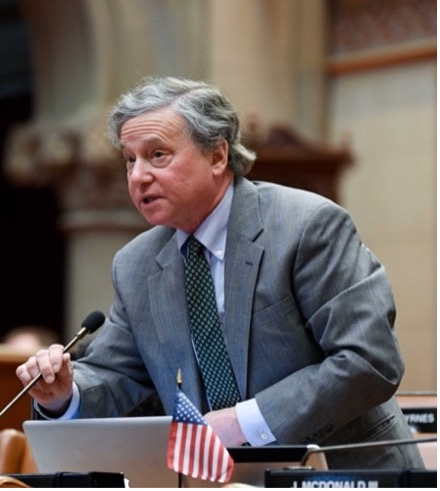
Asm. Steve Otis
Sponsored bills
Provides that an accusatory instrument or supporting deposition consisting of factual allegations by a deponent with limited English proficiency is not sufficient unless accompanied by a sworn statement from an interpreter affirming the accuracy of the English interpretation.
Maddy summaryThis bill amends New York's environmental conservation law to define "coal tar" for pavement products. It specifies that coal tar is a thick liquid from coal distillation containing polycyclic aromatic hydrocarbons (PAHs) above 1,000 milligrams per kilogram. The definition explicitly includes certain residues like ethylene or steam cracked residues. This change directly affects manufacturers and suppliers of pavement materials using coal tar, as it sets a clear regulatory threshold for PAH levels. The bill was advanced to third reading in April 2025 but was later substituted by S3179.
Maddy summaryThis bill directs New York's Department of Environmental Conservation (DEC) to establish air quality standards for specific harmful pollutants like benzene, mercury, and formaldehyde by December 2027. It requires major pollution sources (factories emitting 10+ tons/year of toxic pollutants) to include these standards in their permits starting in 2028 and mandates fenceline monitoring near disadvantaged communities. The law ensures standards are based on health science and considers community proximity to pollution sources, directly affecting industrial facilities and communities near them.
Provides additional protections for sensitive health information; requires all health information networks, electronic health record systems, and health care providers to provide patients with a right to restrict the disclosures of such patient's health information; defines terms; provides for exceptions.
Prohibits the idling of any passenger vehicle, with certain exceptions, for more than 3 consecutive minutes; establishes the first violation is a warning and subsequent violations of such section are traffic infractions punishable by a fine of $150.
Waives the state's sovereign immunity in state and federal courts with regard to liability for violations of the Americans with Disabilities Act of 1990, the Fair Labor Standards Act, the Age Discrimination in Employment Act, and the Family and Medical Leave Act; waives the immunity of all instrumentalities and political subdivisions of the state.
Maddy summaryThis bill requires owners of large commercial vessels, specifically those 500 feet or longer, to create and submit whale strike prevention policies before entering the marine and coastal district. The legislation mandates that these policies include specific measures such as speed reductions, crew training, and the use of technology to avoid harming whales, while also requiring annual reviews and compliance checks by state agencies. Owners who fail to establish or maintain a compliant policy face fines ranging from $1,000 to $10,000 per violation, with additional daily penalties for continued non-compliance. The act ensures that these new safety requirements do not override existing federal or local speed restrictions and takes effect 180 days after becoming law.
Maddy summaryThis bill prohibits the sale of medical adhesives and bandages containing PFAS (perfluoroalkyl and polyfluoroalkyl substances) in New York State after December 31, 2026. It directly affects manufacturers and sellers of these medical products, requiring them to ensure their items contain no intentionally added PFAS or PFAS above a feasible, regularly reviewed threshold. Sellers must obtain written compliance certificates from manufacturers confirming PFAS-free products, and violations carry civil penalties up to $2,500 per day of noncompliance. The law focuses on concrete regulatory changes for medical products, excluding FDA-regulated devices from its scope.
Requires the chair of the public service commission create rules, regulations, policies, and procedures for the creation of a resilient electric vehicle charging system pilot program to provide power through an extended outage.