

Enacts the "beauty justice act"; provides for the regulation of ingredients in personal care products and cosmetics; prohibits the sale of personal care products and cosmetic products containing certain restricted products.
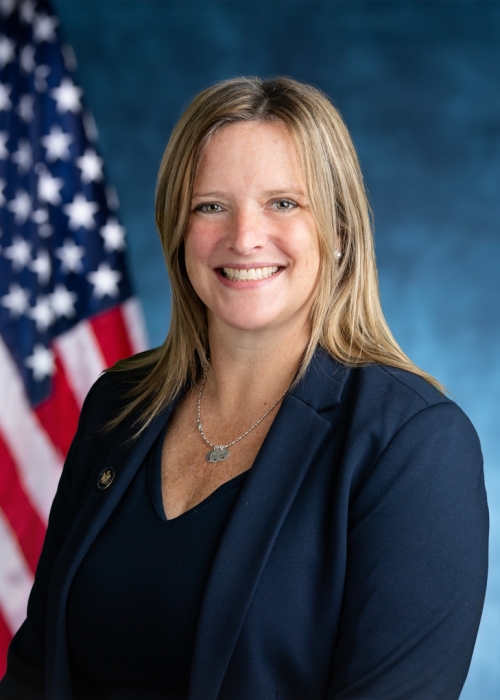
Asm. Sarah Clark
Sponsored bills
Maddy summaryThis bill requires New York State to install electric vehicle (EV) charging stations at state-owned parking facilities with 50+ spaces. Facilities with 50-200 spaces must provide charging for at least 10% of spaces (or equivalent electrical capacity), while larger facilities (over 200 spaces) must provide for 20%. All stations must meet minimum electrical specs (40 amps, 208 volts) and comply with local electrical codes. The Office of General Services will handle installation, maintenance, and necessary electrical upgrades, with contracted work requiring prevailing wages. The law takes effect April 1st after enactment.
Maddy summaryBill A 3026 redirects fines and penalties from environmental conservation law violations (such as those under titles 19, 21, and 27 of the environmental conservation law) into a dedicated "conservation enforcement account" within the state conservation fund. It affects environmental law enforcement officers and the Department of Environmental Conservation by requiring all such fines to fund enforcement activities like staffing, scientific work, and legal support. The bill mandates that these funds must supplement - rather than replace - existing enforcement budgets and requires annual expenditure reports to legislative leaders. Courts collecting fines must remit payments directly to this account, streamlining how penalty revenue supports environmental protection efforts.
Enhances know your customer requirements and responsible gaming procedures; relates to the opening and closing of an authorized sports bettor's account; prohibits an authorized sports bettor from allowing another person to access such bettor's account; allows a bettor who does so to be designated a prohibited bettor; provides for the disposition of revenues from violation fines.
Establishes an educator development workforce for the purpose of contracting with EDHUBNY, a nonprofit organization, for support of New York's child serving and educator workforce; authorizes the workforce to contract with EDHUBNY including performance measures, reporting requirements, and fiscal controls; authorizes collaboration with other state agencies; provides for an appropriation of $50 million.
Expands the type of certifications that may be accepted by the state of New York for restricted licenses; requires individuals may only perform toxicology testing in a laboratory authorized by the state of New York.
Maddy summaryThis bill requires certain alcohol-serving establishments to provide tap water to customers upon request at no cost. It applies to retail licensees for on-premises consumption, with exceptions for corporations operating vessels, railroad cars, or aircraft on regularly scheduled flights by certified U.S. airlines. The water must meet all federal and state purity standards and be served in a container of at least eight ounces per serving. The law will take effect 30 days after it becomes official.
Maddy summaryThis bill requires most health insurance plans issued after 2020 to cover contraceptive services provided by pharmacists without cost-sharing. It mandates coverage for all FDA-approved contraceptives (including over-the-counter options), emergency contraception, patient counseling, and follow-up care, with pharmacists receiving administrative fees at least at Medicaid rates. Plans must allow dispensing up to 12 months of contraceptives at once and cover alternative versions if preferred options aren’t available or medically unsuitable. This directly affects insured individuals seeking contraceptive care and insurers offering comprehensive health coverage.
Maddy summaryThis bill requires sellers to provide lead-based paint test reports to buyers before selling residential properties built before 1978. It directly affects home sellers, buyers, and real estate agents in New York for properties constructed prior to 1978, which are most likely to contain lead paint. The key mechanism mandates a one-time inspection and disclosure of test results before title transfer, with reports added to a state registry for future buyers. This complements existing laws by standardizing disclosure across all residential sales, not just rentals, ensuring buyers receive clear information about potential lead hazards. The law does not replace buyer due diligence or existing seller responsibilities.
Renames the block grant for child care to the early childhood fund; requires the office of children and family services administer such fund; expands who qualifies for guaranteed child care assistance.