

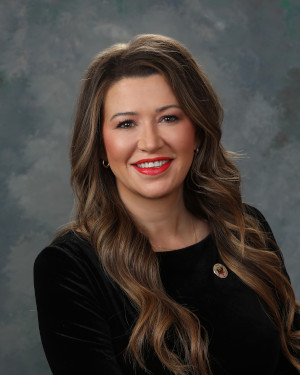
Maddy summarySB 51 would appropriate $3 million from the state general fund to improve communication infrastructure, specifically cellular and radio towers, in Dona Ana, Hidalgo, and Luna counties. The funds would be managed by the Department of Finance and Administration's Local Government Division for use in fiscal year 2026, with any unspent balance reverting to the state treasury. The bill was referred to committees, passed with amendments, but was postponed indefinitely on June 3, 2025, meaning it did not advance to become law.
Sponsored bills
Maddy summarySB 129 creates a tax credit for New Mexico railroads to offset costs for infrastructure improvements. It allows eligible railroads (classified as Class 2 or 3 by federal regulators, or owners of rail spurs in NM) to claim a 50% credit on qualified reconstruction/replacement costs (capped at $5,000 per mile of track) or new rail infrastructure projects (capped at $1 million per new customer project). To claim the credit, railroads must first get certification from the Department of Transportation, which limits annual credits to $6 million total. The credit can be carried forward if unused or transferred to another business, but it only applies to state tax liability and excludes federally funded projects.
Maddy summaryNew Mexico's Senate Joint Resolution 5 (SJR 5) requests Congress to call a constitutional convention under Article V of the U.S. Constitution. The resolution seeks to propose amendments that would impose fiscal restraints on federal spending, limit the federal government's power and jurisdiction, and establish term limits for federal officials and members of Congress. This application, formally submitted by New Mexico's legislature, remains active until two-thirds of states apply for the same purpose. The bill directly affects the federal legislative process by initiating a state-level application for constitutional change, though it does not alter current laws or directly impact New Mexico residents.
Maddy summaryHB 4 updates New Mexico's criminal competency laws to better connect defendants found incompetent to stand trial with mental health treatment. It requires competency evaluation reports to include a professional's opinion on whether a defendant qualifies for involuntary commitment or assisted outpatient treatment, and mandates courts to consider community-based restoration programs for non-dangerous defendants. The bill expands the list of serious crimes that can trigger involuntary treatment decisions (like firearm offenses or child abuse) and allows courts to advise prosecutors to initiate mental health proceedings after dismissing a criminal case. These changes directly affect defendants in criminal cases determined incompetent, aiming to streamline access to treatment while maintaining judicial oversight.
Maddy summarySB 25 increases penalties for selling or trafficking large quantities of fentanyl in New Mexico. It specifically enhances the basic prison sentence by three years when a court finds that one kilogram or more of fentanyl was sold or trafficked under existing drug laws. This change directly affects individuals convicted of large-scale fentanyl distribution, targeting the most severe cases. The bill modifies sentencing guidelines without altering the underlying criminal statutes.
Maddy summarySB 472 would allow New Mexico cities and counties to authorize off-highway vehicles (like ATVs and recreational dirt bikes) to operate on paved streets and highways within their boundaries, subject to specific safety requirements. To operate under this authorization, vehicles must have headlights, taillights, brakes, mirrors, and mufflers, while operators must hold valid licenses, insurance, and eye protection (with helmets for riders under 18). The bill requires local governments to establish speed limits and operating rules for these vehicles and ensures operators follow standard traffic laws except where conflicting with OHV-specific rules. This directly affects local governments (which can approve usage) and OHV owners/operators who wish to use paved roads.
Maddy summarySB 307, the Child Ombud Act, creates a new Office of Child Ombud within New Mexico's court system to independently review child welfare services. The ombud, appointed by a nine-member committee with child welfare expertise, will investigate complaints about the state's child welfare department, review policies protecting children's rights, and operate a toll-free hotline for families. Key provisions include requiring the ombud to investigate cases involving children in state custody, provide annual reports to lawmakers, and compile data on fatalities or near-fatalities. This office directly affects children in state custody, families receiving child welfare services, and the state department responsible for child protection.
Maddy summarySB 87 prohibits New Mexico state or local governments from adopting laws, ordinances, rules, or regulations that restrict the use of personnel or resources to assist federal immigration enforcement or interfere with such enforcement. It directly affects counties, cities, and state agencies by preventing them from passing policies that limit cooperation with federal immigration authorities. The key provision bans any local or state measure that would block officials from using staff or funding to support federal immigration enforcement efforts. This bill does not change federal immigration law but aims to remove state-level barriers to federal enforcement coordination.
Maddy summarySB 291 would expand the enforcement authority of conservation officers and state parks law enforcement officers in New Mexico. The bill specifically allows these officers to enforce certain sections of the Criminal Code (like criminal trespass and resisting officers), Motor Vehicle Code, and Boat Act while on duty, in addition to existing game and fish laws. This directly affects conservation officers and state parks officers by broadening their legal powers to address violations beyond wildlife enforcement, such as camping restrictions near water or vehicle-related offenses. The bill does not create new laws but clarifies that these officers can enforce existing provisions of these codes during their official duties.
Maddy summaryHB 515 appropriates $1.5 million from the state general fund to the Board of Regents of Western New Mexico University (WNMU) to create and support a men's baseball program during fiscal years 2026 and 2027. Any unspent funds at the end of 2027 would revert to the general fund. The bill, introduced by Representatives Terrazas, Ramos, and Brantley, was referred to committees but was postponed indefinitely on June 3, 2025. This is a funding measure for a specific university sports program, not a policy change affecting broader public interests.