

Maddy summaryHB 336 allows retired state employees who were peace officers to return to state work without the usual 12-month waiting period required for most retirees. Specifically, it amends retirement rules to exempt retired peace officers from the standard waiting period when rejoining the state as employees with peace officer powers. During reemployment, their pension is suspended but resumes upon leaving the position. This change directly affects retired peace officers employed by the state who wish to return to roles involving law enforcement authority. The bill updates existing retirement provisions without altering pension benefits or creating new financial obligations.
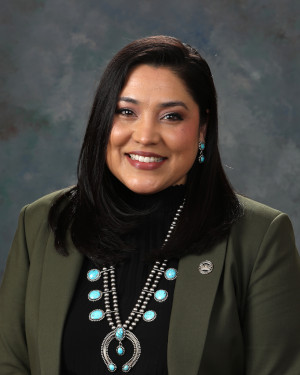
Rep. Paulene Abeyta
Sponsored bills
Maddy summaryThis non-binding House Memorial (HM 37) affirms New Mexico's commitment to protecting Mount Taylor as a sacred cultural site for Indigenous nations, particularly the Pueblos of Acoma and Laguna. It opposes uranium mining projects that threaten the mountain's cultural integrity and water sources, citing risks of aquifer contamination and environmental damage. The memorial urges state and federal agencies to deny mining permits within the designated cultural property area and calls for federal reform of the 1872 Mining Act to prioritize tribal consultation.
Maddy summarySB 41 creates a "Turquoise Alert System" to rapidly share information about missing enrolled members or eligible members of federally recognized American Indian tribes, pueblos, or nations in New Mexico. The bill requires the Department of Public Safety to develop a plan for issuing these alerts, including notifying law enforcement, media, and cellular providers through existing emergency alert systems. It mandates specific record-keeping for each alert, tracking details like the person's age, gender, and recovery date. This system directly affects tribal communities and law enforcement agencies responsible for implementing the alerts, while distinguishing this category from existing "Silver" (elderly/dementia) or "Brittany" (developmental disability) alerts.
Maddy summaryThis House Memorial (HM 15) urges the U.S. Congress to support expanded federal compensation for people exposed to radiation through nuclear weapons testing or uranium mining. It specifically calls for backing Senate Bill 243, which aims to extend the deadline for claims and broaden eligibility under the existing Federal Radiation Exposure Compensation Act (RECA). The memorial highlights that current RECA rules exclude many affected individuals, including those working in uranium mining after 1972 or living downwind outside designated areas like Arizona and Utah. It directly concerns communities in New Mexico, the Navajo Nation, and other Western states impacted by historical nuclear activities.
Maddy summarySB 163 prohibits New Mexico public and charter schools from banning students enrolled in or eligible to enroll at federally recognized tribes, pueblos, or nations from wearing tribal regalia at graduation ceremonies and other school events. The bill amends existing school discipline policies to explicitly state that schools cannot restrict "tribal regalia" - defined as traditional dress, symbols, jewelry, beading, or feathers - along with graduation attire or as part of cultural expression. It directly affects Native American students in New Mexico public schools by protecting their right to display cultural items during formal school activities. The law clarifies that such protections are part of broader anti-discrimination policies already in place for students' cultural and religious expression.
Maddy summaryHB 5 creates a new independent Office of Child Advocate in New Mexico to oversee child welfare services. It establishes a State Child Advocate position appointed by the governor (with a six-year term), selected by a nine-member committee with diverse expertise including foster care experience and Indian Child Welfare knowledge. The office will review services provided to children in foster care, group homes, or juvenile facilities, handle complaints via a toll-free hotline, and ensure policies protect children's rights. The bill was enacted after passing the legislature and being signed into law on March 21, 2025.