

Maddy summaryHB 44 (Dental & Dental Hygienist Compact) proposes to create a multi-state agreement allowing licensed dentists and dental hygienists from New Mexico to practice in other participating states without obtaining separate licenses. It establishes a "compact privilege" that would let qualified professionals work temporarily in other member states, reducing duplicative licensing requirements. The bill also requires state and federal criminal background checks for license applicants, as amended in the Dental Health Care Act. This aims to improve access to dental care, address workforce shortages, and facilitate mobility for military members and their families. The bill is currently under review by the House Health & Human Services and Judiciary Committees.
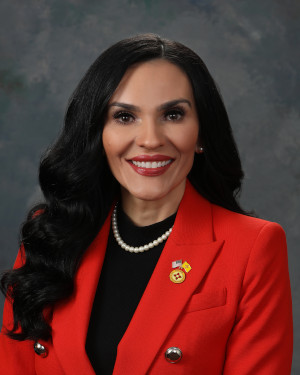
Rep. Elaine Sena Cortez
Sponsored bills
Maddy summaryHB 65 creates a three-year pilot program in seven New Mexico counties (Dona Ana, Chaves, San Juan, McKinley, Bernalillo, Santa Fe, and Eddy) to improve stability for children in state custody. It provides in-home or home-like placements with enhanced services - including 24-hour crisis support, weekly therapy, parent training, and monthly family sessions - to reduce placement disruptions. The program prioritizes children with frequent placement history, behavioral health needs, or risk of disruption, and includes specialized incentives for foster homes caring for adolescents, siblings, or those needing short-term stabilization. The state appropriates $2.5 million to fund the program through fiscal year 2029, requiring collaboration between the Children, Youth and Families Department and Health Care Authority.
Maddy summaryHB 160 creates a new "All Cities and Counties Fund" in New Mexico's state treasury to distribute a portion of gross receipts tax revenue to municipalities (cities/towns) and counties. The bill requires 8% of eligible tax revenue to be transferred into this fund, with annual distributions calculated using a formula based on each municipality's or county's population and their share of state tax revenue. Transfers are scheduled to begin on November 1, 2027, and annually thereafter, directly affecting all cities and counties across New Mexico. The fund aims to provide ongoing financial support to local governments based on population data and tax contributions.
Maddy summaryHB 266 increases penalties for sexual exploitation of children in New Mexico by elevating certain offenses to higher felony levels (e.g., changing some fourth-degree felonies to third-degree) and adding mandatory minimum sentences when children under 13 are involved. It also clarifies that consent from children aged 14-18 does not exempt possession of depictions if the child voluntarily created or produced them, but does not cover coerced content. Separately, the bill raises the interest rate on delinquent child support from 4% to 6.5% annually. These changes directly affect individuals who possess, distribute, or create child exploitation materials, and those who fail to pay court-ordered child support. The bill aims to strengthen legal consequences for these offenses without altering existing protections for victims.
Maddy summaryHB 207 requires New Mexico's Water Quality Control Commission to create specific rules allowing the reuse of treated water generated from oil and gas operations (called "produced water"). This bill directly affects oil and gas operators, water treatment facilities, and entities seeking to use this treated water for purposes like irrigation or industrial processes. The key mechanism is mandating the Commission to develop these rules, which must be based on scientific data and consider water quality protection, while ensuring the rules align with existing legal authority under the Water Quality Act. The bill does not specify the exact permitted uses but sets a process for the Commission to establish them.
Maddy summaryHB 259 creates a process for optional actuarial reviews of New Mexico health care bills that could change insurance coverage requirements. The Legislative Finance Committee must hire qualified contractors to analyze proposed bills, estimating impacts like affected residents, premium changes, and cost shifts for consumers and health insurers. Legislators can request up to two reviews per party per chamber annually, with reports published online by January 1 each year. The bill appropriates $100,000 for this purpose in fiscal year 2027, focusing on data-driven analysis rather than altering coverage directly.
Maddy summaryHB 80 increases funding for New Mexico's Oil and Gas Reclamation Fund by raising the tax distribution percentage from 2/19% to 50% starting July 2027, gradually increasing to 100% through 2037 before returning to 50% after 2037. The bill directly affects oil and gas operators (through higher tax contributions) and the state's energy department (which administers the fund). Key provisions include expanding fund use to cover energy education programs ($150,000 annually) and requiring the department to plug abandoned wells, restore sites, and pursue cost recovery from operators. Funds will be managed under the Energy, Minerals and Natural Resources Department with annual reporting requirements.
Maddy summaryHB 275 would establish a 0% flat individual income tax rate for New Mexico residents, effective for tax years beginning January 1, 2026. The bill eliminates the requirement for residents to file personal income tax returns (though filing remains optional), modifying existing tax code sections to remove all tax brackets and filing obligations. It directly affects all New Mexico residents who currently file state income tax returns, including individuals, married couples, and heads of household. The key provision replaces all existing tax brackets with a zero tax rate and removes the mandatory filing requirement under Section 7-2-12. The bill was referred to committees but was postponed indefinitely on June 3, 2025.
Maddy summaryHJR 17 proposes a constitutional amendment to limit New Mexico governors' emergency powers. It would require any state of emergency declaration issued by the governor to automatically end after 90 days unless the legislature passes a joint resolution extending it with a three-fifths vote in both chambers. The bill also gives the legislature authority to call itself into session to extend, modify, or terminate emergency declarations. This change would directly affect governors' emergency authority and the legislature's role in overseeing prolonged emergencies. The amendment must be approved by voters after legislative passage, as it amends the state constitution.
Maddy summaryHB 293 would remove income limits for New Mexico residents claiming an exemption on Social Security income under state tax law. Currently, the exemption is capped at $75,000 for married individuals filing separately, $150,000 for joint filers, and $100,000 for single filers. The bill eliminates these caps, allowing all Social Security income to be exempt from state income tax regardless of total earnings. This change would directly affect higher-income Social Security recipients (e.g., retirees) who currently face partial taxation on their benefits. The amendment applies to tax years beginning January 1, 2025.