

Maddy summaryThis bill requires New Mexico's Oil Conservation Division to review and act on applications for produced water disposal well permits within strict timeframes. Within 30 days of receiving an application, the division must determine if it's complete and notify the applicant; if incomplete, the applicant gets up to two 30-day opportunities to fix it, restarting the review clock each time. Once an application is deemed complete, the division must grant, conditionally grant, or deny the permit within 15 days, or the permit is automatically approved. The bill directly affects oil and gas companies seeking these permits and the state agency managing the permitting process.

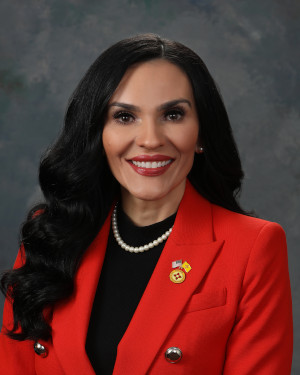
Rep. Elaine Sena Cortez
Sponsored bills
Maddy summaryHB 33, the Psychology Interjurisdictional Compact, would allow licensed psychologists in New Mexico to provide telepsychology services across state lines and offer up to 30 days of in-person practice annually in another participating state without needing a separate license. It establishes mutual recognition of licenses between states that adopt the compact, enabling psychologists to serve clients in other states while ensuring public safety through shared disciplinary records. The compact directly affects licensed psychologists seeking to expand practice across state lines and clients in states with limited local mental health providers. Key mechanisms include standardized telepsychology authorization, temporary in-person practice limits, and a coordinated system for sharing license and disciplinary information among participating states.
Maddy summaryHB 45, the Physician Assistant Licensure Compact, would allow physician assistants licensed in one participating state to practice in other participating states without obtaining separate licenses. It creates a shared data system for states to track license status and disciplinary actions, and requires that physician assistants follow the laws of the state where the patient is located during care. The bill directly affects physician assistants, particularly military families who can more easily practice across state lines with one license, and state licensing boards that must adopt the compact's standards. If enacted, it would streamline licensure for medical professionals while maintaining patient safety through mutual recognition of licenses.
Maddy summaryHB 32 creates the Counseling Licensure Compact, allowing licensed professional counselors in participating states to practice across state lines without obtaining separate licenses. It directly affects licensed counselors and their clients in member states, enabling them to provide in-person or telehealth counseling services where the client is located. Key provisions include mutual recognition of licenses, sharing of disciplinary records between states, and requiring counselors to follow the practice laws of the state where the client is located. The compact also specifically supports military spouses relocating with active-duty service members. This bill does not change existing state licensure requirements but streamlines interstate practice for qualified counselors.
Maddy summaryHB 143 expands tax credits for healthcare providers working in New Mexico's rural underserved areas. It increases the rural health care practitioner tax credit to $15,000 annually for physicians/dentists/optometrists (requiring 1,584+ hours of service) and $9,000 for other providers like nurses, pharmacists, and therapists. The bill also creates a new Medical Residency Loan Repayment Act to award loan repayment assistance to qualifying medical residents and fellows. These provisions directly target healthcare professionals in rural communities to improve provider recruitment and retention.
Maddy summaryHB 161 adjusts how New Mexico school districts calculate funding for "K-12 plus schools" - those offering more than 1,140 instructional hours annually (1,195+ hours for extended calendars). It modifies the formula to award higher funding rates (16 thousandths vs. 12 thousandths) for schools exceeding 1,195 instructional hours, based on actual hours and days taught. This directly affects school districts operating extended-calendar programs, changing how they receive state funding for those schools. The bill requires districts to submit student participation data by October 15 annually for the next school year’s funding calculations.
Maddy summaryHB 93 increases New Mexico's standard income tax deduction to 205% of the federal standard deduction amount. This change directly affects individual taxpayers who file state income taxes and claim the standard deduction instead of itemizing deductions. The bill amends the state's tax code to adjust "net income" calculations by expanding the deduction, lowering taxable income for qualifying filers. This policy change would reduce the state income tax liability for eligible taxpayers without requiring them to itemize expenses. The bill is currently pending referral to relevant legislative committees.
Maddy summaryHB 72 makes it a crime for anyone 18 or older to intentionally give Schedule I or II controlled substances (like certain narcotics or methamphetamine) to a person under 18. It increases penalties for this offense, classifying first-time violations involving these specific drugs as a first-degree felony, while other Schedule I-IV drugs carry a second-degree felony for a first offense. The bill targets distributors who supply dangerous substances to minors, with harsher penalties for narcotics, methamphetamine, or their analogs. This law directly affects adults distributing such substances to minors in New Mexico, changing sentencing under existing criminal code.
Maddy summaryHB 240 creates the Education Opportunity Account Act, allowing eligible New Mexico students (residents without a high school diploma or equivalent) to access state-funded accounts for education expenses. The program deposits state funds - calculated based on average public school spending per grade, adjusted for special needs - into accounts managed by the state education department. Parents can use these funds for approved costs at qualifying private schools (not online schools), tutoring, textbooks, assessments, and transportation, but funds cannot be refunded to families and unspent balances revert to the state treasury after two years or upon graduation. The bill specifies strict usage rules, prohibits personal deposits into accounts, and requires annual contracts detailing approved expenses.
Maddy summaryHB 92 would expand New Mexico's tax exemption for Social Security income, directly benefiting seniors whose primary income comes from Social Security. The bill phases in higher tax exemptions over time: starting at 20% for 2026-2027, increasing to 40% (2028-2029), 60% (2030-2031), 80% (2032-2033), and reaching 100% by 2034. It sets income thresholds: $75,000 for married filing separately, $150,000 for joint filers, and $100,000 for single filers. The bill is currently pending before the House Commerce & Economic Development and Taxation & Revenue Committees.