

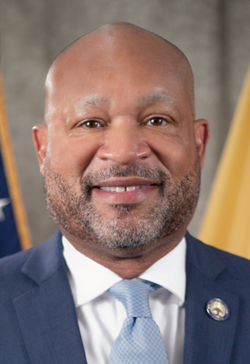
Photo of Benjie Wimberly
D New Jersey Senate · District 35

Sen. Benjie Wimberly

Compare
Total votes
3,724
all sessions
Attendance
90%
284 missed
Higher than 88% of chamber peers
With party
100%
of cast votes
Higher than 75% of chamber peers
Bipartisan score
0%
crosses aisle rarely
Lower than 78% of chamber peers
Sponsored
1,744
bills & resolutions
Near the chamber average
Committees
2
assignments
1,744 bills and resolutions

Sponsored bills

Total
1,744
Primary
1,154
Co-sponsor
590
This page
1,744
matching current filters
Primary S 1444
In committee · New Jersey Senate · Lead sponsor
Prohibits sewerage authority from imposing connection fee in certain circumstances.

Maddy summaryThis bill prohibits New Jersey sewer authorities from charging new connection or tapping fees when redeveloping properties that have been connected to the sewer system for 20 or more years. It directly affects property owners and occupants of such long-connected properties during redevelopment projects. The law includes an exception if the redevelopment requires modifying or relocating existing sewer connections. Authorities must also refund fees paid under protest for improper charges before this law took effect. The bill takes immediate effect upon enactment.

In committee Nov 10, 2025 0 co-sponsors
Primary S 3915
In committee · New Jersey Senate · Lead sponsor
Requires municipalities to share certain payments in lieu of property taxes with school districts; informs counties, school districts, and DCA of certain information related to property tax exemptions and abatements.

Maddy summaryThis bill requires municipalities to share certain payments in lieu of property taxes (PILOTs) with school districts when urban renewal projects benefit from long-term property tax exemptions. For residential projects, municipalities must remit to school districts an amount calculated by multiplying the number of school-age children residing in the project by the base per pupil amount determined by the Commissioner of Education. For nonresidential or mixed-use projects, school districts would receive 5% of the PILOT amount. The bill also mandates that municipalities provide the Department of Community Affairs, counties, and school districts with information about property tax exemptions and abatements, including applications, approvals, and annual audits.

In committee Nov 10, 2025 0 co-sponsors
Primary S 4736
In committee · New Jersey Senate · Lead sponsor
Enhances ability of religious and nonprofit organizations to convert certain property to inclusionary developments with affordable housing.

Maddy summaryS 4736 allows religious and nonprofit organizations to convert their nonresidential properties into housing developments that include affordable units without needing special zoning variances. The bill requires that at least 20% of the residential units be reserved as affordable housing, with specific breakdowns: at least 50% of those units must be low-income, and at least 13% of the low-income units must be very-low income. Municipalities must approve such conversions as a permitted use if they meet zoning requirements and affordability standards, and projects can be built at up to 40 units per acre with one additional story above standard height limits. The bill also ensures these developments qualify for long-term tax exemptions under New Jersey's tax law.

In committee Oct 27, 2025 0 co-sponsors
Co-sponsor S 2783
Signed into law · New Jersey Senate · Co-sponsor
"Travel Insurance Act."

Maddy summaryThe Travel Insurance Act (S 2783) establishes a regulatory framework for travel insurance in New Jersey, defining key terms and setting requirements for how travel insurance must be sold and marketed. It creates licensing requirements for travel insurance producers and retailers, mandates clear disclosure of coverage details to consumers, and specifies that travel insurance must be classified under inland marine or accident and health insurance. The bill requires travel retailers to provide detailed information about coverage, prohibits misleading marketing practices like marketing blanket insurance as "free," and sets rules for cancellations and refunds. This legislation directly affects travel insurance companies, travel retailers, and consumers purchasing travel insurance in New Jersey.

Signed into law Oct 20, 2025 1 co-sponsor
Primary S 4720
In committee · New Jersey Senate · Lead sponsor
Creates certain requirements for certain earned income access services and related provider contracts.

Maddy summaryS 4720 creates a regulatory framework for "earned income access services" in New Jersey, which allow workers to access earned but unpaid wages before their regular payday. The bill requires service providers to obtain a license from the Department of Banking and Insurance, verify workers' earned income, and deliver funds before the employer's scheduled payment date while withholding the amount from the next paycheck. It prohibits providers from charging interest or usurious fees (treating fees as interest only if structured as a rate over time), mandates clear consumer disclosures, and requires annual reporting on revenue and transactions. The bill directly affects workers who use these services and the providers who offer them, with the Department of Banking and Insurance responsible for enforcement.

In committee Oct 20, 2025 0 co-sponsors
Primary S 4728
In committee · New Jersey Senate · Lead sponsor
Dedicates 50 percent of revenues collected from additional fees and taxes imposed on real property transfers valued over $1 million to Affordable Housing Trust Fund.

Maddy summaryThis bill redirects 50% of revenue from two specific taxes on high-value real estate transactions to New Jersey's Affordable Housing Trust Fund. It affects sellers of residential, commercial, or farm property (or controlling interests in commercial entities) transferring property valued over $1 million, who currently pay additional fees and taxes. Under the bill, 50% of the revenue from these taxes - currently deposited into the General Fund - would instead fund affordable housing programs through the Trust Fund, as specified in existing law. The policy change requires the state to annually allocate this portion to housing initiatives without altering the tax rates or thresholds.

In committee Oct 20, 2025 0 co-sponsors
Co-sponsor A 4544
Signed into law · New Jersey General Assembly · Co-sponsor
Expands eligibility requirements of State's child care assistance program to include full-time graduate and post-graduate students.

Maddy summaryThis bill expands New Jersey's child care assistance program to include full-time graduate and post-graduate students who meet income, asset, and residency requirements and are enrolled full-time in good academic standing at a public or private college or university. Currently, the program covers only full-time undergraduate students pursuing associate's or bachelor's degrees. The state must update its eligibility rules and seek federal funding through the Child Care and Development Block Grant to cover the costs of this expansion. This change directly affects graduate and post-graduate students who are parents and rely on the program for child care support.

Signed into law Oct 1, 2025 1 co-sponsor
Co-sponsor A 1675
Signed into law · New Jersey General Assembly · Co-sponsor
Extends membership in TPAF to 10 years after discontinuance of service and to 15 years for those who were laid off or had 10 or more years of continuous service upon voluntary termination.*

Maddy summaryThis bill extends the time teachers can be away from service while maintaining membership in New Jersey's Teachers' Pension and Annuity Fund (TPAF). It increases the standard discontinuance period from two to seven years, and extends the return-to-service window to 25 years for teachers who were laid off or voluntarily left with 10 or more years of service. Teachers returning within these extended timeframes will be re-enrolled in the TPAF at their previous tier with no additional contributions required. The changes apply to all current and future TPAF members who meet the specified conditions.

Signed into law Oct 1, 2025 1 co-sponsor
Co-sponsor A 2929
Signed into law · New Jersey General Assembly · Co-sponsor
Requires disclosure of lead drinking water hazards to tenants of residential units; prohibits landlords from obstructing replacement of lead service lines; concerns testing of certain property for lead drinking water hazards.*

Maddy summaryThis bill requires landlords in New Jersey to disclose lead drinking water hazards to tenants before lease agreements, including information about lead service lines, building construction dates (pre-1986 properties may contain lead), and recent lead exceedance notices. Landlords must provide a standardized disclosure statement within 90 days of the bill's effective date, with exemptions for newer buildings (post-1986), lead-safe properties, and seasonal rentals. Tenants can request free lead testing from water systems, which must test annually upon request (or every 60 days if lead levels exceed standards), and landlords cannot obstruct replacement of lead service lines - tenants may terminate leases without penalty if obstruction occurs. Violations carry fines up to $1,000 for repeated non-compliance.

Signed into law Sep 19, 2025 1 co-sponsor
Co-sponsor A 2390
Signed into law · New Jersey General Assembly · Co-sponsor
Requires municipalities in compliance with affordable housing obligations be provided priority consideration for certain State grants and assistance.

Maddy summaryThis bill requires New Jersey's Department of Community Affairs (DCA) and Economic Development Authority (EDA) to give priority consideration to municipalities that meet their state-mandated affordable housing requirements when awarding competitive grants through programs like Main Street New Jersey and Neighborhood Preservation. It specifies that compliance is determined by factors such as past housing obligation fulfillment, settlement agreements, or builder's remedy use in the prior housing obligation round (for the first five years), shifting to current-round fulfillment after that. The priority does not apply to grants specifically intended to help municipalities meet their housing obligations. Exempt municipalities (those not subject to housing requirements) automatically qualify for priority consideration.

Signed into law Sep 11, 2025 1 co-sponsor
Showing 371 to 380 of 1,744 bills
Previous 1 … 37 38 39 … 175 Next