

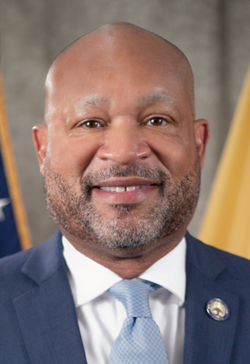
Maddy summaryThis bill establishes New Jersey's "John R. Lewis Voter Empowerment Act," which sets new standards to protect voting rights. It requires courts to interpret election laws liberally in favor of voters, particularly protecting racial, color, and language-minority groups (defined as "protected classes"), ensuring their equal access to voting and registration. The Attorney General is designated as the chief enforcer to investigate violations, issue guidance, and litigate cases related to voting rights under this law. Key provisions include prohibiting unnecessary voting barriers and mandating that election policies be narrowly tailored to serve compelling government interests.
Sponsored bills
Maddy summaryThis bill (S 451) prohibits landlords and property management software from using algorithmic systems to coordinate rental pricing and supply, which the legislature states has contributed to New Jersey's housing affordability crisis. It defines a "coordinator" as any service (including software) that collects pricing data from multiple landlords, analyzes it with algorithms, and recommends rental prices or lease terms - effectively enabling price-fixing. Landlords are banned from subscribing to such services, and coordinators are prohibited from facilitating agreements that restrict competition among rental property owners. The law directly affects landlords, property management companies, and software providers operating in New Jersey's rental market, aiming to increase price competition and reduce rent burdens for renters.
Maddy summaryNew Jersey's S 2141 bans businesses from owning, operating, or selling cryptocurrency ATMs within the state. The bill defines a cryptocurrency ATM as a physical kiosk that allows users to buy, sell, or exchange digital currency using cash, debit, or credit cards. Violations would result in fines up to $20,000 per offense, with enforcement under the state's consumer fraud laws. This action responds to Federal Trade Commission data showing crypto ATM scams caused over $65 million in fraud losses in the first half of 2024, disproportionately affecting older adults.
Maddy summaryS 2617 establishes the Council for Community Recovery and Family Success to develop a statewide initiative focused on improving outcomes for infants, children, youth, and families in New Jersey. The council, composed of 25 members including state agency heads and appointed community representatives, will coordinate services across departments and advocate for a State Bill of Rights for Children based on UN standards. It will identify gaps in preventive services and develop strategies across four key areas: family relationships, financial security, education, and health. The bill appropriates $4.0 million to fund the council’s operations and its work plan. This is a procedural bill creating a new oversight body, not a direct policy change affecting specific programs.
Maddy summaryS 2338, the "Climate Superfund Act," imposes strict liability on fossil fuel companies responsible for over one billion metric tons of covered greenhouse gas emissions during 1995-2026 (the "covered period"). It requires these companies to pay compensatory damages into a state fund managed by the Department of Environmental Protection (DEP). The collected funds will finance climate change adaptation projects - such as flood protection, infrastructure upgrades, and heat-resilient housing - as defined in the bill. This legislation directly affects major fossil fuel extraction and refining entities operating in New Jersey during the covered period, establishing a new cost recovery program without requiring proof of negligence.
Maddy summaryThis bill allows parents in New Jersey to request additional court-ordered parenting time if their scheduled visits were interrupted by investigations into unsubstantiated child abuse, neglect, or related custody issues. Under the new rules, the Superior Court must grant this compensatory time unless a judge determines it is not in the child's best interest, provided the investigation did not result in a finding of abuse or neglect. The replacement time must match the original schedule in type and duration, occur within two years of the denial, and be selected by the affected parent. Additionally, the legislation clarifies that these provisions do not create civil liability for investigative agencies or their employees.
Maddy summaryThis bill modifies how New Jersey school districts calculate the tax levy limits for preschool education aid, specifically targeting districts that operate pilot programs or are newly receiving such funding. It establishes a formula that allows districts to raise taxes to cover local shares of preschool costs by accounting for increases in student enrollment, healthcare expenses, and pension contributions beyond set thresholds. The legislation also includes specific rules for districts with low tax levies and those participating in pilot programs starting in the 2027-2028 school year. Ultimately, the act updates existing state laws to provide clearer guidelines on how much local funding districts can generate to support preschool education.
Maddy summaryThis bill makes a temporary community crisis response team pilot program permanent and allocates $6 million in funding to support it. The Attorney General will manage the program by issuing annual grants to eligible municipalities and community-based organizations in specific counties to help them establish or expand these teams. To qualify for funding, applicants must demonstrate a connection to state-approved violence intervention or harm reduction programs and meet specific population and density criteria. The funds can be used for planning, staffing, training, and operational costs, with a requirement to prioritize non-police human service interventions over law enforcement actions.
Maddy summaryThis bill appropriates approximately $64.8 million from various constitutionally dedicated funds to the State Agriculture Development Committee in New Jersey to support farmland preservation. The money will be used to purchase development easements or full ownership of farmland, provide grants to counties and municipalities for up to 80 percent of acquisition costs, and offer grants to non-profit organizations for up to 50 percent of such costs. Additionally, the legislation allocates $2.7 million specifically for stewardship activities like soil and water conservation and deer fencing on preserved lands. Any farmland bought with these funds must be resold or leased with agricultural restrictions to ensure it remains used for farming purposes.
Maddy summaryThis bill appropriates $3,479,032 from dedicated corporation business tax revenues to the State Agriculture Development Committee to fund farmland preservation projects. The funds are designated for grants to specific nonprofit organizations, primarily the Land Conservancy of New Jersey, to help purchase development easements or farm titles in Warren County. A key provision of the bill is that it increases the maximum grant coverage from 50 percent to 80 percent of the acquisition costs for these preservation efforts. The legislation specifically targets four farms in Blairstown and Harmony townships, with total grant amounts not to exceed the appropriated sum.