

Maddy summaryThis bill creates a central registry managed by New Jersey's Department of Law and Public Safety to streamline background checks for employees and volunteers working with youth. It applies to organizations providing recreational, educational, or social activities for people under 18 (excluding schools), requiring them to register and pay a fee to participate. The registry mandates biennial background checks for all staff/volunteers - requiring written consent and capping check fees at actual cost - and automatically updates disqualification records for offenses like violent crimes, child-related offenses, theft, or certain drug violations. Organizations can check employee/volunteer status via a secure website or phone, ensuring consistent disqualification standards across all participating groups.
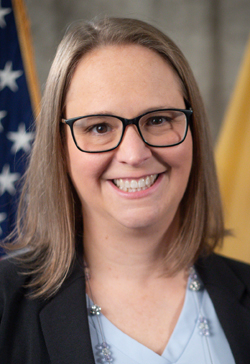
Asm. Andrea Katz
Sponsored bills
Maddy summaryThis bill (A4589) allows organizations licensed to operate bingo, raffles, and penny auctions in New Jersey to accept credit cards, debit cards, or other electronic payments for ticket or share purchases. It directly affects licensed venues (like community centers or nonprofits) that host these games and their participants. The bill requires the Legalized Games of Chance Control Commission to create new regulations enabling electronic payments, updating current law which only permitted cash transactions. The change takes effect immediately upon enactment.
Maddy summaryThis bill (A4941) provides educational support professionals in New Jersey school districts - non-teaching staff like paraprofessionals or administrative workers - with seniority credit for military service. It allows them to count up to four years of active U.S. military service toward seniority, as if they were continuously employed, if they qualify for federal veterans' benefits. The credit applies to all military service, including time served before their current school district employment. This extends an existing benefit currently available to teaching staff to support staff.
Maddy summaryThis bill requires judges and law enforcement officers in New Jersey to receive training on coercive control as part of their existing domestic violence education. It affects municipal and Superior Court judges handling domestic violence cases, judicial personnel, and all law enforcement officers, mandating initial training within 90 days of appointment or transfer and annual in-service training. The training must cover recognizing indicators of coercive control - defined as patterns like isolating victims, monitoring movements, or threatening harm - and other key topics such as trauma-informed approaches and safety planning. The bill amends current law to update training curricula without creating new penalties or funding.
Maddy summaryThis bill eliminates the statewide high school graduation proficiency test requirement in New Jersey. It removes the test from graduation standards, so students no longer need to pass it to receive a diploma, and school districts no longer need to administer it. The bill also amends school district report cards to remove test results and eliminates the requirement for out-of-school youth to pass the test for a State endorsed diploma. This directly affects all New Jersey high school students, school districts, and out-of-school youth seeking diplomas by changing graduation requirements from a standardized test to local standards developed by school boards.
Maddy summaryThis bill allows for-profit movie theaters that primarily show newly released (first-run) movies to obtain a special license enabling alcohol sales. The license permits alcohol service only during the two hours before and during movie showings at the theater location. The initial license fee is $210,000 (reduced to $150,000 if 10% of alcohol sold comes from New Jersey producers with specific licenses), paid in installments over 18 months. It applies exclusively to theaters operating as motion picture exhibition facilities, not to other venues or uses.
Maddy summaryThis bill prohibits non-disclosure agreements (NDAs) that conceal details or prevent public review of data center development plans. It directly affects developers applying for data center projects (as defined in the bill, including facilities for storing and processing digital data) and requires them to attest they haven’t used such agreements with property sellers or municipal agencies. Municipal agencies must deny approvals for data center projects if applicants violate this rule, and any prohibited NDA is deemed unenforceable. The law specifically applies to data centers, not other developments, and doesn’t override existing public disclosure laws for other structures.
Maddy summaryThis bill increases the FY2026 annual funding for New Jersey's Department of Children and Families (DCF) by $16.7 million to raise the monthly reimbursement rate paid to care management organizations (CMOs). The rate for CMO services will increase from $1,032 to $1,200 per client starting in FY2026, with annual $100 increases each year until reaching $1,500 per client. CMOs - county-based agencies providing coordinated care for youth with behavioral health needs, substance use disorders, or developmental disabilities - will directly benefit from this higher payment rate. The change is implemented through an amendment to the state's 2025-2026 budget appropriations act.
Maddy summaryThis bill appropriates $52,798,268 from existing farmland preservation funds to the State Agriculture Development Committee (SADC) for farmland preservation. It provides $21 million for acquiring development easements or fee simple titles to farmland, including grants to counties (up to 80% of costs) and nonprofits (up to 50% of costs). An additional $3.45 million supports stewardship activities like soil conservation and deer fencing on preserved farmland, while $28.3 million covers administrative costs for SADC operations and enforcement. The funding directly affects landowners, local governments, and nonprofit organizations working to preserve agricultural land in New Jersey.
Maddy summaryThis bill requires New Jersey's Medicaid program and Plan First program to cover fertility preservation services for individuals whose fertility may be impaired by medically necessary treatments like cancer therapy. It defines "iatrogenic infertility" as fertility loss caused by medical treatments affecting reproductive organs, and specifies that covered services include storage of sperm, eggs, embryos, and cryopreserved ovarian tissue. The coverage must be provided without discrimination based on age, gender, sexual orientation, or other personal characteristics, making these often-expensive services accessible to low-to-moderate income patients who would otherwise be unable to afford them.