

Maddy summaryThis bill requires New Jersey's Medicaid program and Plan First program to cover fertility preservation services for individuals whose fertility may be impaired by medically necessary treatments like cancer therapy. It defines "iatrogenic infertility" as fertility loss caused by medical treatments affecting reproductive organs, and specifies that covered services include storage of sperm, eggs, embryos, and cryopreserved ovarian tissue. The coverage must be provided without discrimination based on age, gender, sexual orientation, or other personal characteristics, making these often-expensive services accessible to low-to-moderate income patients who would otherwise be unable to afford them.
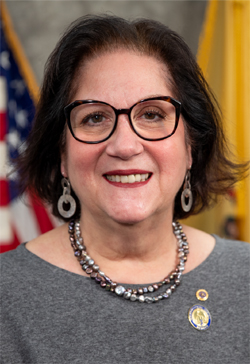
Asm. Melinda Kane
Sponsored bills
Maddy summaryThis bill (A6134) changes New Jersey law to make it optional for physicians to report patients with persistent seizure disorders to the Motor Vehicle Commission (MVC). Currently, physicians treating patients aged 16+ for recurrent seizures, unconsciousness, or motor coordination issues due to epilepsy must report within 24 hours; this bill replaces "shall" with "may," allowing physicians to choose whether to report. It directly affects physicians treating qualifying patients and the MVC, which would receive reports only if physicians opt to submit them. The change modifies the existing mandatory reporting requirement to a voluntary one without altering how the MVC handles such reports.
Maddy summaryNew Jersey's Assembly Bill 6147 would lower the minimum required uninsured and underinsured motorist coverage for transportation network company (TNC) drivers and companies, such as Uber or Lyft drivers. Currently, when a TNC driver is providing a ride, the law requires at least $1.5 million in such coverage; the bill would reduce this minimum amount. This change directly affects TNC drivers and companies by decreasing their mandatory insurance obligations. The bill amends existing insurance requirements without altering other coverage types like liability or medical payments.
Maddy summaryThe Mattress Stewardship Act requires mattress producers in New Jersey to join a stewardship organization and implement a program for environmentally sound management of discarded mattresses. Retailers must collect a stewardship assessment from consumers at point of sale to cover program costs and provide information about mattress collection opportunities. Stewardship organizations must submit detailed plans to the Department of Environmental Protection for approval, including collection sites, recycling methods, and performance goals. The Department will oversee implementation, publish compliance lists, and can impose civil penalties of up to $1,000 per violation for non-compliance. The program aims to increase mattress recycling rates and reduce improper disposal in New Jersey.
Maddy summaryThis bill requires New Jersey's electric public utilities (and their affiliates) to submit an annual report by February 1st to the Board of Public Utilities (BPU). The report must list every recorded vote cast by the utility or its affiliates at PJM Interconnection meetings (including votes not publicly disclosed by PJM), describe the meeting context, and explain how each vote supports New Jersey's energy goals of affordability, reliability, and sustainability. The BPU must then summarize these reports for the Governor and Legislature. This aims to increase transparency about how utilities influence regional electricity decisions using ratepayer funds.
Maddy summaryNew Jersey's A3558 bill establishes the state's official definition of antisemitism using the International Holocaust Remembrance Alliance (IHRA) standard, including specific examples of antisemitic conduct. State agencies and institutions must use this definition when reviewing, investigating, or deciding on cases involving discriminatory acts motivated by antisemitism. The bill appropriates $100,000 for a public awareness campaign by the Attorney General's office to educate residents on identifying and reporting bias crimes through community outreach and the existing bias crimes hotline. This campaign aims to improve reporting of antisemitic incidents without affecting First Amendment rights or conflicting with existing anti-discrimination laws.
Maddy summaryThis bill reorganizes New Jersey's State Health Benefits Program governance by expanding the State Health Benefits Commission to 11 members and eliminating the previous Plan Design Committee. It requires the program to offer exactly five health plans for employees and non-Medicare-eligible retirees, including a new "NJ Gold" plan that doesn't require salary-based employee contributions. The bill establishes an escalator system to adjust employee contribution rates based on premium cost trends, increasing rates if premiums rise significantly above inflation and decreasing them if premiums fall. Additionally, it mandates that local government employers must decide within one year whether to join the SHBP, with a two-year commitment if they choose to participate.
Maddy summaryThis bill appropriates funds to New Jersey's Department of Environmental Protection (DEP) for fiscal year 2026 to provide zero-interest and principal-forgiveness loans to local governments and public water utilities for environmental infrastructure projects. It directly affects municipalities and water utilities that need financing for clean water projects (like combined sewer overflow reduction and water quality restoration) and drinking water projects, with specific funding limits based on project type and affordability criteria. The bill includes detailed lists of 151 qualifying clean water projects totaling $1.7 billion and 59 drinking water projects totaling $652 million, all intended to meet federal requirements under the Clean Water Act and Safe Drinking Water Act. The loans may offer full principal forgiveness for eligible projects or a blended interest rate based on project costs and borrower affordability.
Maddy summaryThis bill allows commercial farms on preserved farmland (producing $10,000+ annually in agricultural products) to host special occasion events like weddings or parties, provided they meet specific conditions. Key restrictions include: events cannot interfere with farming, must stay under 10% of the farm’s annual revenue from such events, and cannot use permanent structures built within the last five years unless the revenue threshold is met. Farms must obtain written approval from the land’s grantee (e.g., state or nonprofit entity), limit events to 26 per year (with no more than six events exceeding 250 guests), and follow local regulations for noise, parking, and temporary structures. The policy aims to support farm revenue while maintaining agricultural use of preserved land.
Maddy summaryThe bill appropriates state and federal funds to the New Jersey Department of Environmental Protection for environmental infrastructure projects in fiscal year 2026. It authorizes the DEP to provide zero-interest and principal-forgiveness loans to local governments and public water utilities for clean water and drinking water projects, including 151 clean water projects totaling $1.7 billion and 59 drinking water projects totaling $651.7 million. The bill specifies different funding mechanisms, including full principal forgiveness for qualifying projects and blended interest rates for larger projects, with all funding expiring on July 1, 2026.