

Maddy summaryThis bill eliminates court filing fees for people being sued over consumer debt in New Jersey. It directly affects individuals facing lawsuits to collect personal, family, or household debt - including medical debt - when they file responses, counterclaims, or other court documents. The law removes fees for these filings in both small claims and civil courts, covering actions like answering complaints or disputing claims. It defines "consumer debt" as debt incurred for personal needs under current law, including medical debt as defined by existing statutes.
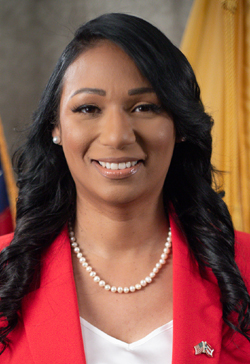
Asm. Carmen Morales
Sponsored bills
Maddy summaryThis bill requires New Jersey state contracting agencies to award at least 30% of contracts to businesses owned by people who are socially or economically disadvantaged. Socially disadvantaged businesses include those owned by racial minorities, individuals with disabilities, or those facing disadvantages due to location or other factors. Economically disadvantaged businesses are those with limited capital, credit access, or low personal net worth compared to similar businesses. Agencies must create annual plans with the state department to meet this goal and adjust targets based on data.
Maddy summaryThis bill requires the New Jersey Motor Vehicle Commission (MVC) to install continuous high-definition video surveillance at all locations where license plates are returned. Cameras must provide full coverage of each drop box, record footage for 30 days, and be accessible only to the MVC and law enforcement for security or criminal investigations related to the drop boxes. The MVC must also place clear signage informing the public that surveillance is in use, and footage cannot be used for any purpose beyond these specific security needs. The policy directly affects MVC operations and individuals returning unused license plates at these locations.
Maddy summaryThis bill establishes the "Minority and Women-Owned Businesses State Contractor Remedies Act" requiring New Jersey State agencies to set specific contract utilization goals for minority and women-owned businesses based on a 2024 disparity study. It sets detailed percentages for contracts across different categories, including 24.26% of construction contracts for women-owned businesses and 10.14% for Hispanic American-owned businesses. State agencies must develop annual plans to achieve these goals and make a "good faith effort" to meet them, with remedial actions required if they fail to do so. Prime contractors are also required to make good faith efforts to meet subcontractor goals for minority and women-owned businesses. The bill amends previous set-aside laws by removing goals for minority and women-owned businesses and shifting oversight to the Department of the Treasury's Office of Diversity and Inclusion.
Maddy summaryThis New Jersey bill (A5608) provides tax credits to businesses that hire neurodiverse individuals working in qualifying STEM or AI fields at minimum wage. Businesses can claim up to $9,000 annually per full-time employee (increasing from $7,000 in year one) or $4,500 for part-time employees. To qualify, employees must be certified as neurodiverse by the Division of Vocational Rehabilitation and work in eligible roles (excluding independent contractors). The credits apply against corporation business tax and gross income tax, with certification required within 90 days of application.
Maddy summaryThis bill establishes programs to support neurodiverse students at New Jersey county colleges, appropriating $1.475 million total. It creates a two-year pilot program to fund three county colleges in hiring accessibility coordinators who will provide academic advising, resource navigation, and job connections for neurodiverse students. It also funds $75,000 for faculty training on supporting neurodiverse students and $500,000 for grants to improve STEM facilities (like sensory-friendly spaces or assistive tech) at county colleges. The programs target county colleges specifically, with selection based on competitive applications and collaboration with four-year institutions.
Maddy summaryThis bill establishes the Inclusive Workplaces Program within New Jersey's Economic Development Authority (EDA) to provide financial incentives for employers to create workspaces accommodating neurodivergent employees. Small businesses (under 150 employees) may receive grants up to $25,000 per applicant for investments like sensory-friendly layouts, adaptive equipment, or neurodiversity training, with a total annual grant limit of $2.5 million. Large businesses (150+ employees) may qualify for tax credits equal to up to $25,000 or 50% of their qualifying investments in similar accommodations, capped at $2.5 million annually. To qualify, employers must have at least one neurodivergent employee (small business) or three (large business), demonstrate commitment to inclusive workplaces, and operate within New Jersey.
Maddy summaryBill A4163 requires health insurers in New Jersey to cover biomarker testing for diagnosis, treatment, management, or ongoing monitoring of diseases when supported by medical evidence such as FDA approvals, drug labels, or clinical guidelines. The bill applies to all health insurance plans including individual, group, Medicaid, and health maintenance organization contracts. Insurers must provide coverage without causing unnecessary disruption (like multiple biopsies) and must make prior authorization decisions within 24 hours for urgent requests or 72 hours for non-urgent requests. This ensures patients can access precision medical testing that's clinically supported without excessive administrative barriers.
Maddy summaryNew Jersey's S 3620 requires electric and gas utilities using smart meters to establish an "Energy Bill Watch" program for smart meter customers. The program mandates utilities to notify customers when their daily usage exceeds the previous billing cycle's average (on the 10th and 20th days of each cycle), offer customizable dollar-value alerts, and include average monthly usage costs and kilowatt/therm amounts in notifications. Utilities must automatically enroll smart meter customers, provide opt-out options, advertise the program through multiple channels, and include specific billing details in all customer bills (previous cycle amount, current cycle amount, and the difference between them). This bill directly affects smart meter customers of New Jersey's electric and gas utilities.
Maddy summaryAJR 166 is a New Jersey legislative resolution urging the U.S. Congress to advance the creation of a National Museum of the American Latino. Introduced by Assembly members Rodriguez, Collazos-Gill, and Quijano, it calls for Congress to reinstate a 2008 commission and establish the museum as part of the Smithsonian Institution on the National Mall in Washington, D.C., while directing copies to federal leaders and New Jersey's congressional delegation.