

Maddy summaryThis bill codifies New Jersey's existing Attorney General directive to prevent state and local law enforcement from enforcing federal immigration laws. It prohibits police from stopping, questioning, or detaining people solely based on immigration status, asking about immigration status unless relevant to a crime investigation, or sharing personal information (like addresses or social security numbers) with federal immigration authorities. Exceptions apply only for serious crimes (e.g., violent offenses or recent convictions) or when required by law for criminal investigations. The law directly affects all New Jersey state, county, and municipal law enforcement agencies and officers, aiming to build trust between police and immigrant communities by clarifying that immigration enforcement is a federal responsibility.
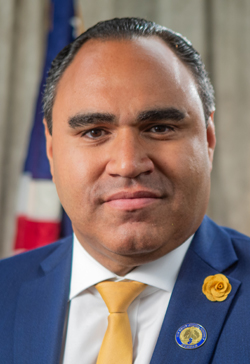
Asm. Gabe Rodriguez
Sponsored bills
Maddy summaryThis bill allocates $10 million from the "New Jersey Debt Defeasance and Prevention Fund" to fund parking facilities at Colin Powell Elementary School in Union City School District. It also appropriates $3.25 million from the General Fund specifically for high-cost special education services in the same district. The funds require the Department of Education to establish a grant agreement with Union City School District outlining terms and disbursement. The bill directly affects Union City School District students and staff through these targeted infrastructure and special education funding mechanisms.
Maddy summaryThis bill allocates $10 million from existing school funding to build parking facilities at Colin Powell Elementary School in Union City, New Jersey, for staff and students. It also appropriates $3.25 million from the General Fund specifically for high-cost special education services in the Union City School District. Both provisions directly benefit Union City School District students and staff by funding infrastructure improvements and specialized educational support. The funds are directed through the Department of Education with required grant agreements for oversight. The bill makes no changes to existing education programs beyond these targeted allocations.
Maddy summaryThis bill upgrades penalties for cyber-harassment targeting public servants or their family members, making it a third-degree crime (up from fourth degree under current law). It establishes the Office of Cyber-Harassment Support within the Department of Law and Public Safety to provide victim assistance, develop educational programs, and coordinate with law enforcement and social media platforms. The office will create accessible reporting systems, offer counseling, promote cyber ethics in schools, and train law enforcement on investigating cyber-harassment cases. The bill appropriates state funds to implement these provisions, directly affecting public servants, their families, and victims of online harassment.
Maddy summaryThis bill upgrades cyber-harassment targeting public servants or their family members to a third-degree crime (up from fourth-degree), increasing penalties. It establishes the Office of Cyber-Harassment Support within New Jersey’s Department of Law and Public Safety to provide victim assistance, develop educational programs, and coordinate with law enforcement and social media platforms to prevent such harassment. The office will create accessible reporting systems, offer counseling and legal aid, promote cyber ethics education in schools, and train law enforcement on handling cyber-harassment cases. The bill appropriates necessary funds from the General Fund to implement these provisions.
Maddy summaryThis bill (A3739) makes it a fourth-degree crime in New Jersey to use devices that block or interfere with wireless communications, such as cell phones, Wi-Fi, GPS, or emergency services. It directly affects anyone using "signal jammers" (also called signal blockers or cell phone jammers), which prevent calls, texts, or emergency location signals. The law updates existing state law to explicitly prohibit interfering with radio communications licensed under federal law, including blocking cellular frequencies or using modified scanning receivers. These devices are already illegal under federal law, but this bill strengthens state enforcement by adding specific language to criminalize their use. The key provision ensures that jamming technology cannot disrupt public safety communications or commercial services.
Maddy summaryThis bill requires New Jersey's Department of Military and Veterans Affairs (DMVA) to develop a mobile application providing veterans and their families with access to key resources. The app must include information on veterans' legal rights, medical and insurance issues, education, housing, and transition support from military to civilian life - mirroring content already available on the DMVA website. It directly affects all New Jersey veterans and their families who use DMVA services. The bill amends state law (N.J.S.38A:3-6) to mandate this mobile resource, aiming to improve accessibility and user experience compared to web-based resources.
Maddy summaryThis bill requires New Jersey's Department of Military and Veterans Affairs (DMVA) to develop a mobile application that provides veterans and their families with guidance on available state and federal resources. The app would consolidate information about benefits, healthcare, housing, education, and other support services into a single accessible tool. It specifically mandates the DMVA to create this mobile resource as a new method for delivering the existing public information requirement currently covered by subsection (y) of N.J.S.38A:3-6. The bill directly affects all New Jersey veterans and their families who rely on state and federal veteran support programs.
Maddy summaryThis bill (A560) requires all New Jersey transportation network company (TNC) drivers - like those for Uber or Lyft - to complete an anti-human trafficking training course approved by the Attorney General. The training, which can be taken online, covers human trafficking definitions, how drivers can report it, and steps to respond to suspected cases. Drivers must certify completion to their TNC; failure to do so results in being blocked from using the app until certified. TNCs must also track and document completion in driver records within 90 days of the bill's effective date.
Maddy summaryThis bill eliminates a $15 fee for special license plates designated for firefighters and members of first aid or rescue squads in New Jersey. It directly affects compensated, partially compensated, and volunteer members of fire departments or first aid/rescue squads who currently pay this fee in addition to standard vehicle registration costs. The bill amends existing law (P.L.1977, c.369) to remove the $15 charge, meaning applicants will only pay standard vehicle registration fees. The special plates (featuring a Maltese Cross with "F.D." for firefighters or a similar design for first aid/rescue members) remain available under the same eligibility rules.