

Maddy summaryThis bill (A3446) requires New Jersey's Governor, Senate President, Speaker of the General Assembly, or other authorized officials to prioritize racial and gender diversity when appointing members to state boards, commissions, or similar bodies established by law. It mandates that appointing authorities consider achieving a membership reflecting the state's racial and gender makeup as a "primary consideration" for all appointments made after the bill takes effect. The requirement applies unless it conflicts with specific circumstances of the appointment or the original law creating the body. The bill defines "gender" to include gender identity and "race" as major groupings based on physical characteristics or ancestry. The bill is currently pending in the Assembly Community Development and Women's Affairs Committee and has not yet become law.
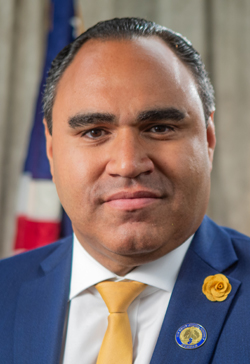
Asm. Gabe Rodriguez
Sponsored bills
Maddy summaryThis New Jersey bill (A 1736) prohibits law enforcement officers from wearing masks or disguises during public interactions while performing official duties. It directly affects all state, county, and municipal officers authorized to enforce laws, including federal officers working in New Jersey. Key exceptions include undercover operations, face shields not hiding the face, medical masks with a doctor's note, and smoke protection during emergencies. Violations are classified as disorderly persons offenses, punishable by fines up to $1,000 or up to six months in jail. The bill takes immediate effect upon passage.
Maddy summaryThis bill (A 1940) required manufacturers of menstrual products sold in New Jersey to list all non-confidential ingredients on product packaging and their websites, with ingredients ordered by quantity. It applied to all menstrual products - like tampons, pads, cups, and underwear - packaged for individual retail sale, giving manufacturers 18 months to comply after the law took effect. Manufacturers could exclude confidential business information but had to list it by common name. Non-compliant products faced civil penalties of up to $1,000 per package, based on 1% of annual in-state sales. The bill was withdrawn after being approved as P.L.2025, c.232 and enacted into law.
Maddy summaryThis bill requires all New Jersey state, county, and private correctional facilities - including juvenile facilities - to provide free voice calls, video calls, and email services to incarcerated adults and juveniles. It prohibits facilities from charging inmates or their families any fees (including per-minute charges, surcharges, or account fees), ensuring both parties to communications bear no cost. The law also mandates that facilities maintain current service access levels and transfer any remaining prepaid funds to inmates' commissary accounts. The bill appropriates state funds for implementation and takes effect six months after enactment.
Maddy summaryAR 62 is a New Jersey Assembly Resolution (not a bill) urging the U.S. President and Congress to enact legislation granting amnesty and creating a path to citizenship for undocumented immigrants. It specifically references the need for 11 million undocumented immigrants to gain legal status, citing economic benefits and historical precedent from the 1986 Immigration Reform Act. The resolution does not create new law but formally requests federal action, emphasizing that current policies prevent immigrants from fully participating economically and socially. It was introduced in the Assembly on January 13, 2026, and referred to the Oversight, Reform and Federal Relations Committee.
Maddy summaryThis bill removes an exemption in New Jersey's Smoke-Free Air Act that previously allowed smoking in casinos and casino simulcasting facilities. Currently, these venues could permit smoking in areas used for gambling (like slot machine rooms or table games), but the bill would eliminate that exception. After passage, all indoor areas of casinos and simulcasting facilities open to the public for gambling would be required to be smoke-free. This change aligns these venues with the state's general indoor smoking ban, which applies to most public workplaces and spaces.
Maddy summaryThis New Jersey Assembly Resolution (AR 26) urges Congress to remove marijuana from Schedule I of the federal Controlled Substances Act. It directly affects medical marijuana patients and businesses in New Jersey (and 37 other states) who face barriers due to federal classification, including lack of insurance coverage, banking restrictions, and high costs ($350-$500 monthly for patients). The resolution highlights that marijuana's Schedule I status conflicts with its accepted medical use in many states and scientific evidence of health benefits. It seeks to protect public safety by ending federal restrictions that force dispensaries to handle large cash amounts, increasing crime risks. The bill does not change current law but calls for congressional action to align federal policy with state legalization.
Maddy summaryThis bill (A 1455) requires anyone circulating a recall petition for an elected official in New Jersey to take an oath by affidavit before an officer qualified to administer oaths. It directly affects petition circulators, who must now personally swear under oath before such an officer that they witnessed all signatures, verified signers' residency, and circulated the petition in good faith. The key provision adds a new requirement to each completed petition page: the circulator must include their name, address, and sworn statements about the signatures and circulation dates, all signed before a qualified official. This aligns recall petitions with the existing standard for nomination petitions, aiming to prevent fraud by verifying circulator responsibility. The bill amends Section 9 of P.L.1995, c.105 (C.19:27A-9).
Maddy summaryThis bill (A 3445) requires publicly held corporations with their principal office in New Jersey to have boards of directors that reflect the racial and gender diversity of New Jersey by December 31, 2021. Corporations must use the most recent U.S. Census data to determine compliance, can add directors to meet the requirement, and must annually report director demographics to the Secretary of State. Failure to comply results in civil penalties of $100,000 for the first violation and $300,000 for subsequent violations. The Secretary of State must also annually report on compliance, corporate relocations, and companies no longer subject to the law.
Maddy summaryThis bill (A-2540, "Cancer Patient Care and Compassion Act") requires health insurance plans and Medicaid in New Jersey to cover specific cancer treatments without cost-sharing for patients with Stage III, IV, or terminal cancer. It mandates coverage for parenteral treatments (like IV medications), survivorship care plans, and other services determined by regulators. The bill also adds protections: mortgage lenders must pause foreclosure during active treatment, creditors cannot initiate collections, and tenants facing eviction can request a 45-day stay with physician certification. These provisions directly affect cancer patients and their families by removing financial barriers to care and preventing housing/financial instability during treatment. The bill is pending before the Assembly Financial Institutions and Insurance Committee.