

Maddy summaryThis bill requires New Jersey to provide volunteer firefighters with free, periodic cancer screenings every three years, starting three years after they begin volunteering. The screenings cover 11 specific cancers (including colon, lung, breast, and prostate) and must be administered by physicians in the State Health Benefits Program network. The state will reimburse providers up to $1,250 per firefighter every three years, with no out-of-pocket costs for the firefighters. Fire districts must maintain records to support reimbursement claims, extending existing paid firefighter benefits to volunteer firefighters.
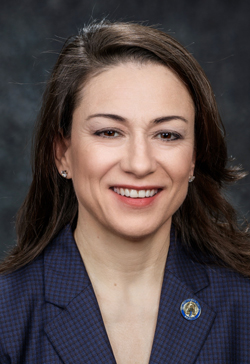
Asm. Aura Dunn
Sponsored bills
Maddy summaryNew Jersey's A4647 requires all public school districts to provide full-day kindergarten programs, with implementation deadlines based on district classification (A/B/CD/DE districts by 2020-2021, others by 2021-2022). It establishes a uniform age requirement: children must be five years old by October 1 of the school year to enroll in kindergarten, replacing current district-specific cutoffs. The bill amends existing education statutes (N.J.S.18A:38-5 and N.J.S.18A:44-2) to mandate these changes. This directly affects all New Jersey public school districts and kindergarten students entering school.
Maddy summaryThis bill changes New Jersey's observance of Juneteenth Day from the third Friday in June to June 19th each year. It directly affects state government employees and businesses operating under New Jersey's public holiday schedule, aligning the state holiday with the federal Juneteenth National Independence Day. The bill amends two existing laws (P.L.2008, c.89 and R.S.36:1-1) to replace the current "third Friday in June" with "June 19" in the list of official state holidays. This change ensures New Jersey's state holiday matches the federal date without altering other holiday provisions.
Maddy summaryThis bill increases the monthly personal needs allowance (PNA) from $50 to $140 for low-income residents in nursing homes, state psychiatric hospitals, and state developmental centers. The allowance is intended for residents to spend on discretionary items like phone calls, meals out, clothing, or hobbies. The new amount includes an automatic annual increase tied to the Social Security cost-of-living adjustment starting the year after enactment. It also ensures SSI recipients in these facilities receive the same $140 monthly allowance as Medicaid recipients, with the state covering the difference if federal supplements remain unchanged.
Maddy summaryThis bill requires all New Jersey school psychologists and counselors to complete an eight-hour mental health first aid training course. The training, developed by the Department of Education with input from Human Services, must cover identifying mental health signs in youth, risk factors, crisis interventions, and specific conditions like anxiety and depression. School staff must complete the training within their first year of employment and again at least once every three years as part of professional development. The course content must be updated every three years to reflect current mental health practices.
Maddy summaryThis bill (A4012) establishes a minimum Medicaid reimbursement rate for structured day program services provided to Medicaid beneficiaries with brain injuries. It requires that these services be reimbursed at the average rate currently paid for Day Habilitation Services Tiers D and E under the Division of Developmental Disabilities program - approximately $9.38 per 15 minutes, compared to the current $3.65 rate for brain injury day programs. The policy directly affects licensed brain injury service providers and Medicaid beneficiaries requiring brain injury treatment. The change applies to services provided on or after the bill's effective date, aligning brain injury service reimbursement with rates for comparable developmental disability services.
Maddy summaryThis bill requires New Jersey's Department of Health (DOH) to study the causes and risk factors of youth suicide, including mental health conditions, substance use, trauma, and family history. The DOH Commissioner must consult with state agencies and the Youth Suicide Prevention Advisory Council to review suicide data, health records (while respecting privacy laws), and scientific research. Within 180 days of the bill's effective date, the DOH must submit a report to the Governor and Legislature with findings and recommendations for potential policy changes. The bill expires once the report is delivered, making it a time-bound study mandate rather than an immediate law.
Maddy summaryThis bill provides an additional $500,000 in state funding from the General Fund to the Department of Military and Veterans Affairs (DMVA) for the New Jersey SOS Veterans Stakeholders Group. The funding directly supports the group’s existing services for New Jersey veterans, including financial assistance, housing support, emergency transportation, and benefits counseling. The bill adds this amount to the DMVA’s "Veterans Program Support" budget line, ensuring the group can continue its community-based outreach and coordination with other veteran service providers. This is a funding allocation, not a new policy, and it specifically aids veterans in New Jersey who access these support services.
Maddy summaryThis bill requires New Jersey school districts classified as "child care deserts" (defined as districts with at least 30 children aged 3-4 and fewer than one-third the needed preschool seats) to provide preschool education vouchers to parents or guardians. The vouchers, equal to the state's standard preschool funding per student, are available for eligible children who qualify for free preschool under existing law but cannot enroll in their district's program. Vouchers can cover private preschool tuition, homeschooling materials, or be deposited into a state savings account. The bill takes effect immediately, applying to the first full school year after enactment.
Maddy summaryThis bill allows New Jersey taxpayers to deduct charitable contributions made to nonprofits that received state funds or economic development subsidies during the same tax year. The deduction is capped at $10,000 for joint filers or heads of household, and $5,000 for single filers, separate filers, or surviving spouses. It applies only to nonprofits that are independent of government (not operated for private profit and not part of federal/state/local governments). Contributions to nonprofits receiving standard government contracts (like procurement for construction) are excluded. The policy change takes effect for tax years beginning January 1 after enactment.