

Maddy summaryThis bill authorizes New Jersey to create special "Sons of the American Legion" license plates for vehicle owners. It requires a $50 one-time application fee and a $10 annual fee, with all collected funds deposited into a dedicated fund. The money in this fund is then annually appropriated to the Sons of the American Legion Detachment of New Jersey to support its activities. The plates must display a design approved with the local Legion detachment and follow standard vehicle registration rules.
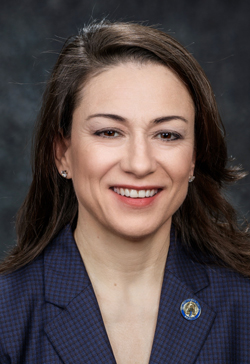
Asm. Aura Dunn
Sponsored bills
Maddy summaryThis bill creates a dedicated "Civil Air Patrol Fund" within New Jersey's Department of Military and Veterans' Affairs. It requires the state to appropriate $100,000 annually from the General Fund to the fund, which can also receive federal grants and public donations. The money must support the New Jersey Wing of the Civil Air Patrol, specifically for programs like cadet STEM/aviation training, search and rescue readiness, disaster relief equipment (including a Redbird Simulator), and volunteer training. Unspent funds carry forward each year, making it a permanent funding source for these state-level Civil Air Patrol activities.
Maddy summaryAJR 151 is a symbolic resolution condemning Russia's deportation of over 19,500 Ukrainian children since 2022, with only about 1,900 returned. It specifically highlights Russia's targeting of vulnerable children (orphans, those with disabilities, military families) and their placement in camps where they face propaganda, forced Russian language use, military training, and abuse. The resolution expresses New Jersey's support for all children's immediate return to Ukraine and directs copies to U.S. leaders, Ukrainian diplomats, and the UN. As a joint resolution, it has no legal effect but serves as a formal statement of condemnation.
Maddy summaryThis bill requires drivers to stop at least 25 feet from school buses loading/unloading children or individuals with developmental disabilities on undivided highways, and to slow to 10 mph on divided highways. It establishes that violations captured by school bus monitoring systems (like cameras) will result in a $300 civil penalty instead of criminal charges or license points. The law directly affects drivers near school buses, school bus operators, and enforcement agencies. Key provisions include standardized stopping distances, speed limits for divided highways, and shifting penalties for monitored violations to a civil fine system. This changes enforcement by prioritizing evidence from monitoring systems to reduce penalties for documented violations.
Maddy summaryThis New Jersey bill allows high school juniors and seniors (grades 11-12) to miss up to three school days per year for college visits, tours of technical schools, or military recruitment activities without penalty. Absences for military enlistment prep - like testing, medical evaluations, or interviews - are specifically designated as excused. Schools cannot list these absences on student transcripts, job applications, or attendance records, and they won’t affect a student’s perfect attendance status. The policy aims to support college and career pathway exploration while ensuring no academic or administrative disadvantage for participating students.
Maddy summaryThis bill creates the "Justice Center for the Protection of Individuals with Intellectual or Developmental Disabilities" to handle abuse, neglect, and exploitation complaints in state-licensed residential and day habilitation facilities. It directly affects people with intellectual or developmental disabilities (IDD) living in these settings, as well as state-funded caregivers (excluding immediate family members). The key mechanism establishes a centralized, independent office to investigate complaints - replacing current systems managed by the Department of Human Services and Department of Children and Families - and creates a Medical Review Board to address related deaths. The bill aims to improve safety and accountability by implementing a model inspired by New York's oversight system.
Maddy summaryThis proposed bill (A-3137) would amend New Jersey law to make it a crime for a parent or caregiver to unlawfully use, manufacture, or distribute illegal drugs in the presence of a child. It directly affects parents and caregivers who engage in drug-related activities around minors. The key provision adds specific language to the endangering welfare statute, classifying such drug activity in front of a child as a criminal offense (third degree for caregivers, fourth degree for others), separate from standard drug violations. The bill is currently pending before the Assembly Children, Families and Food Security Committee.
Maddy summaryThis bill requires New Jersey school districts to cancel all classes on election days when a public school serves as a polling place. Instead, school boards may use the day for staff training or professional development. The law aims to improve student safety by preventing large crowds of voters from entering school buildings during elections. It applies immediately, first affecting the November 2021 general election. The bill does not change voting procedures but modifies school operations on election days.
Maddy summaryThis bill creates a temporary child care reimbursement program within New Jersey's Department of Children and Families (DCF), funded by $500,000 from federal CARES Act funds. It directly helps employed parents or guardians who need to enroll children in licensed child care due to school closures or remote learning caused by the COVID-19 pandemic. Eligible families can apply to DCF for reimbursement of child care tuition costs, with the commissioner setting selection criteria and distributing funds based on available funding. The program expires when the state's declared COVID-19 public health emergency ends.
Maddy summaryThis bill makes knowingly making a false report of child abuse or neglect a crime. It targets individuals who submit false reports under New Jersey's child abuse reporting law, imposing a third-degree criminal penalty (up to 5 years in prison or a $15,000 fine) and adding a separate civil penalty of up to $10,000. The civil penalty funds the Department of Children and Families. The law applies immediately upon enactment and directly affects people who file false reports, not the victims or reporting systems.