

Maddy summaryThis bill adds two alternate voting members to each New Jersey county agriculture development board (CADB). One alternate represents farmers (to replace voting members actively engaged in farming) and one represents the general public (to replace public representatives), both appointed through the same process as regular members. Alternates may vote only when a voting member is absent or unable to serve, but cannot vote in regular sessions. The change affects all 21 county CADBs, which manage agricultural land preservation and development programs. The bill modifies existing law to ensure board continuity during member absences without altering the board's core structure.
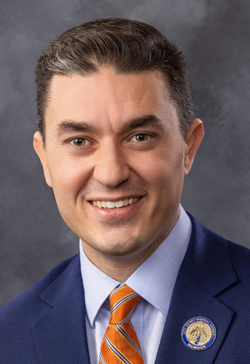
Asm. Mike Inganamort
Sponsored bills
Maddy summaryThis bill phases out New Jersey's transfer inheritance tax over two years. For the first year after enactment, the tax rate is reduced to 50% of current rates for taxable transfers (such as those to siblings or non-relatives). In the second year, the tax is eliminated entirely for all transfers. It directly affects individuals inheriting property that would have been subject to the tax under current law, including non-spousal and non-lineal transfers. The change applies to all estates, whether the decedent was a New Jersey resident or not.
Maddy summaryThis bill allows New Jersey municipalities to count housing units built for agricultural workers toward their required affordable housing quota. Specifically, it permits towns to credit one housing unit for each dwelling used exclusively by low- or moderate-income migrant or seasonal farm workers employed in agriculture. These units do not count toward future housing needs under the Fair Housing Act, meaning they don’t create additional obligations for municipalities. The policy directly affects municipalities with farm worker housing and agricultural workers who occupy these units.
Maddy summaryThis bill prohibits New Jersey municipalities and counties from adopting policies that would prevent local officials from cooperating with federal immigration enforcement requests. It makes noncooperation with such requests an ethics violation for state and local employees, with penalties including fines up to $1,000 or imprisonment for up to one year for officials who vote to adopt noncooperation policies. The bill amends existing ethics codes to explicitly require cooperation with federal immigration enforcement requests, stating that officials must comply with "lawful requests from a federal agency regarding immigration and customs enforcement." It also creates a state-level defense for municipal employees who face civil actions related to cooperating with federal immigration authorities.
Maddy summaryThis bill changes the standard for lawful firearm transporters who deviate from their course of travel from "reasonably necessary" to "reasonable." It specifically allows for common, brief, lawful detours like picking up passengers, obtaining supplies or medication, and using restrooms before reaching a permitted destination. The bill also explicitly permits firearm transportation during bona fide emergencies or declared disaster evacuations. This affects individuals lawfully transporting firearms under existing exemptions, such as gun owners traveling between home and business, hunters, and members of rifle/pistol clubs.
Maddy summaryThis bill would change how property tax relief is applied to residents in municipalities affected by the Highlands Water Protection and Planning Act. It would require that the tax credit be applied directly to each line item on property tax bills rather than just reducing the total amount owed. The credit would be calculated by multiplying a tax rate (determined by dividing total stabilization aid by total taxable property value) by each property's taxable value. This change would make the tax relief more directly visible on individual tax bills. The bill would affect property taxpayers in municipalities located within the Highlands preservation area.
Maddy summaryThis bill establishes the New Jersey COVID-19 Response Task Force, a bipartisan group of eight members appointed by legislative leaders (two each by Senate and Assembly majority and minority leaders). The task force will study New Jersey's pandemic response over 18 months, examining government communication, impacts on nursing homes, children's education/health, crime rates, financial effects on businesses/residents, and comparisons with other states' approaches. It must hold at least three public hearings statewide and submit findings and recommendations to the Legislature and Governor. The task force expires after submitting its report, with no direct policy changes enacted by the bill itself.
Maddy summaryThis bill requires New Jersey's Secretary of State to create a website where voters can report problems with mail-in ballots they receive, such as ballots sent to deceased or non-resident voters. The website would let voters provide their contact details and describe issues, with reports automatically sent to local election officials for follow-up. It also establishes a nine-member "Vote by Mail Study Commission" to investigate mail-in voting irregularities, including how to prevent duplicate ballots or mailings to inactive voters. The commission must hold public hearings across the state and submit findings and recommendations to the Governor and Legislature within one year.
Maddy summaryThis bill upgrades burglary of a home to a second-degree crime (previously third-degree) unless the person is armed with a weapon or explosive, in which case it becomes a first-degree crime. It clarifies that armed residential burglary would trigger New Jersey's No Early Release Act (requiring at least 85% of the sentence to be served before parole eligibility), while non-armed residential burglary would not. The bill directly affects individuals convicted of breaking into or remaining in a home without permission to commit a crime.
Maddy summaryThis bill restricts cash assistance recipients from using their electronic benefit cards to withdraw cash at ATMs or make purchases at casinos, adult entertainment venues, adult bookstores, liquor stores, or travel agencies (for cruise bookings). It requires the state to implement technology to block these transactions at specified venues, aligning with existing federal rules to maintain access to federal funding. The bill also clarifies that recipients will not be charged for system use except for fees after three free ATM withdrawals per month, for replacement cards, or for certain point-of-sale transactions.