

Maddy summaryThis bill allows certain drivers to renew their licenses online or by mail instead of in-person. It specifically applies to individuals with a valid commercial driver license who already hold a federal Transportation Worker Identification Credential (TSA) or a hazardous materials endorsement requiring TSA fingerprinting and background checks. These individuals have already met REAL-ID requirements through their existing federal credentials, so the bill removes the need for them to visit a Motor Vehicle Commission office to renew their licenses into REAL-ID compliant versions. This change aims to reduce wait times for in-person appointments while ensuring compliance with federal identification standards.
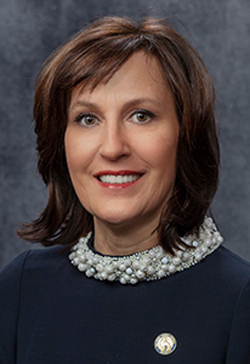
Asm. Michele Matsikoudis
Sponsored bills
Maddy summaryThis bill creates a process for New Jersey municipalities to be exempt from affordable housing obligations if designated as "extensively flood-prone." The Council on Affordable Housing would determine exemption eligibility based on flood insurance data, repetitive flood loss properties relative to municipality size, and other relevant information. Qualifying municipalities would be exempt from current and future affordable housing obligations, including past unfulfilled requirements under the Fair Housing Act. This change modifies the existing framework to account for flood risk as a factor in housing obligations.
Maddy summaryThis bill allows New Jersey municipalities to grant a temporary property tax exemption for homeowners who elevate their homes after natural disasters (e.g., floods) to create additional space underneath. The exemption covers the increased taxable value specifically from the new space created by elevation, excluding other improvements, for up to five years. Municipalities must adopt an ordinance declaring the area "in need of rehabilitation" due to a declared disaster, and assessors must exclude the elevation-related value from tax calculations during the exemption period. Homeowners still pay taxes on other value increases from repairs or upgrades beyond the elevated space.
Maddy summaryThis bill would allow New Jersey craft distilleries to directly ship distilled spirits to consumers. Specifically, it authorizes craft distilleries with a 3d license to ship up to nine liters of distilled spirits per year to individuals over 21 for personal consumption (not for resale). The bill removes current restrictions that prohibited direct shipping of distilled spirits within and outside New Jersey, eliminated the requirement for tour participation to consume on premises, and removed the five-liter limit for off-premises consumption. These changes would permit direct shipping while requiring distilleries to maintain invoices for inspection and verify customer age.
Maddy summaryThis bill creates a presumption of pretrial detention for individuals charged with reckless vehicular homicide (when driving under the influence) or strict liability vehicular homicide (driving while intoxicated). It directly affects defendants convicted of these specific vehicular homicide offenses, requiring courts to detain them pretrial unless they can prove by a preponderance of evidence that release conditions would reasonably assure their appearance in court and community safety. The bill amends New Jersey law to extend the existing pretrial detention presumption, which currently applies to murder and life imprisonment offenses, to these vehicular homicide cases. It also includes provisions for vehicle forfeiture (unless hardship is proven) and allows courts to suspend or revoke drivers' licenses in these cases.
Maddy summaryThis bill authorizes New Jersey to issue special childhood cancer awareness license plates for motor vehicles. Vehicle owners who choose these plates would pay a $50 one-time application fee and a $10 annual renewal fee, with the excess funds (after covering production and administrative costs) deposited into a dedicated fund for childhood cancer research. The fund, managed by the state, would annually provide grants to the New Jersey Commission on Cancer Research. The program requires the WITH Grace Initiative to secure initial funding (up to $25,000) and 500 applications before plates are issued, and it can be discontinued if costs exceed fees for two consecutive years.
Maddy summaryACR 102 is a non-binding resolution urging New Jersey's Department of Education to impose a two-year moratorium on developing or implementing new Student Learning Standards. It requests this pause due to recent adoption of standards in 2020, parent concerns about current standards, and pandemic-related learning loss. The resolution does not change existing standards but asks the Department to halt new standards development while the Legislature considers related bills addressing learning loss. This affects the Department's curriculum planning process during the moratorium period.
Maddy summaryThis bill allows New Jersey taxpayers to claim a state income tax deduction for charitable donations made to qualifying New Jersey-based organizations. It mirrors the federal deduction limit (under IRS Section 170) for donations that would be deductible on federal returns, without requiring taxpayers to itemize federal deductions. To qualify, organizations must be registered under New Jersey's Charitable Registration Act or meet specific in-state presence requirements (maintaining an office, employing staff, and providing services in New Jersey). The deduction applies to donations made in tax years beginning January 1 following enactment.
Maddy summaryThis bill temporarily reduces New Jersey's corporate business tax rate from 9% to 7.5% for five tax years (starting January 1 after enactment) and repeals the 2.5% corporation business surtax. It directly affects most corporations (excluding S corporations and partnerships with over $100,000 annual net income) by lowering their tax burden on net income. The key provisions are the rate reduction and surtax repeal, which were set to expire in 2023. The sponsor states the goal is to promote economic development and job creation by easing taxes for businesses.
Maddy summaryThis bill requires New Jersey's Division of Developmental Disabilities to set maximum hourly rates for self-directed employees (caregivers hired directly by eligible individuals) equal to the rates paid to contracted service providers for identical services, duration, and care level. Currently, self-directed employee rates average $20-$25/hour for high-acuity support, while service providers receive about $51/hour for the same care. The bill mandates that the division establish provider rates as the ceiling for self-directed rates, closing this pay gap. It directly affects individuals using self-direction services and their authorized representatives who hire personal caregivers.