

Maddy summaryThis bill designates the interchange between State Highway Route 42 and Interstate Highway Route 295 in New Jersey as the "Ensign John R. Elliott Memorial Interchange" to honor a U.S. Naval Academy graduate killed in a 2000 traffic accident. It requires the state transportation commissioner to install signs bearing this name but explicitly prohibits using public funds for the signage. Instead, the state must secure private donations or grants from nonprofits, charities, or other private entities to cover all costs related to the signs. The bill takes immediate effect and affects only the specific highway junction, with no broader policy changes.
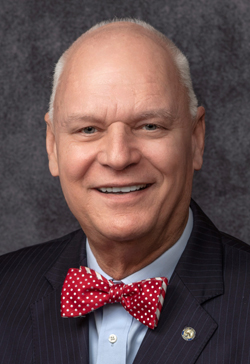
Asm. Don Guardian
Sponsored bills
Maddy summaryThis bill creates a certification process for non-physicians (such as licensed estheticians or technicians) to legally perform laser tattoo removal in New Jersey. It requires the State Board of Medical Examiners to establish specific standards, including qualification criteria, testing procedures, and continuing education requirements. Non-certified individuals would be prohibited from offering these services, and certification would need renewal every two years. The bill directly affects non-physician practitioners seeking to provide tattoo removal services and aims to standardize safety and training under state oversight.
Maddy summaryThis New Jersey bill (A4407) increases daily pay for election workers from $300 to $400 per election (primary, general, or special). It also raises additional compensation for workers managing signature copy registers: from $12.50 to $20 for one worker, or $6.25 to $10 each for two workers sharing the duty. The state will increase its reimbursement to counties from $225 to $325 per election worker, meaning counties still cover $75 of the $400 daily rate. The bill directly affects election workers and county governments across all New Jersey counties.
Maddy summaryThis bill creates a 10-year urban enterprise zone in Atlantic City to stimulate economic development. Businesses within the zone (excluding casino operations themselves, but including non-casino businesses operating on casino property that meet eligibility criteria) would qualify for a 50% reduction in sales tax on qualifying retail sales. The tax revenues collected from these businesses would be directed to a public safety trust fund specifically for Atlantic City to fund public safety services. The zone would be established within 90 days of Atlantic City submitting an application and zone development plan.
Maddy summaryThis bill requires new affordable housing developments (called "inclusionary developments") with 10 or more units or four or more stories to meet LEED Silver or equivalent green building standards. Developers must also submit impact studies on traffic, schools, stormwater, and carbon emissions (if clearing over one acre) to local municipalities before construction begins. The law applies to new projects only, exempting those with applications submitted before the law takes effect. It directs the Department of Community Affairs to create implementing rules within eight months of enactment.
Maddy summaryThis bill would exempt certain plastic materials processed at advanced plastic processing facilities from New Jersey's solid waste disposal and recycling laws. Specifically, plastics transported to and processed using chemical methods like gasification, pyrolysis, or solvolysis would no longer be classified as "solid waste" under state law. The exemption does not apply to plastics labeled with codes 1 (PETE) or 2 (HDPE). Advanced plastic processing facilities would still be subject to environmental regulations governing air and water pollution. This change would primarily affect plastic processors using these advanced chemical conversion methods.
Maddy summaryThis bill establishes a certification program for businesses owned and controlled by LGBTQ+ individuals in New Jersey. To qualify, a business must be at least 51% owned, operated, and controlled by LGBTQ+ persons (including real, substantial management authority), not just formally registered. The Division of Revenue will process applications and maintain a public listing in the SAVI database for state contracting agencies to identify certified businesses. This creates a standardized process for certification but does not require state agencies to prioritize these businesses in contracts.
Maddy summaryThis bill expands the definition of "child" under New Jersey's Police and Firemen's Retirement System (PFRS) and State Police Retirement System (SPRS) to include disabled children of any age. Specifically, it adds a new category for children who are unable to work due to a long-term disability (lasting or expected to last at least 12 months), as verified by a medical board. This change directly affects adult children of retired or deceased police and firefighter members, allowing them to qualify for benefits they previously might not have received. The amendment modifies the eligibility criteria without altering other aspects of the retirement systems.
Maddy summaryThis bill prohibits unauthorized drone operations near schools in New Jersey. It makes it a disorderly persons offense to fly a drone below 250 feet over school property for surveillance, to hover over school grounds without permission, or to use school buildings/grounds as a drone takeoff or landing site. School administrators must provide written authorization for any drone activity within this zone. Violations carry penalties of up to six months in jail, a $1,000 fine, or both. The law specifically exempts authorized public employees and first responders operating drones for official duties.
Maddy summaryThis bill would establish a certification program for businesses owned by LGBTQ+ individuals in New Jersey. To qualify, a business must be at least 51% owned, operated, and controlled by LGBTQ+ persons, with specific documentation required to verify eligibility. Certified businesses would be listed in the SAVI database, making them eligible for state contracting opportunities and public recognition. The program formalizes an existing executive order (E.O. 295) that created this certification process, making it permanent rather than temporary. Businesses seeking certification would apply through the Division of Revenue and Enterprise Services, with appeal processes available for denials or revocations.