

Maddy summaryThis bill requires New Jersey's Board of Public Utilities (BPU) to establish a program to incentivize the development of transmission-scale energy storage systems with a minimum capacity of 5 megawatts. The program will solicit applications for projects totaling at least 500 megawatts of capacity, with projects needing commercial operation by December 2030 and interconnection to the PJM grid. The BPU will provide incentive awards totaling at least $60 million annually for 15 years, based on a scoring system that evaluates price, project maturity, and community benefits. The program is designed to help New Jersey meet its 2030 energy storage target of 2,000 megawatts, with the BPU required to report on progress one year after the initial procurement.
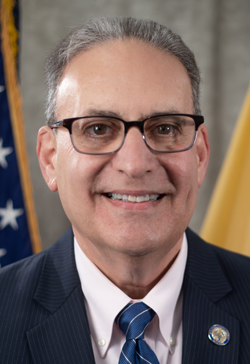
Asm. Roy Freiman
Sponsored bills
Maddy summaryS 3944 allows New Jersey nonprofit theaters to obtain special alcohol licenses by clarifying that "disregarded entities" (like single-member LLCs treated as part of their parent nonprofit for tax purposes) qualify for these licenses. It applies to art-house movie theaters or performing arts venues with seating capacities of 50-1,000 people (for smaller venues) or 1,000+ people (for larger venues), operated by tax-exempt 501(c)(3) organizations. The license permits alcohol sales during specified times: two hours before, during, and two hours after performances (with a 15-performance annual limit for smaller venues). This change directly affects nonprofit theaters seeking to sell alcohol to support their operations, without counting toward other liquor license limits. The bill clarifies existing law to expand eligibility for these specialized licenses.
Maddy summaryThis bill requires New Jersey employers of first responders (law enforcement officers and paid firefighters) to cover workers' compensation for up to 12 hours of confidential mental health counseling after a "critical incident," such as witnessing violence, serious injury, or trauma during duty. Additional up to 24 hours of counseling may be covered if a mental health professional deems it necessary for the responder's well-being. The law also mandates confidentiality for mental health communications between first responders and peer support teams or resiliency program officers, with limited exceptions if a responder poses a risk to themselves or others. All counseling must be completed within one year of the first session and cannot require use of the responder's accrued paid leave.
Maddy summarySJR 154 directs New Jersey's Board of Public Utilities (BPU) to investigate PJM Interconnection's capacity market pricing model to determine if it ensures reliable electricity at the lowest cost, requiring a report within 12 months. It also mandates the state to collaborate with neighboring PJM states to promote affordable energy practices, urge PJM to implement market reforms protecting ratepayers from rising prices, and accelerate reviews of new power generation projects. The resolution addresses concerns about increasing electricity costs for New Jersey customers, linked to PJM's current pricing structure and delays in new energy resources entering the grid. This action aims to align PJM's operations with New Jersey's energy affordability goals under the Electric Discount and Energy Competition Act.
Maddy summaryThis bill authorizes the New Jersey Infrastructure Bank to provide up to $2.4 billion in loans for environmental infrastructure projects during FY2026. It directly affects local governments and public water utilities (referred to as "project sponsors") seeking funding for clean water and drinking water system improvements. The bill specifies 151 clean water projects totaling $1.7 billion and 59 drinking water projects totaling $651.7 million that qualify for these loans, with repayment terms up to 45 years. The loans cover a portion of construction costs, and the bank can adjust loan amounts based on actual project expenses. The bill also includes provisions for transferring funds between state trust funds to support these projects.
Maddy summaryThis bill requires New Jersey's electric public utilities (and their affiliates) to submit an annual report by February 1st to the Board of Public Utilities (BPU). The report must list every recorded vote cast by the utility or its affiliates at PJM Interconnection meetings (including votes not publicly disclosed by PJM), describe the meeting context, and explain how each vote supports New Jersey's energy goals of affordability, reliability, and sustainability. The BPU must then summarize these reports for the Governor and Legislature. This aims to increase transparency about how utilities influence regional electricity decisions using ratepayer funds.
Maddy summaryThis bill authorizes the New Jersey Infrastructure Bank to provide up to $53.45 million in low-interest loans for transportation infrastructure projects in fiscal year 2026. It specifically funds 17 local government projects across New Jersey, including bridge replacements, road improvements, and street redesigns in cities like Bayonne, Hoboken, and Princeton. The bill also allows for up to $1 million in principal-forgiveness loans for project planning and design costs, with up to $100,000 of that amount forgiven upon project completion. All loans must be repaid within 31 years and are subject to specific eligibility requirements. The funding expires on July 1, 2026.
Maddy summaryNew Jersey's A3974 prohibits substance use disorder treatment providers from using deceptive marketing practices. The bill requires all advertising to include accurate, plain-language details about services, locations, and contact information (including phone numbers and addresses), and bans false claims about network status, geographic location, or affiliations with other providers without written consent. Violations carry civil penalties up to $20,000 per incident, and affected individuals may sue for triple damages plus attorney fees. This directly affects licensed treatment facilities, certified providers, and recovery residences offering substance use disorder services within the state.
Maddy summaryThis bill appropriates $107,999,000 from constitutionally dedicated corporation business tax revenues and Green Acres funds to the New Jersey Department of Environmental Protection (DEP). The funds support local governments in acquiring land for recreation and conservation (e.g., parks, open space) and developing existing lands (e.g., park improvements, inclusive playgrounds under "Jake's Law"). Specifically, $22.4 million funds land acquisition projects, $80.3 million supports development projects like park upgrades and inclusive playgrounds, and $3 million establishes a new planning grant program for local conservation planning. It prioritizes projects in densely populated areas and urban aid municipalities, as defined by population density thresholds.
Maddy summaryNew Jersey's A3558 bill establishes the state's official definition of antisemitism using the International Holocaust Remembrance Alliance (IHRA) standard, including specific examples of antisemitic conduct. State agencies and institutions must use this definition when reviewing, investigating, or deciding on cases involving discriminatory acts motivated by antisemitism. The bill appropriates $100,000 for a public awareness campaign by the Attorney General's office to educate residents on identifying and reporting bias crimes through community outreach and the existing bias crimes hotline. This campaign aims to improve reporting of antisemitic incidents without affecting First Amendment rights or conflicting with existing anti-discrimination laws.