

Maddy summaryThis bill increases penalties for retailers who sell tobacco or vapor products to people under 21. First violations now carry $500 fines (up from $250), second violations $1,000 (up from $500), and third or subsequent violations $2,000 (up from $1,000). Small businesses with clear compliance policies pay only $100 for the first violation. Five percent of collected fines will fund public education on vapor product dangers and illegal sales. Retailers must also post new signs at points of sale and vending machines warning that selling to minors is prohibited.
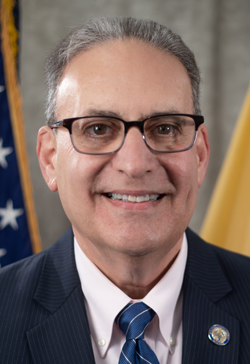
Asm. Roy Freiman
Sponsored bills
Maddy summaryThis bill requires New Jersey's Medicaid managed care organizations to automatically cover lower-cost generic and biosimilar drugs when they are cheaper than the original brand drugs. Specifically, if a generic drug's wholesale cost is lower than its reference drug at launch, the health plan must immediately add it to their formulary with better cost-sharing (like lower copays) and cannot impose extra barriers like prior authorization. The bill also mandates that health plans publish clear, accessible formulary lists online with update dates, ensuring transparency for Medicaid enrollees and the public. These changes directly affect Medicaid health plans and beneficiaries by improving access to affordable medications.
Maddy summaryThis bill creates a binding arbitration process for disputes between health insurance companies (carriers) and healthcare providers over pricing and payment terms when negotiations fail. If a dispute isn't resolved 60 days before a provider network contract expires, arbitration is automatically triggered. Both parties must submit final offers before arbitration, and the arbitrator must choose one of those offers - making the decision binding. Patients receive 30 days' notice before providers become out-of-network for the next plan year, and coverage remains unchanged until the new plan year begins. The Department of Banking and Insurance administers the process.
Maddy summaryThis bill (A6175) allows New Jersey dental service corporations (DSCs) to create nonprofit parent corporations while maintaining their existing charitable status and purpose of providing dental care to subscribers. It requires DSCs to submit an application to the Commissioner of Banking and Insurance for approval before forming a parent corporation, which must be structured as a nonprofit entity and cannot operate as an insurance producer. The bill ensures that forming a parent corporation does not alter the DSC’s core mission to deliver dental services and promote oral health, as required by current law. This change aims to modernize DSC corporate structures to better utilize technology and expand services without compromising their nonprofit obligations.
Maddy summaryThis bill appropriates $13.64 million from constitutionally dedicated corporation business tax revenues to fund conservation and recreation projects through New Jersey's Department of Environmental Protection. The funds will be distributed as grants to nonprofit organizations for open space acquisition ($8.35 million), park development ($2.13 million), and stewardship activities ($1.48 million), plus $1 million for a new planning grant program to help nonprofits prepare conservation plans. The grants support land conservation and recreation initiatives across multiple counties and municipalities throughout New Jersey. All funding decisions require approval from the Joint Budget Oversight Committee, and the program is funded from revenues specifically dedicated to open space preservation under New Jersey law.
Maddy summaryThis bill appropriates $52,798,268 from existing farmland preservation funds to the State Agriculture Development Committee (SADC) for farmland preservation. It provides $21 million for acquiring development easements or fee simple titles to farmland, including grants to counties (up to 80% of costs) and nonprofits (up to 50% of costs). An additional $3.45 million supports stewardship activities like soil conservation and deer fencing on preserved farmland, while $28.3 million covers administrative costs for SADC operations and enforcement. The funding directly affects landowners, local governments, and nonprofit organizations working to preserve agricultural land in New Jersey.
Maddy summaryNew Jersey Assembly Bill A5862 appropriates $34 million from constitutionally dedicated corporation business tax (CBT) revenues to fund farmland preservation. The funds will provide planning incentive grants to eligible counties - specifically five counties receiving base grants of $500,000-$1 million, plus 10 additional counties eligible for competitive grants - to cover up to 80% of costs for permanent land protections (development easements) on farmland. The grants are administered through the State Agriculture Development Committee under the Preserve New Jersey Farmland Preservation Fund, with a county’s maximum total award capped at $8.5 million. This bill directly affects participating counties in agricultural areas by enabling local governments to preserve farmland through permanent land protections.
Maddy summaryThis bill establishes standardized credit transfer rules for New Jersey public colleges and universities, replacing previous "collective agreements" with requirements set by the Secretary of Higher Education. It creates a New Jersey Transfer Ombudsman within the Secretary's office to resolve disputes between students and institutions about credit transfers, conduct compliance reviews every three years, and publish annual reports on transfer outcomes. Public institutions must now provide transfer students with data on program completion rates and ensure associate degrees earned at community colleges are fully transferable toward bachelor's degrees. The changes directly affect students transferring between NJ public colleges and universities, as well as the institutions themselves, by standardizing credit recognition and adding oversight.
Maddy summaryAJR 150 designates July of each year as "Cleft and Craniofacial Awareness and Prevention Month" in New Jersey. This symbolic resolution encourages community organizations, medical institutions, and advocacy groups to raise public awareness about cleft lip and palate birth defects - conditions affecting about 1 in 1,700 babies in the U.S. - and promote collaboration on outreach and research. It does not create new laws or funding but requests the Governor issue an annual proclamation to support this awareness effort. The resolution directly affects New Jersey residents and families impacted by these birth defects by fostering community engagement and education.
Maddy summaryNew Jersey's Assembly Bill 6147 would lower the minimum required uninsured and underinsured motorist coverage for transportation network company (TNC) drivers and companies, such as Uber or Lyft drivers. Currently, when a TNC driver is providing a ride, the law requires at least $1.5 million in such coverage; the bill would reduce this minimum amount. This change directly affects TNC drivers and companies by decreasing their mandatory insurance obligations. The bill amends existing insurance requirements without altering other coverage types like liability or medical payments.