

Maddy summaryThis bill defines "Islamophobia" for New Jersey state law as a form of racism targeting Muslim identity or perceived Muslim identity, including discrimination, stereotyping, harassment, or violence against Muslims or Muslim-majority communities. It requires state officials and law enforcement to use this definition when reviewing civil or criminal cases involving anti-Muslim bias. The definition explicitly excludes criticism of Muslim-majority countries similar to criticism of other nations. The bill does not override First Amendment protections or existing anti-discrimination laws. This is New Jersey's first state-level definition of Islamophobia, adopted to standardize responses to anti-Muslim hate incidents.
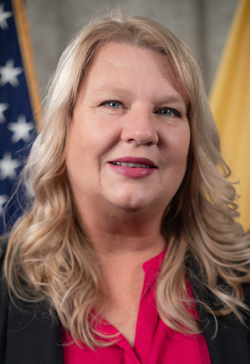
Asm. Mitchelle Drulis
Sponsored bills
Maddy summaryThis bill establishes the "Family and Private Burial Grounds Preservation Act" to protect family or private burial sites in New Jersey that are not owned by governments, religious groups, or commercial cemeteries. It requires the Department of Environmental Protection (DEP) to create and maintain a public map of all such burial grounds, oversee their preservation, and mandate permits for construction or development near these sites. The law directly affects property owners with family burial grounds and developers planning projects on or near these locations. Key provisions include prohibiting unauthorized disturbance of burial grounds, requiring DEP review of nearby construction, and enabling the department to authorize permanent disinterment only under strict conditions.
Maddy summaryThis bill provides tax credits to New Jersey-based small businesses during their first three years of operation. It directly affects qualifying startups that are registered in New Jersey, maintain most operations within the state, have no more than 50 employees, and earn under $100,000 net income in their first taxable year. The credit reduces the business's gross income tax liability by 75% in year one, 50% in year two, and 25% in year three. Businesses must apply for approval from the state director to claim these credits, ensuring they aren't using the credit to offset taxes from other unrelated businesses.
Maddy summaryThis bill requires all New Jersey law enforcement officers to complete mandatory training on identifying machine gun conversion devices and related components used to modify standard firearms. It directly affects every officer employed by state or local law enforcement agencies, as this training becomes a condition for continued employment or appointment. The bill amends existing law by adding specific content to required continuing education, focusing on recognizing devices that convert semiautomatic guns to fire multiple shots per trigger pull. The training must be approved by the Police Training Commission and documented by officers and their agencies.
Maddy summaryThis bill requires New Jersey's Board of Public Utilities (BPU) to study the feasibility of developing advanced reactors statewide within 18 months. The study must examine suitable locations (including retired power sites), regulatory requirements, economic viability, safety, environmental impacts, and public input through three stakeholder sessions. It directs the BPU to recommend a potential program for deploying small modular reactors and publish findings online. The study expires 30 days after the report is submitted to the Governor and Legislature.
Maddy summaryThis New Jersey bill (A 946), now law as P.L.2025, c.177, requires mental health services to be provided in the communication method preferred by each deaf or hard of hearing individual - such as sign language or oral communication - based on their assessment. It mandates that mental health professionals be fluent in that method, trained in cultural needs, and able to collaborate with interpreters. The law also requires a state resource guide listing specialized mental health services and ensures individuals can help shape their own care plans. It directly affects all deaf or hard of hearing residents seeking mental health support in New Jersey, addressing long-standing barriers in access and care quality.
Maddy summaryThis bill creates a New Jersey program to help reproductive health care professionals reduce student loan debt. It appropriates $5 million to redeem up to $200,000 in qualifying student loans for eligible providers who work at approved sites (including abortion providers) for 1-4 years. Participants earn 18% loan redemption after one year of service, increasing to 26%, 28%, and 28% for subsequent years. The program prioritizes providers in counties with shortages of reproductive health services, targeting areas where abortion access is limited. It directly affects licensed professionals providing reproductive health care, including abortion services, within the state.
Maddy summaryThis bill requires all New Jersey hospitals providing inpatient maternity services and licensed birthing centers to offer new parents who have given birth either: (1) an in-person lactation consultation before discharge, or (2) a remote consultation via live voice if requested. The counseling must include breastfeeding education, support, care planning, demonstration of breastfeeding techniques, recommendations for assistive devices, and health benefit information. It defines "lactation counselor" and "lactation consultant" to include certified professionals like IBCLCs without requiring additional nursing licensure. The law applies to facilities licensed under New Jersey's birthing center regulations and aims to standardize postpartum lactation support.
Maddy summaryThis bill amends New Jersey's brewery licensing laws to permit certain licensed breweries to sell alcoholic beverages by the glass for on-premises consumption in designated salesrooms. Specifically, it expands the "Limited brewery license" (Section 1b) to allow license holders to sell up to 15.5 fluid gallons per person for off-premises consumption and to offer samples, while maintaining existing restrictions on food sales. The provision directly affects licensed breweries seeking to sell directly to consumers in tasting rooms or sales facilities. Note: The bill's title incorrectly references "wineries," but the text applies only to breweries producing malt alcoholic beverages, not wine producers. This bill was withdrawn after being enacted as P.L.2025, c.376.
Maddy summaryThis bill requires private contractors operating New Jersey's motor vehicle inspection facilities to offer full-time employment to eligible employees of the New Jersey Motor Vehicle Commission who lose their jobs due to contract outsourcing. The number of job offers must be proportional to the contractor's share of inspection lanes (e.g., a contractor operating 30% of lanes must offer jobs to 30% of affected employees). It also mandates that collective bargaining agreements covering these employees remain binding under the new contract. This policy directly affects state employees working in motor vehicle inspection facilities when operations transition to private contractors.