

Maddy summaryThis bill allows New Jersey counties and municipalities to make voluntary annual contributions of up to $70,000 to nonprofit veterans' organizations that provide support services to veterans (including physical, emotional, and medical care). It directly affects local governments, which can now fund these organizations, and the veterans' groups themselves. The bill defines eligible organizations broadly to cover services addressing veterans' needs, and requires audits if contributions exceed $70,000. This expands existing funding rules that already permit up to $125,000 annually for emergency services associations.
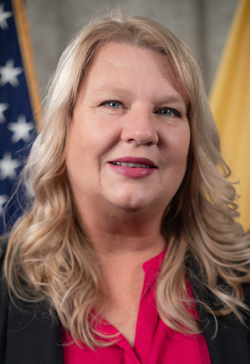
Asm. Mitchelle Drulis
Sponsored bills
Maddy summaryThis bill requires New Jersey financial institutions (like banks, credit unions, and mortgage servicers) to allow homeowners (mortgagors) to choose biweekly payments (every two weeks), bimonthly payments (twice monthly), or extra payments directly to their mortgage principal - without penalties. It mandates that any amount paid beyond the annual required total in biweekly plans must reduce the principal balance. The law applies to all new mortgage agreements signed six months after enactment and affects homeowners seeking more flexible repayment options to potentially pay off loans faster. It does not change existing mortgage terms but expands payment choices for future agreements.
Maddy summaryThis New Jersey bill (A5608) provides tax credits to businesses that hire neurodiverse individuals working in qualifying STEM or AI fields at minimum wage. Businesses can claim up to $9,000 annually per full-time employee (increasing from $7,000 in year one) or $4,500 for part-time employees. To qualify, employees must be certified as neurodiverse by the Division of Vocational Rehabilitation and work in eligible roles (excluding independent contractors). The credits apply against corporation business tax and gross income tax, with certification required within 90 days of application.
Maddy summaryThis bill establishes programs to support neurodiverse students at New Jersey county colleges, appropriating $1.475 million total. It creates a two-year pilot program to fund three county colleges in hiring accessibility coordinators who will provide academic advising, resource navigation, and job connections for neurodiverse students. It also funds $75,000 for faculty training on supporting neurodiverse students and $500,000 for grants to improve STEM facilities (like sensory-friendly spaces or assistive tech) at county colleges. The programs target county colleges specifically, with selection based on competitive applications and collaboration with four-year institutions.
Maddy summaryThis bill establishes the Inclusive Workplaces Program within New Jersey's Economic Development Authority (EDA) to provide financial incentives for employers to create workspaces accommodating neurodivergent employees. Small businesses (under 150 employees) may receive grants up to $25,000 per applicant for investments like sensory-friendly layouts, adaptive equipment, or neurodiversity training, with a total annual grant limit of $2.5 million. Large businesses (150+ employees) may qualify for tax credits equal to up to $25,000 or 50% of their qualifying investments in similar accommodations, capped at $2.5 million annually. To qualify, employers must have at least one neurodivergent employee (small business) or three (large business), demonstrate commitment to inclusive workplaces, and operate within New Jersey.
Maddy summaryBill A4163 requires health insurers in New Jersey to cover biomarker testing for diagnosis, treatment, management, or ongoing monitoring of diseases when supported by medical evidence such as FDA approvals, drug labels, or clinical guidelines. The bill applies to all health insurance plans including individual, group, Medicaid, and health maintenance organization contracts. Insurers must provide coverage without causing unnecessary disruption (like multiple biopsies) and must make prior authorization decisions within 24 hours for urgent requests or 72 hours for non-urgent requests. This ensures patients can access precision medical testing that's clinically supported without excessive administrative barriers.
Maddy summaryNew Jersey's S 3620 requires electric and gas utilities using smart meters to establish an "Energy Bill Watch" program for smart meter customers. The program mandates utilities to notify customers when their daily usage exceeds the previous billing cycle's average (on the 10th and 20th days of each cycle), offer customizable dollar-value alerts, and include average monthly usage costs and kilowatt/therm amounts in notifications. Utilities must automatically enroll smart meter customers, provide opt-out options, advertise the program through multiple channels, and include specific billing details in all customer bills (previous cycle amount, current cycle amount, and the difference between them). This bill directly affects smart meter customers of New Jersey's electric and gas utilities.
Maddy summaryThis bill lowers the cost threshold for public works projects that may include project labor agreements (PLAs) from $5 million to $3 million. It applies to projects requiring prevailing wages under New Jersey's Prevailing Wage Act, such as construction, renovation, or demolition work by public entities like state agencies, counties, or school districts. By reducing the threshold, more projects will be eligible to use PLAs - pre-hire agreements between labor organizations and contractors that set wages, benefits, and work rules for a specific project. The change takes effect immediately upon enactment.
Maddy summaryThis bill requires all health insurance plans and Medicaid in New Jersey to cover treatment for stuttering, including habilitative and rehabilitative speech therapy as determined medically necessary by a patient's doctor. The coverage must be provided without prior authorization, utilization management requirements, or any cost-sharing such as deductibles, copays, or coinsurance. It applies to all insurance types including individual and group health plans, health maintenance organizations, and Medicaid, and covers both in-person and telehealth services. The bill defines habilitative speech therapy as therapy that helps a person keep, learn, or improve daily living skills, and rehabilitative speech therapy as therapy that helps restore or improve skills that have been lost or impaired. This legislation would directly affect individuals with stuttering who rely on insurance or Medicaid for speech therapy services.
Maddy summaryS 3587 upgrades retail theft offenses in New Jersey, including elevating "leader of organized retail theft enterprise" to a first-degree crime punishable by 10-20 years in prison. The bill creates a new offense for "fostering the sale of stolen property" (including online sales), which is a disorderly persons offense punishable by up to six months in jail. It establishes a retail theft unit within the Department of Law and Public Safety to investigate and prosecute organized retail theft, appropriating $1 million for this purpose. The bill also includes new requirements for gift card sales to prevent fraud, such as mandatory notices for retailers and packaging restrictions for both open- and closed-loop gift cards.