

Maddy summaryThis bill amends New Jersey's film and digital media tax credit program to require that all original music and musical scores developed for qualifying productions must be produced and recorded domestically within the United States. The requirement directly affects film and digital media companies seeking tax credits under the program, making domestic music production a necessary condition for eligibility. The tax credit program allows eligible producers to claim credits of 30-40% of qualified production expenses, with additional requirements related to New Jersey-based work. This policy change updates the program to ensure that music content for eligible productions is created within the U.S.
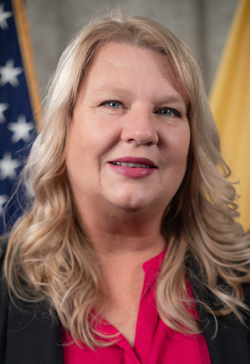
Asm. Mitchelle Drulis
Sponsored bills
Maddy summaryThis bill requires New Jersey's Board of Public Utilities (BPU) to collect and review electricity load-forecasting data from utilities and load-serving entities (non-utility electricity providers). It mandates the BPU to analyze this data - including contracts and commitments affecting future demand - and coordinate with PJM (the regional grid operator) to ensure forecasts are accurate, non-duplicative, and incorporated into regional planning. The BPU must submit annual reports to the Governor and Legislature starting in 2026, summarizing collected data, analysis, and coordination efforts. The goal is to prevent costly overbuilding or underbuilding of grid infrastructure by improving forecasting transparency for consumers and system reliability.
Maddy summaryThis New Jersey bill (S 1067) requires the state's Department of Human Services to conduct a landscape analysis of mental health services accessible to deaf and hard of hearing residents. It mandates that mental health services be provided in a client's primary communication method (like sign language or speech), delivered by professionals certified in that method and trained in culturally appropriate care for the deaf community. The bill also requires the creation of a resource guide listing providers meeting these standards and defines key terms like "culturally affirmative mental health services." It directly affects deaf and hard of hearing individuals seeking mental health care across New Jersey.
Maddy summaryThis bill requires New Jersey municipalities to submit quarterly data on affordable housing and senior citizen housing units to the Department of Community Affairs. The information includes building addresses, management contacts, application status, and online application links. This data will be published on state government websites (Community Affairs, Housing Finance Agency, and Housing Resource Center) and linked from municipal websites. The bill directly affects local governments by mandating data reporting and aims to make housing availability information more accessible to the public. It does not change housing eligibility or funding but creates a centralized public resource.
Maddy summaryThis bill allows a request for guardianship to be filed up to six months before a minor turns 18, if the minor is expected to need a legal guardian at age 18. The guardianship arrangement would only become effective on the minor's 18th birthday, preventing gaps in legal protection during the transition to adulthood. It also requires that such requests cannot be withdrawn without proof the minor is deceased or has decision-making capacity, which can be shown through testimony rather than medical evidence. This change aims to streamline the process for minors who require ongoing guardianship support after turning 18.
Maddy summaryThis bill establishes new safety requirements for railroad operations in New Jersey. It requires at least two crew members on dangerous hazardous trains (transporting large quantities of hazardous materials) with specific exceptions, prohibits trains longer than 8,500 feet on main and branch lines, and mandates railroad companies to submit federally required bridge inspection reports to state officials. The bill also requires railroad companies to install and maintain wayside detector systems to identify defects, with oversight by the Board of Public Utilities and Department of Transportation. Violations of the train length limit could result in civil penalties of $500-$1,000 per foot exceeding the limit, up to $250,000 for gross negligence or repeated violations.
Maddy summaryACR 169 is a New Jersey legislative resolution urging Congress to provide emergency funds for Newark Liberty International Airport (EWR). It specifically requests immediate action to modernize EWR's aging air traffic control infrastructure and increase staffing at facilities supporting the airport. The resolution cites recent disruptions - including radar outages, flight delays, and cancellations - stemming from outdated FAA systems (like aging copper lines) and staffing shortages (only 22 certified controllers at Philadelphia TRACON managing EWR airspace). This resolution directly affects EWR passengers (nearly 50 million annually), airport operations, and regional economic activity, emphasizing the urgent need for federal intervention before a long-term FAA system upgrade becomes operational.
Maddy summaryThis bill requires all public school staff in New Jersey to complete training on caring for students with epilepsy or seizure disorders every two years. It directly affects school staff (including teachers, coaches, and support personnel) and students with these conditions. The training, provided through Department of Health-approved courses by nonprofit organizations, covers recognizing seizures, emergency response, and daily care. This update builds on existing law (P.L.2019, c.290) that already requires schools to develop individualized health plans for affected students but adds the mandatory biennial staff training requirement. The law applies to all school-sponsored activities, including those outside regular school hours.
Maddy summaryS 4569 appropriates $13.64 million from constitutionally dedicated corporation business tax revenues to fund conservation and recreation projects through the New Jersey Department of Environmental Protection. The bill allocates $8.35 million for nonprofit organizations to acquire land for open space (across 8 specific projects), $2.13 million for park development (across 2 projects), and $1.48 million for stewardship activities (across 4 projects). Additionally, $1 million establishes a new planning grant program to help nonprofits prepare conservation plans, and $681,000 covers administrative costs. All projects listed in the bill have been pre-approved by the DEP. The funding comes from a dedicated tax revenue stream established by the Preserve New Jersey Act.
Maddy summaryThis bill appropriates $52,798,268 from constitutionally dedicated CBT revenues and existing farmland preservation funds to New Jersey's State Agriculture Development Committee. It funds the protection of farmland through purchase or easements, providing grants to counties (up to 80% of acquisition costs) and nonprofits (up to 50% of costs), plus $3.45 million for stewardship activities like soil conservation and deer fencing. The funds also cover administrative costs ($28.3 million) for program management and enforcement. This directly supports landowners selling easements, local governments acquiring farmland, and farm operators maintaining preserved land.