

Maddy summaryThis bill extends eligibility for a one-time grant program to the Marie H. Katzenbach School for the Deaf, allowing it to access funding for school facility projects. The grant covers the state's share of costs for projects addressing health, safety, or critical needs, calculated as the greater of 40% of eligible costs or the district aid percentage. The school must apply annually within 90 days of an annual notice, with decisions made within 90 days of submission. This change aligns the school with other eligible districts under New Jersey's Section 15 grant program.
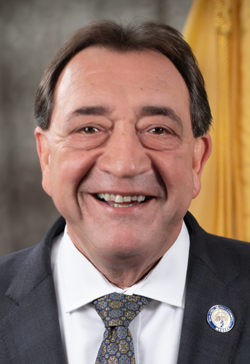
Asm. Anthony Verrelli
Sponsored bills
Maddy summaryS 2082 creates a 12-member New Jersey Educator Evaluation Review Task Force to examine the state's current teacher and administrator evaluation system established under the 2012 TEACHNJ Act. The task force will specifically study the use of student growth objectives in evaluations, assess administrative burdens on educators, review current research on effective evaluation practices, and recommend potential updates to the law. It will hold public hearings and submit a final report to the Governor and Legislature by September 30, 2024. This bill does not change evaluation rules directly but sets up a process to review them; the current system affects all public school teachers, principals, and administrators in New Jersey. The task force includes representatives from teachers' unions, school administrators, and education associations.
Maddy summaryThis bill (A 3980) requires New Jersey's Department of Human Services to create a system that stops funding for substance use disorder treatment or housing services when General Assistance program beneficiaries exit those services. It directly affects beneficiaries receiving General Assistance cash benefits and the service providers (like treatment centers or housing agencies) that receive state funds. The key mechanism mandates that funding must cease on the exact date a beneficiary is discharged or no longer receives services, with the Commissioner authorized to verify service dates and demand repayment if funds were incorrectly paid after services ended. The bill aims to prevent overpayment by ensuring funds align precisely with active service delivery.
Maddy summaryThis bill establishes a Peer Recovery Specialist Committee to regulate individuals providing peer support for substance use disorder and mental health challenges. To become certified, applicants must meet specific requirements including a high school diploma or equivalent, 500 hours of peer recovery experience, 46 hours of training in key areas (advocacy, mentoring, wellness support, and ethics), and a background check. The committee will oversee certification, enforce standards, and manage renewals, while exempting clergy, students in training, licensed professionals (like social workers), and volunteers in self-help groups who do not claim the certified title. The law requires anyone using the title "peer recovery specialist" to hold certification, except in exempted circumstances outlined in the bill.
Maddy summaryThis bill requires New Jersey hospitals to include fentanyl and xylazine testing in standard urine drug screenings when conducted for patient diagnosis. It directly affects licensed general acute care hospitals that perform such screenings. Hospitals must report de-identified positive results for either drug to the state Department of Health, without altering existing opioid or overdose reporting requirements. The goal is to improve overdose treatment by providing healthcare workers with critical drug detection data and to help the state track the spread of these dangerous substances.
Maddy summaryThis bill clarifies that teachers and professional support staff in New Jersey charter schools must meet the same New Jersey certification requirements as those in traditional public schools. It amends existing law to explicitly require identical certification standards for all classroom teachers and professional support staff, regardless of whether they work in a charter or district school. The change applies to all public schools, ensuring consistent qualifications for educators across the state. This policy standardizes certification without altering existing requirements for public school staff.
Maddy summaryAJR 69 is a joint resolution designating March 31 of each year as "Cesar Chavez Day" in New Jersey. The bill commemorates the birth anniversary of Cesar Chavez, a farm worker advocate who co-founded the United Farm Workers union and championed nonviolent labor rights for agricultural workers. It requires the Governor to issue an annual proclamation encouraging public officials and citizens to observe the day with appropriate activities. This resolution, which takes effect immediately, honors Chavez's legacy as a labor leader whose work led to California's 1975 Agricultural Labor Relations Act - the only U.S. law guaranteeing farm workers the right to unionize. The designation aligns New Jersey with nine states and federal recognition of March 31 as a day to celebrate Chavez's contributions.
Maddy summaryThis bill amends New Jersey's Law Against Discrimination to explicitly protect individuals from discrimination based on membership in a labor organization. It expands the definition of "labor organization" to include any group formed for collective bargaining or mutual aid among employees, and adds membership in such organizations to the list of protected characteristics. This means employers, labor organizations, and others cannot discriminate against employees or job applicants based on their membership in a labor union or employee representation committee. The law already protects people from discrimination based on characteristics like race, gender, and disability; this bill extends that protection to include labor organization membership.
Maddy summaryThis bill abolishes New Jersey's Council on Affordable Housing (COAH) and replaces its system with a new municipal framework for meeting affordable housing obligations. Municipalities must now determine their own "fair share" of low- and moderate-income housing through binding resolutions, using state-published calculations, while allowing advocates to contest these determinations. The law appropriates $16 million for housing programs to support new construction and rehabilitation of substandard housing, particularly in urban areas. It directly affects all New Jersey municipalities and low-to-moderate-income residents seeking housing, ending regional contribution agreements and establishing clearer deadlines to prevent previous compliance gaps.
Maddy summaryThis bill establishes the New Jersey Educator Evaluation Review Task Force to study and evaluate the state's current teacher and administrator evaluation system under the TEACHNJ Act. The 12-member task force, including educators, principals, and education organization representatives, must report findings and recommendations to the Governor and Legislature by September 30, 2024. It temporarily pauses new student growth data collection for the 2024-2025 school year, requiring schools to use existing data instead - except for new, non-tenured, or first-year teachers who must set new objectives during that year. Starting in 2025-2026, school districts will implement updated data collection guidelines based on the task force's final recommendations. The bill directly affects all public school teachers, principals, and administrators in New Jersey.