Issue · Criminal Justice

Criminal Justice

Every criminal justice bill, vote, and legislator stance in New Jersey, automatically classified by Maddy, our AI policy reader.

Total bills
1,156
2026-2027 Regular Session
Top supporter
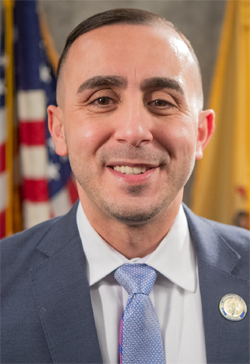
Al Abdelaziz
100% support rate
Top opponent
Al Barlas
0% support rate
Ranked legislators
10
5 support · 5 oppose
Key legislators

Who's moving criminal justice in New Jersey

Legislators moving criminal justice in New Jersey
Legislator Party Stance Support rate Decisive votes
Al Abdelaziz
Al Abdelaziz House · District 35
D
Strong +
100% 8
Alixon Collazos-Gill
Alixon Collazos-Gill House · District 27
D
Strong +
100% 8
Angela McKnight
Angela McKnight Senate · District 31
D
Strong +
100% 8
Annette Quijano
Annette Quijano House · District 20
D
Strong +
100% 8
Avi Schnall
Avi Schnall House · District 30
D
Strong +
100% 8
Al Barlas
Al Barlas House · District 40
R
Strong −
0% 8
Bob Auth
Bob Auth House · District 39
R
Strong −
0% 8
Brian Bergen
Brian Bergen House · District 26
R
Strong −
0% 8
Carmen Amato
Carmen Amato Senate · District 9
R
Strong −
0% 8
Dawn Fantasia
Dawn Fantasia House · District 24
R
Strong −
0% 8
Showing 531–540 of 1,156 bills

All criminal justice bills

in committee · New Jersey · General Assembly Jan 13, 2026

A 3815: Upgrades burglary of a residence as a crime of the second degree; upgrades it to a crime of the first degree if committed while armed.

This bill (A 3815) proposes to reclassify burglary of a residence. It upgrades burglary of a dwelling or structure adapted for overnight accommodation to a second-degree crime (currently third degree in most cases), and further upgrades it to a first-degree crime if the perpetrator is armed with a weapon or explosives. The change directly affects individuals committing burglaries in homes or similar living spaces, increasing penalties: second-degree burglary carries 5-10 years in prison, while first-degree burglary (with weapons) carries the same term. The bill also aligns sentencing for these offenses with a new requirement that 85% of the sentence must be served before parole eligibility. This is a proposed legislative change, not yet enacted.
in committee · New Jersey · Senate Feb 5, 2026

S 3340: Permits counties to establish a central municipal drug court.

Bill S 3340 allows New Jersey counties to establish specialized "central municipal drug courts" to handle drug-related cases. Counties that choose to create such courts would manage cases referred by county health departments, police, or the court system, focusing specifically on drug offenses within their jurisdiction. The bill requires counties to pass an ordinance and file it with the Administrative Director of the Courts to create these courts. This provides an optional framework for counties to develop dedicated court resources for drug-related matters, without mandating any county to implement it.
in committee · New Jersey · General Assembly Jan 13, 2026

A 2169: Makes supplemental appropriation of $750,000 to Department of Law and Public Safety for public awareness campaign of victims' rights and VCCO assistance.

This bill allocates $750,000 from the General Fund to the Victims of Crime Compensation Office (VCCO) for a public awareness campaign. The campaign will inform crime victims about their rights under the Crime Victim’s Bill of Rights and available VCCO services, including compensation assistance. The funds are a supplemental appropriation added to the existing 2023 budget for the Department of Law and Public Safety. (Procedural bill; no new laws enacted.)
in committee · New Jersey · General Assembly Jan 13, 2026

A 1047: Requires notification to collective bargaining unit of law enforcement officer prior to release of certain information to public.

This bill (A 1047) requires New Jersey’s Attorney General, the Office of Public Integrity and Accountability, or their designee to notify a law enforcement officer’s union (collective bargaining unit) before releasing specific information to the public following incidents involving a death during police encounters or custody. It applies to officer identities, body camera recordings, incident reports, and other investigation details. The notification must occur prior to any public disclosure mandated under current law, superseding prior directives about such releases. The bill does not change disclosure rules but adds a procedural step for union notification. (Amends P.L.2019, c.1, §2)
in committee · New Jersey · General Assembly Jan 13, 2026

A 1330: Requires certain institutions of higher education to make annual payment to municipality.

This bill requires public and independent colleges and universities with over 2,000 full-time equivalent students to pay an annual community service fee to the municipality where their main campus is located. The fee, calculated using a formula based on on-campus and commuter student enrollment (starting at $100 per student, adjusted annually for inflation), must fund local services like police, fire, emergency medical, traffic control, and event management directly impacted by the institution. Institutions may receive up to 50% credit toward their fee by providing direct community benefits (e.g., local public safety funding or scholarships for residents), and those with campus police departments get a 50% reduction in the law enforcement portion of the fee. The municipality must deposit all fees into a dedicated fund and transfer 5% of total collections to the county.
in committee · New Jersey · General Assembly Jan 13, 2026

A 978: Includes Sikhs as protected class in bias intimidation law; appropriates $100,000.

This bill adds "Sikhism" to New Jersey's list of protected classes under the state's bias intimidation law (N.J.S.2C:16-1), explicitly including Sikhs in legal protections against hate crimes motivated by religious bias. It directly affects Sikh residents and community members who face discrimination or violence due to their religious identity, such as attacks targeting turbans, beards, or gurdwaras. The key mechanism amends the statute to cover offenses committed "because of their membership within a protected class," including Sikhism, and creates a legal presumption that bias was a motivating factor in such crimes. The bill also appropriates $100,000, likely for educational or support programs related to Sikh community awareness, though specific funding details aren't outlined in the text.
Sub-Topics Civil Rights
in committee · New Jersey · General Assembly Jan 13, 2026

A 2111: Establishes separate crime of porch piracy, "Porch Theft Task Force," and public awareness campaign; appropriates funds.

This bill creates a new criminal offense for stealing delivered packages from residential properties ("residential package theft"), classifying it as a third-degree crime for thefts under $75,000 or a second-degree crime for $75,000 or more. It establishes a "Porch Theft Task Force" within the Department of Law and Public Safety to coordinate law enforcement, cargo carriers (like USPS), and data collection on package thefts, with mandatory reports to the governor and legislature. The bill also mandates a public awareness campaign to educate residents on prevention and reporting, funded by an appropriation from the General Fund. The law directly affects residents receiving deliveries, law enforcement agencies, and cargo carriers, with stricter sentencing for repeat offenders including mandatory minimum prison terms.
in committee · New Jersey · General Assembly Jan 13, 2026

A 523: Requires defendants charged with certain crimes to be placed in home confinement prior to trial.

This bill requires courts to place defendants charged with specific crimes - bail-restricted offenses or vehicular homicide - in pretrial home supervision instead of general release, if they are not detained before trial. It applies when a court orders release under existing law (P.L.2014, c.31) for these offenses. The key provision mandates that home supervision become a standard condition of release, ensuring defendants remain under monitored supervision while awaiting trial. This policy change directly affects individuals facing these charges who would otherwise be released without structured oversight.
Sub-Topics Courts Violent Crime
in committee · New Jersey · General Assembly Jan 13, 2026

A 3267: Establishes law enforcement procedures for responding to immigration detainers and certain requests issued by federal immigration authorities.

This bill (A 3267) requires New Jersey law enforcement agencies and correctional facilities to refuse federal immigration detainer requests unless the person has been convicted of specific serious crimes, such as murder, sexual assault, domestic violence, or terrorism. It prohibits agencies from detaining, transferring, or notifying federal authorities about a person solely based on immigration requests unless one of these 21 offenses applies. The bill does not prevent agencies from sharing immigration status information with other government entities under existing federal law (8 U.S.C. 1373). It aligns with court rulings confirming states are not obligated to comply with immigration detainers and mirrors California’s "Trust Act" approach. The law takes effect immediately upon enactment.
in committee · New Jersey · Senate Feb 5, 2026

S 3338: Authorizes the court to issue restraining orders to defendants charged with a crime as a condition of release on bail.

This New Jersey bill (S 3338) requires courts to issue restraining orders as a condition of release for defendants charged with crimes before trial. It bars defendants from entering specific locations related to the alleged crime - such as victims' homes, workplaces, or schools - unless exceptions apply. The court must issue these orders when defendants are released on bail (via warrant, summons, or juvenile complaint), defining the prohibited areas clearly. Exceptions allow the court to waive the order if the defendant proves a legitimate need to be at the location (e.g., residence) or if the order would cause undue hardship to innocent people.
Showing 531 to 540 of 1,156 bills
Previous 1 … 53 54 55 … 116 Next