

Maddy summaryS 844 creates a new federal fund to reimburse local emergency responders after train incidents involving hazardous materials. The bill provides immediate initial funding of at least $250,000 and up to $3 million per incident to cover costs like equipment replacement, overtime pay for firefighters/police, and operational expenses incurred during response efforts. It requires railroads transporting hazardous materials to provide local emergency groups with advance warnings about train loads and real-time location data. Shippers and carriers of hazardous materials by rail will pay annual fees to fund this reimbursement program, which is administered by the Federal Railroad Administration. The bill directly affects state/local emergency response agencies (fire, police, emergency services) in communities impacted by such train incidents.
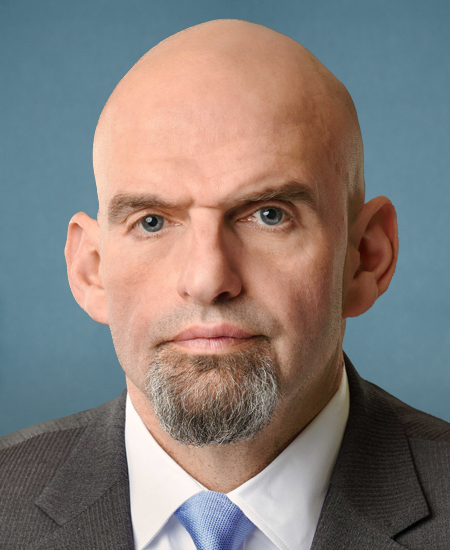
Sen. John Fetterman
Sponsored bills
Maddy summaryThis bill creates a federal grant program to help states and tribal governments improve their systems for licensing firearms dealers. To qualify, a state must already have a law requiring dealers to be licensed (with licenses valid up to 3 years, regular inspections, and penalties for violations like suspension or fines). Grants, capped at $2.5 million per year, can fund developing, implementing, or evaluating these licensing programs. Recipients must report annually on inspections, violations, and license statuses, and the federal government will publish annual reports to Congress on all grant activities.
Maddy summaryThis is a ceremonial Senate resolution (SRES 110) honoring the late James George Abourezk, the first Arab American to serve in the U.S. Senate (1973-1979) from South Dakota. It commemorates his legacy, including his work re-establishing the Senate Committee on Indian Affairs and co-authoring key Native American rights legislation like the Indian Child Welfare Act. The resolution directs the Senate to adjourn in his memory and send a copy to his family, acknowledging his service as a representative and advocate for Native American communities. As a procedural resolution, it has no legislative effect beyond commemoration.
Maddy summaryS 805, the Fighting Trade Cheats Act of 2023, increases penalties for importers who commit customs fraud or gross negligence. It triples civil penalties for fraudulent violations (to three times the domestic value) and raises gross negligence penalties (up to ten times the domestic value), while adding a five-year import ban for fraudulent violators and a two-year ban for gross negligence. The bill also creates a new private lawsuit mechanism, allowing U.S. manufacturers, workers, or trade groups harmed by customs violations to sue violators for triple damages plus attorney fees. Additionally, it excludes individuals or related businesses found guilty of such violations from participating in the U.S. importer of record program. This directly affects importers who violate customs laws, U.S. businesses competing with fraudulent imports, and customs enforcement processes.
Maddy summaryThe MORE Savings Act (S 818) eliminates copays, deductibles, and coinsurance for opioid treatment services under Medicare, Medicaid, and most private health plans. It directly affects Medicare beneficiaries and Medicaid enrollees with opioid use disorders by removing cost barriers to evidence-based treatments. Key provisions include: requiring Medicare to cover opioid medications and recovery support services (like peer counseling) without cost-sharing, mandating private health plans to cover similar treatments starting in 2025, and increasing federal Medicaid funding for medication-assisted treatment. The bill also establishes a 15-state pilot program for Medicare to test expanded access in areas with high opioid overdose rates and rural populations.
Maddy summaryS 817, the SVB Act, repeals Title IV of the 2018 Economic Growth, Regulatory Relief, and Consumer Protection Act (Public Law 115-174). This bill restores the banking regulations that existed before Title IV was enacted, effectively undoing the 2018 changes to financial oversight. It directly affects banking regulations governing financial institutions by reverting to the prior regulatory framework. The key mechanism is the explicit repeal of Title IV and the restoration of pre-2018 provisions as if the 2018 law had never applied.
Maddy summaryThis bill authorizes the minting of commemorative coins to mark the 100th anniversary of the U.S. Foreign Service. It specifies three coin types: up to 50,000 $5 gold coins (90% gold), 400,000 $1 silver coins (90% silver), and 750,000 half-dollar clad coins, all to be issued in 2025. A surcharge ($35 for gold, $10 for silver, $5 for half-dollars) will be added to each coin's sale price, with all funds going directly to the Association for Diplomatic Studies and Training to support its diplomatic history preservation work. The bill ensures no net cost to the government by requiring all design, production, and marketing expenses to be recovered through coin sales.
Maddy summaryThe Pay Teachers Act requires states to ensure public elementary and secondary school teachers earn a starting annual base salary of at least $60,000 that increases throughout their career. The bill mandates federal funding increases for education programs, including Title I funding, rural education, and Bureau of Indian Education programs, with annual adjustments for inflation. States must submit detailed plans showing how they'll meet salary requirements and address resource inequities, with a special pathway for states needing extended timelines to comply. The legislation directly affects teachers, school staff, and students across all 50 states, aiming to improve teacher retention and address shortages in underserved schools.
Maddy summaryS 737, the No Tax Breaks for Union Busting (NTBUB) Act, denies tax deductions for employers who spend money to influence employees about union activities or collective bargaining. It amends the tax code to make non-deductible expenses related to swaying union elections, labor disputes, or collective actions - such as anti-union consulting fees, captive audience meetings, or legal settlements over unfair labor practices. Employers must report such spending on tax returns (using new Form 6720D) and face penalties for non-compliance, including fines up to $100,000. The bill directly affects businesses that engage in union-avoidance tactics, aiming to remove tax incentives for undermining workers’ rights under labor laws.
Maddy summaryThe MINDS Act establishes a dedicated Mental Health and Psychosocial Support (MHPSS) Coordinator at USAID to oversee the integration of mental health services across all U.S. international development and humanitarian assistance programs. It mandates that all such programs must be evidence-based, culturally competent, trauma-informed, and prioritize vulnerable groups like conflict-affected children, displaced populations, and those impacted by diseases like Ebola or COVID-19. The bill requires annual reports to Congress detailing funding, program integration progress, and barriers to implementation, with a 5-year sunset provision. This legislation directly affects USAID and State Department programming worldwide, aiming to systematically address mental health needs in global aid efforts.