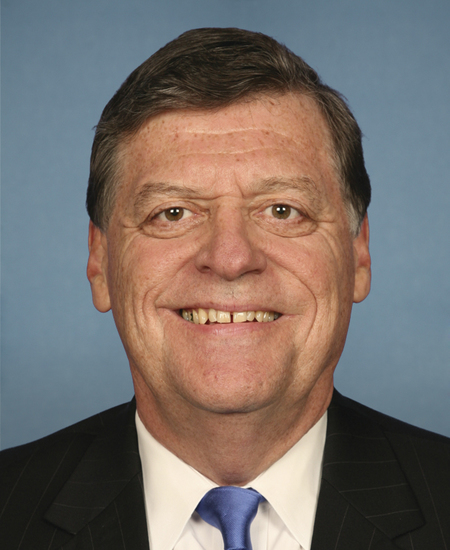
Signed into law
·
Nevada House
·
Lead sponsor
Full-Year Continuing Appropriations and Extensions Act, 2025
Full-Year Continuing Appropriations and Extensions Act, 2025 This act provides continuing FY2025 appropriations for federal agencies and extends various expiring programs and authorities. DIVISION A--FULL-YEAR CONTINUING APPROPRIATIONS ACT, 2025 Full-Year Continuing Appropriations Act, 2025 This division provides continuing FY2025 appropriations to federal agencies for the remainder of FY2025 and extends various expiring programs and authorities. It is known as a continuing resolution (CR) and prevents a government shutdown that would otherwise occur if the FY2025 appropriations bills have not been enacted when the existing CR expires on March 14, 2025. The CR funds most programs and activities at the FY2024 levels. It also includes several additional provisions that increase or decrease funding for various programs compared to FY2024 levels. For more information, see CRS Report R48517, Section-by-Section Summary of the Full-Year Continuing Appropriations Act, 2025 (Division A of P.L. 119-4) DIVISION B--HEALTH This division extends several expiring programs and authorities related to public health, Medicare, and Medicaid. TITLE I--PUBLIC HEALTH EXTENDERS (Sec. 2101) This section extends through FY2025 funding for the Teaching Health Center Graduate Medical Education Program, the Community Health Center Fund, and the National Health Service Corps. The Teaching Health Center Graduate Medical Education Program supports education and training of medical students in primary care residency programs in community-based ambulatory patient care centers. The Community Health Center Fund supports (1) grants for outpatient health care facilities that serve medically underserved populations; and (2) the National Health Service Corps, which provides scholarships and student loan repayment awards to health care providers who agree to work in areas with health care provider shortages. (Sec. 2102) This section extends funding through FY2025 for the Special Diabetes Program for Type I Diabetes and the Special Diabetes Program for Indians. (The Special Diabetes Program for Type I Diabetes supports research on the prevention and cure of Type I diabetes, and the Special Diabetes Program for Indians supports diabetes treatment and prevention for tribal populations.) (Sec. 2103) This section extends through FY2025 the authority that allows states and tribes to request the temporary reassignment of state and local health department personnel who are funded through certain federal programs to immediately address a public health emergency. It also extends through FY2025 provisions that prohibit the disclosure of information about Department of Health and Human Services (HHS) programs that could compromise national security (e.g., information regarding biomedical threats). The section extends through FY2025 provisions that authorize HHS to engage with developers of medical countermeasures, and that provide for related antitrust exemptions, for the purpose of furthering product development. Additionally, the section extends through FY2025 the National Advisory Committee on Children and Disasters, the National Advisory Committee on Seniors and Disasters, and the National Advisory Committee on Individuals with Disabilities and Disasters. It also extends through FY2025 the authority of HHS to directly appoint candidates to positions within the National Disaster Medical System if HHS determines the number of personnel in the system is insufficient to address a public health emergency or potential public health emergency. (The National Disaster Medical System is a partnership between HHS, the Department of Defense, and other federal departments that responds to public health and other emergencies, including by deploying medical response teams.) TITLE II--MEDICARE (Sec. 2201) This section extends through FY2025 certain increased payment adjustments for low-volume hospitals under Medicare's inpatient prospective payment system. (Sec. 2202) This section extends through FY2025 the Medicare-Dependent Hospital Program, which provides additional payments to certain small rural hospitals that have a high proportion of Medicare patients. (Sec. 2203) This section extends through FY2025 certain increased payment adjustments for ground ambulance services in rural and other areas under Medicare. (Sec. 2204) This section extends through FY2025 funding for certain Medicare quality-measurement activities. (Sec. 2205) This section extends through FY2025 funding for state health insurance programs, area agencies on aging, aging and disability resource centers, and technical assistance related to outreach and enrollment with respect to Medicare and other programs. (Sec. 2206) This section extends through FY2025 certain minimum adjustments to the work geographic index with respect to payments for physician services under Medicare. (Sec. 2207) This section extends through FY2025 certain telehealth flexibilities under Medicare. Specifically, the section (1) removes geographic restrictions on originating sites (i.e., the location of the beneficiary); (2) allows the home of the beneficiary to serve as the originating site for all services; (3) allows audiologists, physical therapists, occupational therapists, and speech-language pathologists to furnish telehealth services; (4) allows federally qualified health centers and rural health clinics to serve as the distant site (i.e., the location of the health care practitioner); (5) delays implementation of certain in-person evaluation requirements for mental health telehealth services; (6) expands coverage to include audio-only services for evaluation and management and behavioral health services; and (7) allows, for purposes of hospice care recertification under Medicare, physicians and nurse practitioners to fulfill the requirement of a face-to-face encounter with the hospice patient via telehealth. (Sec. 2208) This section extends through FY2025 the Acute Hospital Care at Home Program under Medicare. (The program allows hospitals to treat certain patients from emergency departments or inpatient hospital beds at home.) (Sec. 2209) This section extends through FY2025 coverage under the Medicare prescription drug benefit of prescription oral antiviral drugs that were authorized in response to the COVID-19 public health emergency. (Sec. 2210) This section increases funding for the Medicare Improvement Fund beginning in FY2026. (Sec. 2211) This section extends by two months the sequestration that applies to Medicare payments in FY2032. TITLE III--HUMAN SERVICES (Sec. 2301) This section extends through FY2025 the Sexual Risk Avoidance Education Program. This program supports projects to implement sexual risk avoidance education that teaches participants to voluntarily refrain from nonmarital sexual activities. (Sec. 2302) This section extends through FY2025 the Personal Responsibility Education Program. This program provides grants to states to (1) educate young people about abstinence and contraception to prevent pregnancy and sexually transmitted infections, and (2) support pregnant youth and mothers under the age of 21. (Sec. 2303) This section extends through FY2025 the Family-to-Family Health Information Centers Program, which is administered by the Health Resources and Services Administration. The program awards grants to family-run organizations to support the provision of information and peer support to families of children with special health care needs. TITLE IV--MEDICAID This section delays reductions to Medicaid disproportionate-share hospital (DSH) allotments until FY2026. (DSHs are hospitals that receive additional payments under Medicaid for treating a large share of low-income patients.) DIVISION C--OTHER MATTERS This division extends several expiring programs and authorities through FY2025. (Sec. 3101) This section extends authorities related to the Commodity Futures Trading Commission’s whistleblower program. (Sec. 3102) This section extends the authority of the Department of Homeland Security (DHS) and the Department of Justice to take certain actions to mitigate a credible threat to certain facilities or assets from an unmanned aircraft system (UAS). These include certain facilities that are located in the United States and identified as high-risk and a potential target for unlawful UAS activity. (Sec. 3103) This section extends the special assessment on nonindigent persons or entities convicted of certain offenses involving sexual abuse or human trafficking. The assessment funds programs for human trafficking survivors. (Sec. 3104) This section extends the authority for DHS’s National Cybersecurity Protection System and related reporting requirements. The system authorizes multiple activities by DHS to help defend federal agencies from cyberthreats. (Sec. 3105) This section extends, the temporary scheduling order issued by the Drug Enforcement Administration to place fentanyl-related substances in schedule I of the Controlled Substances Act. (Sec. 3106) This section exempts the budgetary effects of Divisions B and C of this act from (1) the Statutory Pay-As-You-Go (PAYGO) Act of 2010, (2) the Senate PAYGO rule, and (3) certain budget scorekeeping rules.