

Maddy summaryHR 9574, the Stop CARB Act of 2024, repeals federal provisions that allowed California to set stricter vehicle and engine emissions standards than the national baseline. It eliminates the waiver process under the Clean Air Act (specifically Section 209) that enabled California’s Air Resources Board (CARB) to establish its own rules for nonroad engines and vehicles. The bill also repeals Section 177 of the Clean Air Act, which authorized California’s unique new motor vehicle emission standards. As a result, California would no longer be permitted to implement its own vehicle emission requirements separate from federal standards.
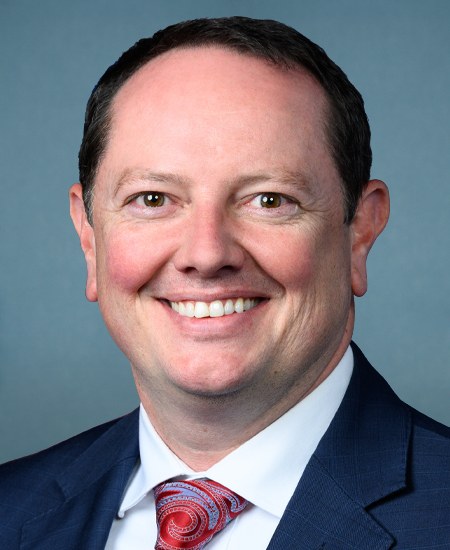
Rep. Eric Burlison
Sponsored bills
Maddy summaryHR 9534, the National Constitutional Carry Act, would prohibit states and localities from banning or restricting the public carrying of legally owned firearms by eligible U.S. citizens. It directly affects all gun owners who meet federal and state possession requirements, removing the need for permits or licenses to carry in public spaces. Key provisions state that any state law restricting public carry - such as requiring permits or imposing financial barriers - would be invalidated, with exceptions for privately-owned businesses that clearly prohibit firearms or locations with security screening. The bill bases this on Supreme Court rulings affirming the constitutional right to carry firearms for self-defense outside the home.
Maddy summaryHR 9497, the AI Advancement and Reliability Act of 2024, creates a new Center for AI Advancement and Reliability within the Commerce Department to advance U.S. leadership in AI safety and reliability. The Center will conduct research, develop voluntary standards, and collaborate with federal agencies, industry, and researchers to address AI reliability, security, and safety risks - such as system flaws and adversarial attacks - through testing and benchmarking. It prohibits new regulatory authority or mandatory data sharing from private entities, requires annual reports to Congress, and is funded at $10 million for fiscal year 2025 with a six-year sunset provision. This bill directly affects federal agencies (like NIST and the National Science Foundation), research institutions, and private sector partners working on AI systems, without imposing new compliance requirements.
Maddy summaryThis bill amends an existing reporting requirement in the 2023 National Defense Authorization Act. It changes the provision to require the Department of Homeland Security to submit annual reports on counter-illicit cross-border tunnel operations, rather than just one report after developing a strategic plan. The bill does not create new programs or alter border security policy; it only modifies the frequency of required reporting. This procedural change directly affects the Department of Homeland Security's reporting obligations.
Maddy summaryHJRES 167 cancels a U.S. Department of Agriculture rule that would have allowed electronic eartags as official identification for cattle and bison. The resolution directs that the rule published in the Federal Register on May 9, 2024 (89 Fed. Reg. 39540), has no force or effect. This directly affects ranchers and farmers who would have been required to use electronic identification systems for livestock. The bill halts the implementation of this specific regulatory change without creating new requirements.
Maddy summaryHR 7130, the FAIR Labels Act of 2024, requires clear labeling for plant-based and lab-grown products marketed as meat or poultry. It mandates that products not containing actual meat or poultry - such as plant-based "burgers" or "chicken" alternatives - must prominently display "imitation" or "cell-cultured" on labels, alongside disclaimers stating they do not contain meat or poultry. This applies to all such products sold in interstate commerce, with no exceptions allowed. The bill also specifically requires "cell-cultured" or "lab-grown" labeling for meat grown from animal cells outside a live animal, while clarifying that existing meat inspection rules still apply to conventional meat products.
Maddy summaryThis resolution aims to block a rule issued by the National Highway Traffic Safety Administration (NHTSA) that sets new fuel efficiency standards for passenger cars, light trucks (starting in 2027), and heavy-duty pickup trucks/vans (starting in 2030). If passed, it would prevent this specific rule from taking effect by disapproving it under a congressional review process. The rule directly affects vehicle manufacturers by requiring them to meet these updated fuel economy targets for future model years. This is a procedural resolution, not a new law, focused solely on halting the implementation of the existing NHTSA rule.
Freedom from Unfair Gun Taxes Act of 2024 This bill prohibits states or localities from imposing a levy or collecting an excise tax on the sale of a firearm, ammunition, or any part or component thereof, by a manufacture or retailer.
Maddy summaryThis bill defines "sex," "male," and "female" in federal law based on biological characteristics present at birth, specifically referencing reproductive anatomy (e.g., sperm production for males, egg production for females). It mandates that all federal agencies, courts, and laws interpret these terms strictly according to this biological definition, excluding self-identification or gender identity. The bill directly affects how federal programs, regulations, and legal decisions interpret terms like "sex," "gender," and "gender identity" in all federal contexts. Key provisions clarify that "gender" refers only to biological sex differences and explicitly states that gender identity does not override these definitions.
Maddy summaryThe Respect State Housing Laws Act amends the CARES Act by removing subsection (c) of Section 4024, which governed notice requirements for housing assistance programs. This change eliminates a specific federal notice provision that applied to tenants and landlords receiving CARES Act housing aid. The bill directly affects the administrative process for housing assistance under the CARES Act, streamlining or removing a requirement for notice delivery. It modifies an existing provision without creating new policy or altering broader housing protections.