

Maddy summarySF 1240 establishes new privacy rights for Minnesotans regarding brain activity data collected through neurotechnology. It grants individuals the right to mental privacy (preventing government collection of brain data without consent), cognitive liberty, mental integrity, and psychological continuity. The bill requires companies using brain-computer interfaces to obtain separate, informed consent for each data use and third-party sharing, and prohibits "consciousness bypass" (manipulating brain activity without awareness). Violations carry civil penalties up to $10,000 per incident, with amended criminal statutes adding penalties for unauthorized access to neurodata. This bill directly affects individuals using neurotechnology devices and the companies handling their brain activity data.
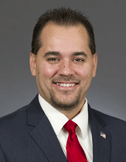
Sen. Eric Lucero
Sponsored bills
Maddy summarySF 956 prohibits Minnesota conservation officers from conducting searches or seizures without a warrant or court order, except in emergencies or with the person's consent. It requires officers to provide a written receipt to anyone from whom property is seized. The bill affects conservation officers enforcing natural resource laws (such as hunting and fishing regulations) and the public they interact with during enforcement. The law amends multiple Minnesota statutes to implement these requirements for property seizures.
Maddy summarySF 886, introduced in the Minnesota Senate on February 3, 2025, amends Minnesota Statutes section 645.451 by adding specific definitions for terms like "female," "male," "girl," "boy," "father," "mother," "gender," and "sex." The bill defines "female" as an individual with a natural reproductive system producing eggs and "male" as an individual with a natural reproductive system producing sperm, excluding those with developmental or genetic anomalies. It explicitly states that "gender" is not synonymous with gender identity, and clarifies that "sex" refers to biological sex, not gender identity, in legal contexts. This bill directly affects how these terms are interpreted in Minnesota law, particularly in statutes, administrative rules, and guidelines.
Maddy summaryThis bill prohibits counties from charging fees when homeowners seek to remove discriminatory housing restrictions (like those based on race or religion) from property titles. It directly affects homeowners in Minnesota who need to clear outdated restrictive covenants from their property records. The key provision amends state law to require county recorders to accept the removal form without charging a fee, ensuring the process is cost-free. This change applies to covenants related to protected classes and takes effect upon final enactment.
Maddy summarySF 753 requires Minnesota public school districts to obtain written consent from a parent or guardian before providing sexual education to minor students. This bill directly affects school districts, parents/guardians of minors, and minor students in public schools. The key provision mandates that written consent must be secured for sexual education curriculum, which was not previously required by law. School districts must now implement a process to collect this consent, while existing parental review processes for other curriculum remain unchanged. The bill does not alter requirements for alternative instruction or other instructional materials.
Maddy summaryThis bill (SF 746) requires all peace officers and part-time peace officers in Minnesota to be U.S. citizens. It amends Minnesota Statutes to add a specific citizenship requirement (as new subdivision 11) to the existing standards for officer licensing and certification under sections 626.843 and 626.845. The change would apply to all officers employed by state, county, municipal, or joint law enforcement agencies, including the Minnesota State Patrol. The policy change integrates citizenship as a mandatory qualification within the existing licensing framework managed by the Peace Officer Standards and Training Board.
Maddy summarySF 797 prohibits public school libraries from containing pornographic material and bans sexually explicit content in libraries of public elementary schools. The bill amends Minnesota Statutes by adding a new section requiring school libraries to remove such materials. It directly affects all public school libraries statewide, with stricter rules applying specifically to elementary school libraries. The law focuses on defined material categories rather than broader book restrictions.
Maddy summarySenate Bill SF 765 clarifies definitions for Minnesota's regional sales tax system by amending statutes to specify that "metropolitan area" includes Anoka, Carver, Dakota, Hennepin, Ramsey, Scott, and Washington counties. It defines key terms like "Metropolitan Council" and "metropolitan sales tax" to ensure consistent application of the tax. The bill sets a 0.25% sales tax rate on retail purchases made within these counties or destined for them, effective after June 30, 2025. This directly affects businesses and consumers in those seven counties who pay the regional sales tax.
Maddy summaryThis bill gives Minnesota residential property owners a legal process to request sheriff assistance in removing people occupying their property without permission. It directly affects property owners who need to evict unauthorized occupants (not tenants, family members, or those with valid lease agreements). The key mechanism requires owners to submit a verified written complaint to the sheriff confirming specific conditions, such as having asked the person to leave and verifying the property wasn't open to the public. The sheriff must then serve a notice to vacate and remove occupants, with owners liable for false claims under penalty of perjury.
Maddy summaryMinnesota Senate Bill 744 prohibits licensed health care providers from performing or assisting with surgical procedures that alter sexual characteristics or prescribing puberty-blocking hormones or hormone antagonist therapies for minors diagnosed with gender dysphoria. The bill directly affects minors seeking gender-affirming medical care and their healthcare providers in Minnesota. It includes a temporary exception allowing existing prescriptions for minors already receiving puberty-blocking treatments before the law takes effect. The legislation aims to ban specific medical interventions for minors with gender dysphoria, effective upon final enactment.