

Maddy summaryHF 2935 extends the deadline for using funds allocated to Otter Tail County's engagement services pilot grant program. The bill changes the availability period for $250,000 in fiscal year 2025 from June 30, 2026, to June 30, 2028. This grant supports mental health services connecting individuals with disabilities, mental health needs, or substance use disorders to appropriate care. The extension specifically applies to this pilot program serving immigrant and refugee communities in Otter Tail County.
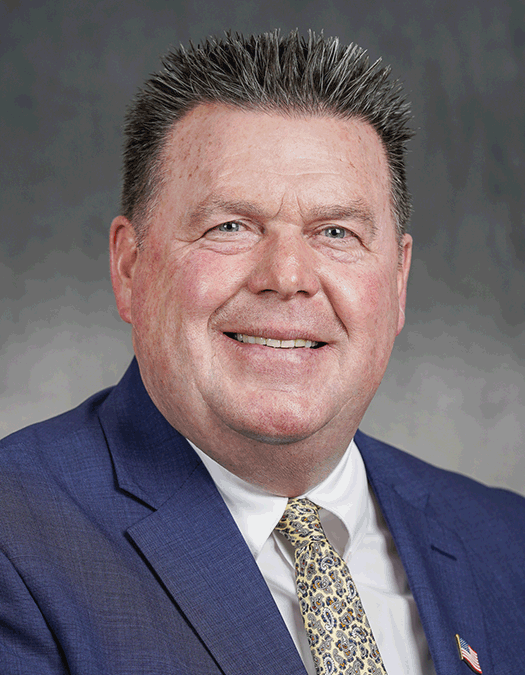
Rep. Tom Murphy
Sponsored bills
Maddy summaryHF 639 requires Minnesota's commissioner of public safety to update driver safety rules by January 1, 2026, to establish new certification standards for drivers who have experienced loss of consciousness or voluntary control due to medical conditions. The rule change would allow physicians to certify drivers who have been seizure-free for 10 years (without antiseizure medication) for epilepsy history, or 5 years for a single nonepileptic seizure, eliminating the need for ongoing medical reviews. This directly affects drivers with such medical histories and the physicians who assess their fitness to drive.
Maddy summaryHF 2878 allows commercial feed businesses in Minnesota to directly hire licensed veterinarians without needing to form a separate professional firm under state law. This change removes a requirement from the Minnesota Professional Firms Act (Chapter 319B) for businesses holding commercial feed licenses. The bill specifically permits veterinarians employed by these feed companies to provide veterinary services directly to the feed business's customers. It affects commercial feed licensees and their veterinary staff by simplifying employment arrangements. (Procedural bill; summary limited to key policy change.)
Maddy summaryThis bill establishes a new criminal offense for intentionally transferring bodily fluids (like blood or feces) onto healthcare workers in hospital emergency departments. It expands fourth-degree assault to include all healthcare providers - such as physicians, nurses, and other staff - by adding specific protection for them when assaulted. The law makes it a felony punishable by up to two years in prison or a $4,000 fine, applying to assaults causing demonstrable bodily harm. The changes take effect August 1, 2025, and directly affect healthcare workers providing services in emergency settings.
Maddy summaryHF 2648 prohibits certain sex offenders convicted of crimes against minors under 18 from accessing social media platforms where users under 18 can interact. It requires these individuals on parole or probation to disclose all social media account details (including usernames and passwords) to their supervising agent and bans access to platforms allowing minor users. The law defines "social media platform" narrowly to exclude email, search engines, and business communication tools. The commissioner must annually publish a list of compliant platforms for probation agents to enforce these restrictions. This directly affects sex offenders sentenced under Minnesota statutes 609.342-609.3458 for offenses involving minors under 18.
Maddy summaryHF 2615 extends Minnesota driver's license and identification card expiration periods from every 5 years to every 8 years. The bill increases standard license and ID card fees (e.g., moving from $27.75 to $34.50 for some non-REAL ID cards) and adds a $4.50 surcharge to all license-related fees. These changes apply to all new and renewed licenses submitted on or after August 1, 2025. The bill directly affects every Minnesota driver who renews their license, altering both renewal timing and cost structure.
Maddy summaryHF 2612 appropriates $5.4 million from state bond proceeds to fund safety and mobility improvements along Trunk Highway 210 in Otter Tail County, between Aurdal and Nidaros Townships. The funds cover environmental analysis, design, right-of-way acquisition, and construction, with up to 17% allocated for project delivery. Before spending, the state commissioner must submit project details to Otter Tail County Board for written approval within 90 days. The bill authorizes the state to issue bonds to cover the costs, depositing proceeds into the trunk highway fund. This directly affects Otter Tail County residents, landowners whose property may be acquired, and local infrastructure.
Maddy summaryHF 4 proposes a constitutional amendment requiring Minnesota to return budget surplus funds to taxpayers. If approved, it would create a "Minnesota tax relief account" funded by revenue exceeding 105% of projected spending, using those funds to refund or reduce property and income taxes. Taxpayers would receive direct refunds or tax reductions, but only up to the amount they owe in taxes, with the account funded annually from the state's general fund surplus. The amendment must be voted on by voters in the 2026 general election.
Maddy summaryHF 26, titled the "Never Again Act," shifts emergency declaration authority from the governor to the Minnesota legislature. It repeals the governor's power to declare emergencies and establish a new process requiring legislative approval for emergency declarations and extensions. The bill also prohibits the governor from issuing emergency orders with the "full force and effect of law" and explicitly protects citizens' rights, including free speech, religious freedom, assembly, travel, gun rights, and the ability to operate businesses. These changes amend multiple sections of Minnesota Statutes to clarify that only the legislature may enact emergency measures with legal force during crises.
Maddy summaryHF 23 amends Minnesota Statutes section 181.932 to strengthen whistleblower protections for public employees. It expands the list of protected disclosures to include reporting gross mismanagement or waste of public funds (subsection 7), clarifies protections for health care quality concerns (subsection 4), and adds specific scenarios like reporting truthful scientific studies (subsection 5) or classified service communications about state services (subsection 6). These changes directly affect state and local government employees who report violations of law, safety risks, or financial misconduct. The bill modifies existing anti-retaliation language to explicitly cover these new disclosure types while maintaining that protected disclosures cannot override other legal data protections.