

Maddy summaryThis bill expands eligibility for Minnesota's health professional education loan forgiveness program to include physical therapists and physical therapist assistants. Under the new provisions, these healthcare workers can receive loan forgiveness if they agree to practice in designated rural areas or underserved urban communities. The legislation amends existing state statutes to formally add these professions to the list of eligible health care professionals who can access this financial assistance. By broadening the program's scope, the bill aims to support workforce development in areas with healthcare shortages while providing debt relief to qualified practitioners.
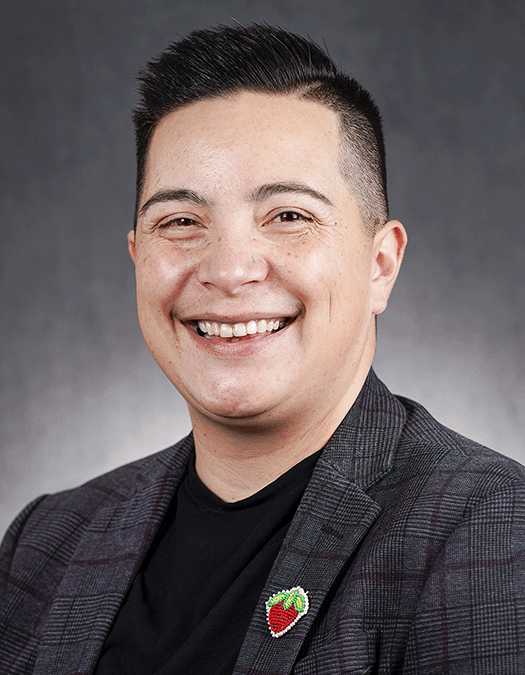
Rep. Liish Kozlowski
Sponsored bills
Maddy summaryThis bill requires sellers of emotional support dogs to provide written notice to buyers stating that the dog is not a service animal and does not have the special training required for service dogs. The notice must be printed in bold 12-point type and included on the purchase receipt or a separate document, informing buyers that the dog is not entitled to the legal rights and privileges granted to service animals. Additionally, the bill increases criminal penalties for intentionally misrepresenting an emotional support dog as a service dog, raising the offense from a petty misdemeanor to a gross misdemeanor for repeat violations. These changes apply to all sales of emotional support dogs and take effect on August 1, 2026.
Maddy summaryThis bill extends funding availability for a grant designed to expand Minnesota's wild elk population and range, specifically benefiting the Fond du Lac Band of Lake Superior Chippewa. The legislation authorizes $2,300,000 for the first year to support elk reintroduction efforts, including moving elk from existing herds in northwest Minnesota to the Fond du Lac State Forest and Reservation area. Funds must be used for thorough planning with the Department of Natural Resources to develop capture and handling protocols, disease management strategies, and postrelease comanagement plans between state and Tribal authorities. The appropriation is a one-time funding allocation available until June 30, 2029.
Maddy summaryThis bill designates the 1854 Ceded Territory as Minnesota's Core Moose Range and creates a new Moose Co-Stewardship Committee to manage moose restoration and research. The committee will include representatives from state agencies, Tribal nations, conservation groups, and the timber industry to develop management plans, coordinate habitat restoration, and review population data using both scientific and Indigenous knowledge. Revenue from moose licenses and auctions will fund research, habitat work, and committee expenses, while an annual report will track population trends and restoration outcomes. The bill also gives the commissioner authority to set bull-only hunting seasons and establish licensing processes based on population thresholds and habitat capacity.
Maddy summarySF 3596 creates a one-time state-funded emergency rental assistance program for Minnesota counties and Tribal governments to help eligible households facing housing instability. Eligible households must have income at or below 200% of the federal poverty level, experienced financial hardship after August 31, 2025, and be at risk of eviction or homelessness. The program covers up to two months of prospective rent, past-due rent, utility costs, or related fees for qualifying households. Counties and Tribal governments must distribute funds within four months of the bill's effective date and return any unspent money to the state.
Maddy summaryHF 2499 expands Minnesota's renter's credit to match the maximum refund amount available under the homestead credit for homeowners. The bill adjusts the calculation so renters with household incomes up to $137,789 can receive a maximum credit of $3,500, aligning with the homestead credit's highest tier. This change directly affects renters who pay rent considered equivalent to property taxes, ensuring they receive the same maximum tax credit as homeowners. The key mechanism revises the credit formula in Minnesota Statutes 290.0693 to eliminate the previous disparity in maximum benefit amounts between renters and homeowners.
Maddy summaryHF 3279 proposes a constitutional amendment to increase Minnesota's sales tax rate by 0.375% (three-eighths of one percent) starting July 1, 2027, through June 30, 2052. The revenue would fund three dedicated housing programs: 25% to a homeownership opportunity fund for owner-occupied housing, 25% to a community and household stability fund for homelessness prevention services, and 50% to a rental opportunity fund for rental assistance and housing development. All Minnesotans purchasing taxable goods would pay the slightly higher tax, with funds specifically targeting housing stability for vulnerable households. The amendment requires voter approval at the 2026 general election before taking effect.
Maddy summaryThis bill increases funding for Minnesota's Family Homeless Prevention and Assistance Program, raising the annual appropriation from $10.27 million to $45.27 million. The additional funds will be used to reduce homelessness risks and improve program effectiveness, with a portion designated for the housing development fund. The legislation also grants agencies flexibility in awarding grants to existing grantees and allows new grantees in certain areas to work with advisory committees or local care systems without meeting specific statutory requirements. These changes take effect immediately and establish a future funding base of $10.72 million starting in fiscal year 2028.
Maddy summaryThis bill authorizes the issuance of up to $4,000,000 in state bonds to fund capital improvements at the Duluth International Airport. The funds will be used by the Duluth Airport Authority to design, construct, and equip a new air traffic control tower base building, which will include office spaces, equipment rooms, and support areas. The project also covers site preparation, demolition of old buildings, utility installation, stormwater systems, and replacement of existing fuel tanks. A portion of the state funding will serve as a match for federal funding for this infrastructure project.
Maddy summaryThis bill requires hospitals in Minnesota to obtain approval from the Department of Health before making significant changes like closing parts of their facilities, moving services to other locations, or stopping specific care offerings such as operating rooms or pediatric overnight services. The law applies to acute care hospitals and aims to prevent abrupt service reductions that could impact patient care, except in cases of financial insolvency or natural disasters. Hospitals must follow a public interest review process similar to existing procedures for other hospital changes, and the Department of Health will enforce compliance using its regulatory authority. The measure takes effect immediately upon final passage and does not address financial outcomes or speculate on how hospitals will respond to these requirements.