

Maddy summaryThis bill modifies Minnesota's escort requirements for oversized loads, specifically addressing manufactured and modular homes. It clarifies that when a licensed peace officer requires an escort beyond standard rules, that officer cannot personally provide the escort or be paid for it. Instead, the state commissioner of public safety must cover the escort costs from existing department funds and create a process to do so. The legislation also clarifies that briefly crossing the centerline during transport does not count as extending beyond the left side for escort determination purposes. These changes directly affect transportation companies moving large homes and the state public safety department.
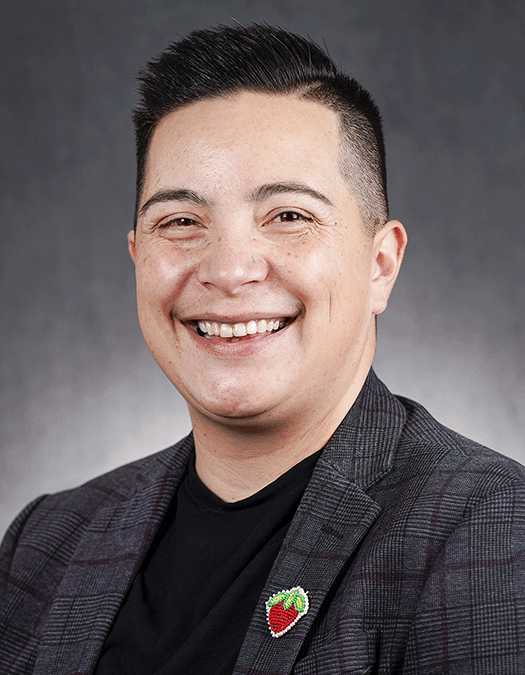
Rep. Liish Kozlowski
Sponsored bills
Maddy summaryThis bill modifies Minnesota's property tax exemption rules for certain properties owned by federally recognized Indian tribes. It allows property used exclusively as medical clinics to be exempt from property taxes if located in cities with fewer than 100,000 people and owned by a tribe within Minnesota. The exemption is limited to no more than five contiguous parcels totaling 30,000 square feet and does not apply to properties used for housing, apartments, agriculture, or forestry. The changes take effect with the 2027 tax assessment year and the exemption will expire after taxes payable in 2038.
Maddy summaryHF 445 appropriates $8,856,000 from the state general fund to provide a one-time grant to Union Gospel Mission, Inc. (a Duluth-based nonprofit) for the construction of a community engagement center. The center will serve people experiencing homelessness and include facilities like a commercial kitchen, warming center, health services, classrooms, and hygiene spaces. This funding is specifically for predesign, construction, and equipping the facility in Duluth.
Maddy summaryHF 3258 repeals two Minnesota statutes (3.226 and 16C.053) that previously prohibited state agencies and the legislature from entering contracts with vendors who discriminate against Israel or businesses operating in Israel. The bill removes the requirement to avoid such vendors, allowing state government to contract with any vendor regardless of their position on Israel-related business practices. This change applies to new contracts published or entered on or after the effective date, which is the day after enactment. The repeal affects all state procurement decisions involving vendors, eliminating the prior restrictions and exemptions for small contracts.
Maddy summaryThis bill requires health care facilities in Minnesota to limit access to their premises by law enforcement agents conducting civil immigration enforcement unless the agent presents a valid judicial warrant. It mandates that facilities notify their leadership and legal representatives whenever such agents enter the property and must only grant access to areas specified in the warrant. Additionally, the bill requires facilities to develop written policies outlining procedures for verifying law enforcement identity and authority, documenting interactions, and designating staff members to handle immigration-related situations on site. The law applies to hospitals, clinics, nursing homes, assisted living facilities, and other licensed health care providers operating in the state.
Maddy summaryThis bill requires health impact assessments for certain proposed projects to evaluate how they might affect human health, directly affecting government agencies and entities that approve or fund construction and development projects. It establishes a systematic, evidence-based process that must be completed before decisions are made on actions with potential significant environmental effects, requiring agencies to analyze physiological, social, economic, and other health-related factors. The legislation assigns specific duties to the commissioner of health and authorizes the Environmental Quality Board to create rules defining which projects need assessments, including exemptions for smaller ethanol and biobutanol facilities outside the metropolitan area. Additionally, the bill creates a public comment period for environmental assessment worksheets and sets requirements for publishing notices and gathering community input before determining if a full health impact assessment is necessary.
Maddy summaryThis bill modifies Minnesota's rent proration rules to require landlords to charge tenants only for the actual number of days they occupy a rental unit during the first or last month of a lease. It applies to all residential leases, including those that require advance payment of the first or last month's rent, and makes these proration requirements mandatory and unwaivable. The law also prohibits lease clauses that limit tenants' legal remedies for violations of this section, such as mandatory arbitration or class action waivers. These changes take effect immediately upon enactment and apply to new leases signed on or after that date.
Maddy summaryThis bill appropriates $250,000 from the general fund for fiscal year 2026 to fund predesign and design work for a new community health and wellness center in western Duluth. The funds are specifically allocated to the Lake Superior Community Health Center to create a regional, multipurpose facility serving as a community hub for health programming and services. The appropriation is one-time and available until the project is completed or abandoned. It directly affects the Lake Superior Community Health Center and Duluth residents who will access the planned wellness center.
Maddy summaryThis bill requires Minnesota employers with 50 or more employees to provide 90 days of advance notice before using artificial intelligence or automation to displace workers, and it mandates a 90-day transitional employment period during which affected employees receive continued wages and access to employer-funded retraining programs. The legislation defines technological displacement as job losses or significant hour reductions caused by AI systems and requires employers to notify employees, labor organizations, state labor officials, local government leaders, and workforce development boards about the changes. Employers who fail to comply face penalties including ineligibility for state grants and tax incentives for five years, potential civil fines of up to $10,000 per violation, and liability for up to 60 days of back pay and benefits to affected workers.
Maddy summaryThis bill establishes new grant programs and provides funding for adult and children's mental health services in Minnesota, with specific priority given to areas affected by Operation Metro Surge. It creates culturally responsive mental health grants for adults and children, funds mobile crisis teams including vehicle purchases, and supports school-linked mental health services. The legislation also expands eligibility for various mental health services such as housing support, crisis intervention, and specialized care for youth at risk of psychosis or bipolar disorder.