

Maddy summaryThis bill creates the Minnesota Business Recovery Loan Program to help businesses that have suffered financial losses due to increased immigration enforcement activities in the state. It appropriates $100 million in fiscal year 2026, with $18 million designated for zero-interest loans to businesses in greater Minnesota and $82 million for zero-interest loans to businesses in the seven-county metropolitan area through nonprofit lenders. To qualify, businesses must be located in Minnesota, owned by state residents, demonstrate a revenue loss of more than 30 percent between enactment and December 1, 2025, and show that losses resulted from staffing shortages, reduced customer access, or other immigration enforcement-related factors. The program provides loans ranging from $25,000 to $200,000 depending on business size and location, which must be used exclusively for business operations in Minnesota and cannot be used to repay prior debt or for real estate speculation.
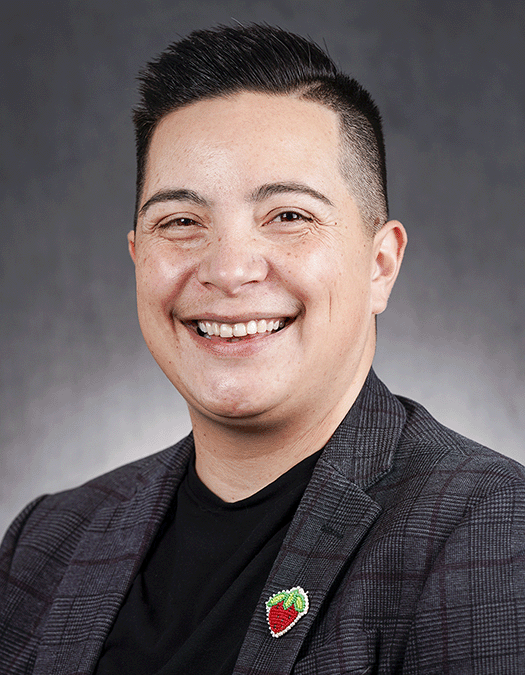
Rep. Liish Kozlowski
Sponsored bills
Maddy summaryThis bill requires Minnesota municipalities to hold at least two public hearings before approving data center development projects. The law mandates that specific information about the project, including the applicant and end user names, facility size and location, security guard details, and utility requirements, be disclosed to the public at least 48 hours before each hearing. These disclosure rules apply regardless of any private agreements that might otherwise prevent the sharing of such information. The requirements would take effect on August 1, 2026, and apply to counties, cities, and towns when considering rezoning petitions or special use permits for data centers.
Maddy summaryThis bill creates a new legal tool in Minnesota that allows the state Attorney General to sue firearm industry members for public nuisance if their conduct harms public safety. It directly affects companies involved in selling, manufacturing, distributing, or marketing firearms and related products like ammunition. To comply, these businesses must implement reasonable controls to prevent sales to prohibited individuals, stop thefts, and ensure adherence to existing laws. If a company violates these rules, the Attorney General can seek court orders to stop the behavior, force cleanup costs, demand financial restitution, and collect damages.
Maddy summaryThis bill allocates $250,000 from the arts and cultural heritage fund to support the renovation and preservation of the historic Mary Murphy home, museum, and park in Hermantown, Minnesota. The funding will be given as a grant to the city of Hermantown through the Minnesota Historical Society's governing board. The money is designated for fiscal year 2027 and is intended specifically for preserving and renovating this historic site.
Maddy summaryThis bill creates a one-time emergency rental assistance fund for counties and Tribal governments in Minnesota to help low-income households facing financial hardship after August 31, 2025. The program would provide financial support for up to two months of prospective rent and utilities, as well as unpaid rent and utility bills and related fines, to households earning at or below 200 percent of the federal poverty guidelines who are at risk of eviction or homelessness. Counties and Tribal governments would receive funding based on population and geographic factors, with 95 percent of funds designated for direct assistance and 5 percent for fraud prevention and compliance monitoring. Local governments, cities, nonprofit organizations, or groups of jurisdictions could administer the assistance, and any unused funds must be returned to the state.
Maddy summaryHF 3691 adds "emergency managers" to the statutory definition of "essential employees" in Minnesota law. This means emergency managers - professionals who coordinate responses to crises like natural disasters or public safety incidents - will now be officially classified as essential employees, alongside firefighters, police dispatchers, and correctional guards. The bill amends Minnesota Statutes § 179A.03, specifically adding "emergency managers" to the list of roles considered essential during emergencies. This change ensures emergency managers receive the same legal protections and operational status as other designated essential workers during critical events.
Maddy summaryHF 3409 prohibits Minnesota public schools from denying students access to free K-12 education based on the student's or their parent's immigration status or citizenship. It requires schools to stop collecting unnecessary immigration information, avoid threatening to share such details with law enforcement, and ensure no student or parent is excluded from school activities due to immigration status. The bill also creates a legal remedy, allowing students or parents who face such denial to file a civil lawsuit for redress.
Maddy summaryHF 3687 modifies Minnesota's medical assistance and MinnesotaCare coverage for chiropractic services. The bill removes the previous age restriction (limiting coverage to those under 21) and establishes new rules: chiropractic care for spinal pain, chronic conditions, and related services is covered for all ages, but limited to 24 visits per year without prior authorization. It also restricts x-ray coverage to specific spine examinations necessary for diagnosing subluxation. This affects all MinnesotaCare and medical assistance recipients seeking chiropractic care, changing coverage from age-limited to broadly applicable with visit and x-ray restrictions. The changes take effect January 1, 2027, or after federal approval.
Maddy summaryHF 2740 requires Minnesota’s Housing Finance Agency commissioner to submit annual reports on affordable housing funding applications, awards, and housing units (including construction/renovation types), plus annual financial stability data broken down by region. It limits commitment terms for low-income tax credit programs to match federal compliance periods (Section 42 of the Internal Revenue Code), directly affecting housing providers who must meet these requirements. The bill also mandates the commissioner to develop a policy framework for stabilizing affordable housing by identifying regulatory relief options and proposing improvements by January 2026, with $ appropriated from the Housing Development Fund for this work. These provisions primarily impact affordable housing providers, local governments receiving aid, and the Minnesota Housing Finance Agency.
Maddy summaryThis bill eliminates Cesar Chavez Day as an official state observance in Minnesota by repealing the existing statute that established the holiday. The law removes the requirement to recognize March 31 as a day dedicated to celebrating the Latino community and honoring Cesar Chavez's contributions to labor rights and social justice. Once enacted, the state will no longer officially observe this day, though the legislative change does not affect private or community celebrations. The measure applies directly to state government operations and removes the legal basis for the annual commemoration.