

Maddy summaryThis bill prohibits local governments in Minnesota from penalizing homeless individuals for specific activities on public land, such as sleeping, eating, storing belongings, or occupying parked vehicles. It establishes a legal defense for homeless people who engage in these behaviors when no adequate alternative indoor shelter is available, defining such shelter as accessible, free, and capable of accommodating family and pets. The legislation also grants the state attorney general the power to enforce these rules and allows individuals to sue for damages or court orders if their rights are violated. Furthermore, the law overrides any conflicting local ordinances and ensures that municipalities cannot use these provisions to discriminate against homeless people or impose cruel punishment.
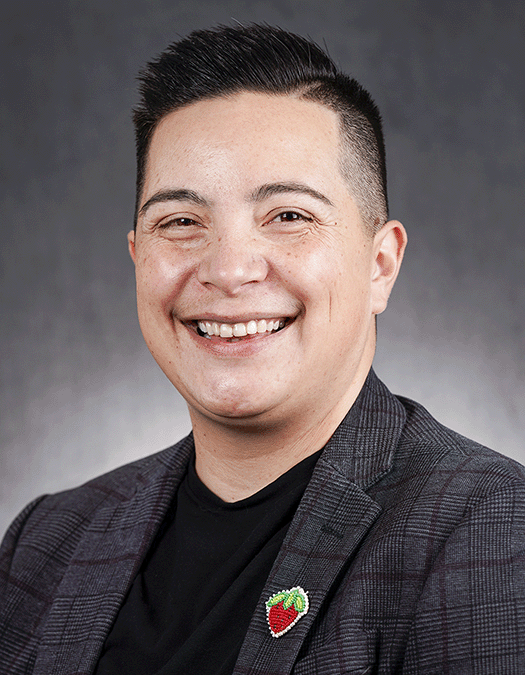
Rep. Liish Kozlowski
Sponsored bills
Maddy summaryThis bill extends the required heating period for landlords in Minnesota from October 1 to September 1, ensuring tenants have access to heat at a minimum of 68 degrees Fahrenheit until May 31. The change applies to all residential leases and licenses, requiring landlords to maintain this temperature in living areas, kitchens, and bathrooms unless a utility company mandates a reduction. Landlords cannot waive this obligation through their lease agreements, and the provision remains subject to utility company instructions regarding heat reduction.
Maddy summaryThis Minnesota bill creates a $100 million relief program to help small businesses that experienced significant revenue declines between July 2024 and February 2026, which the bill attributes to federal enforcement activity. The program provides grants to operators of indoor retail or food market spaces with at least 25 small tenant businesses, requiring that most funds be used to offer rent forgiveness to existing tenants. To qualify, businesses must be Minnesota-based, have fewer than 50 employees, operate from a physical location, and show at least a 20 percent drop in revenue or sales during the specified period. Grant applications will be processed through a lottery system, with funds usable for payroll, rent, utilities, inventory, and other operational expenses, and the state must report on the program's outcomes by December 2026.
Maddy summaryThis bill (HF 3556) is a naming resolution that commemorates Melissa Hortman by designating Minnesota's community solar garden program as the "Melissa Hortman Community Solar Garden Program." It does not change any program rules, funding, or operations - it only adds a short title to Minnesota Statutes section 216B.1641. The bill directly honors Melissa Hortman, a former state legislator, through this naming. It is procedural and has no policy impact beyond the name change.
Maddy summaryThis bill amends Minnesota law to include the Minnesota Board on Aging in the list of state agencies required to consult with Tribal governments. The change ensures that the Board on Aging must proactively seek input from Tribal leaders when developing policies that directly affect them. By adding the Board to the definition of "agency," the legislation formalizes the requirement for meaningful consultation on matters with Tribal implications. This update aligns the Board's operations with existing legal standards that currently apply to other state departments.
Maddy summaryThis bill allocates $1.5 million from the state's general fund to support the Local Initiatives Support Corporation's Duluth office in fiscal year 2027. The funding is intended to promote economic growth in northeast Minnesota by strengthening local community organizations and improving commercial areas. The money can be used for workshops, networking events, staff support, and providing loans to businesses, but it is designated as a one-time appropriation.
Maddy summaryThis bill authorizes the issuance of up to $225 million in state bonds to fund clean water infrastructure improvements. The funds will be distributed through grants and loan matching programs to eligible municipalities for projects addressing emerging contaminants, water infrastructure upgrades, and point source pollution control. The legislation directs $22 million toward emerging contaminants, $19 million to match federal grants for water and drinking water revolving funds, $60 million for general water infrastructure grants, and $124 million for point source implementation projects. All funding is designated for qualified capital projects that must be approved under existing state statutes.
Maddy summaryHF 3419 removes the ability of most Minnesota entities - including businesses, nonprofits, cooperatives, and foreign entities operating in Minnesota - to spend money on elections or ballot measures. The bill retracts this power for all entities except registered political committees that exist solely for political activity and claim no entity benefits (like limited liability). It also voids any organizational documents allowing political spending. This change does not affect regular business operations or charitable work, only political activity.
Maddy summaryThis bill appropriates $6 million from state bond proceeds to fund capital improvements at Duluth's Lake Superior Zoo, directly benefiting the city of Duluth through a grant for predesign, construction, and equipment upgrades. Key provisions include authorizing the sale of up to $6 million in state bonds under Minnesota law and exempting the funding from standard budget rules (Minnesota Statutes § 16A.86, subd. 4). The funds will support critical infrastructure like mechanical/electrical systems, utility infrastructure, and exhibit renovations to sustain zoo operations.
Maddy summaryHF 1531 permanently removes the June 30, 2025, expiration date from Minnesota's law allowing crossbow hunting and fishing during regular archery seasons. This change affects hunters targeting deer, bear, turkey, common carp, or native rough fish using crossbows during designated seasons. The bill amends Minnesota Statutes section 97B.037 by deleting the sunset provision, making the crossbow allowance permanent. Hunters must still meet standard requirements, including valid licenses and crossbow specifications under section 97B.106.