

Maddy summaryThis bill appropriates $675,000 for fiscal year 2026 and $729,000 for fiscal year 2027 from Minnesota's arts and cultural heritage fund. The funds will support two outdoor education programs: Wilderness Inquiry's Canoemobile and Pyramid of Outdoor Engagement. These programs provide statewide, sequential outdoor educational experiences for youth and families, aligning with Minnesota graduation standards and connecting participants to the state's natural resources, outdoor traditions, and public lands. The funding directly supports these programs' operations to expand access to nature-based learning across Minnesota.
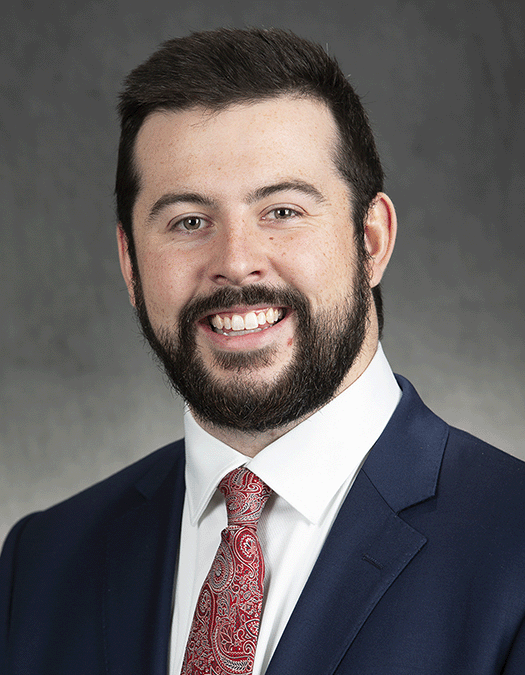
Rep. Spencer Igo
Sponsored bills
Maddy summaryHF 2618 requires Minnesota condo associations and homeowners associations (HOAs) to provide plain-language explanations of governing laws to unit owners upon request. The bill mandates that board members review these explanations when elected and share them with owners seeking help understanding their rights or responsibilities. It appropriates funding to create a statewide guide explaining laws governing common interest communities, including key provisions in Minnesota Statutes sections 515B.4-102, 515B.4-1021, and 515B.4-107. The requirements become effective August 1, 2026.
Maddy summaryHF 2749 appropriates $1 million from the environment and natural resources trust fund for a one-time grant to Forgotten Heroes Ranges and Retreat, a nonprofit organization. The funding is specifically for predesigning, designing, constructing, furnishing, and equipping a new shooting range and retreat facility. This project aims to accommodate handicapped individuals and disabled veterans, with the appropriation available until the project is completed or abandoned. The bill directly affects the nonprofit recipient and the intended beneficiaries of the facility.
Maddy summaryHF 2036 provides $450,000 for each of fiscal years 2026 and 2027 to fund employment services for people with disabilities through Minnesota Diversified Industries (MDI), and $250,000 for career skills programming in 2026. The bill funds inclusive job opportunities, virtual and in-person career classes using virtual reality tools, and employer outreach for individuals with disabilities. MDI must report by January 15, 2028, on program participation, demographics, service hours, and recommendations. This one-time funding directly supports people with disabilities seeking employment and MDI’s service delivery model.
Maddy summaryHF 566 amends Minnesota law to clarify rules for operating all-terrain vehicles (ATVs) on public roads. It specifies that ATVs may be operated on the right shoulder or extreme right side of county/state highways (for accessing businesses/trails) and in ditches/slopes under certain conditions, while restricting operation in agricultural zones (April 1-August 1) and between sunset and sunrise. The bill also updates local government authority to allow ATVs on roads for access to businesses/residences via ordinance, with specific speed and access requirements for smaller communities. These changes directly affect ATV operators, local municipalities creating ordinances, and agricultural workers using ATVs for farm access.
Maddy summaryHF 1341 designates January 9 as Law Enforcement Appreciation Day in Minnesota, requiring the governor to issue an annual proclamation. It encourages school districts to partner with law enforcement agencies to create middle and high school "explorer" programs about law enforcement careers, which may count as course credit. The bill appropriates $6 million for 2026-2027 to reimburse agencies for peace officer training and $1 million for 2026 to fund pathway-to-policing programs that help recruit diverse candidates through local government grants. These provisions directly affect schools, law enforcement agencies, and local governments by supporting career education and training funding.
Maddy summaryHF 2493 appropriates $785,000 for fiscal year 2026 and $785,000 for fiscal year 2027 from Minnesota's arts and cultural heritage fund to renovate the historic Hibbing High School Auditorium. The funds are directed to the Hibbing School District (ISD 701) to preserve and repair specific elements, including the Barton pipe organ, stage, stage curtain, electrical systems, dressing rooms, and sprinkler system. This bill provides direct funding for physical renovations to a historic school facility in Hibbing. It does not create new policy but allocates existing state funds for a specific capital improvement project.
Maddy summaryHF 1040 requires manufacturers and importers of wind and solar energy equipment (like solar panels and wind turbine components) to fund recycling programs for their discarded products. It bans landfill disposal of wind and solar infrastructure, imposes a fee on retail sales to cover recycling costs, and mandates producers to submit detailed recycling plans by March 2026. The law directly affects companies selling wind and solar technology in Minnesota, shifting responsibility for end-of-life management from taxpayers to producers. Key provisions include creating a statewide recycling system, requiring annual reports to the state, and defining terms like "discarded infrastructure" and "producer" to clarify obligations. This focuses on concrete policy changes for waste management, not future environmental outcomes.
Maddy summaryHF 2492 requires that any bill increasing residential construction or remodeling costs by $3,000 or more per unit must be referred to Minnesota's House and Senate committees with jurisdiction over housing finance and policy. This procedural rule applies directly to legislators drafting housing-related bills and ensures such cost-increasing proposals receive specialized committee review. The bill does not change housing policy itself but establishes a referral requirement for specific legislation affecting housing affordability. It is a procedural measure targeting the legislative process, not a substantive policy change.
Maddy summaryHF 2447 establishes a dedicated account for financial assurance funds collected from gas development permits. It requires the commissioner of natural resources to deposit these funds into an account managed by the State Board of Investment, with earnings credited back to the account. The funds can only be used for financial assurance purposes related to specific gas permits under chapters 93 and 103I of Minnesota Statutes. This bill directly affects gas development permit applicants and the commissioner's office, creating a new mechanism for handling and investing these required funds.